586 posters, 8 topics, 23 sessions, 1,077 authors, 622 institutions
ePostersLive by SciGen Technologies S.A. All rights reserved.
ISQua's 40th International Conference 2024
24th - 27th September 2024 | Istanbul, Türkiye

P405
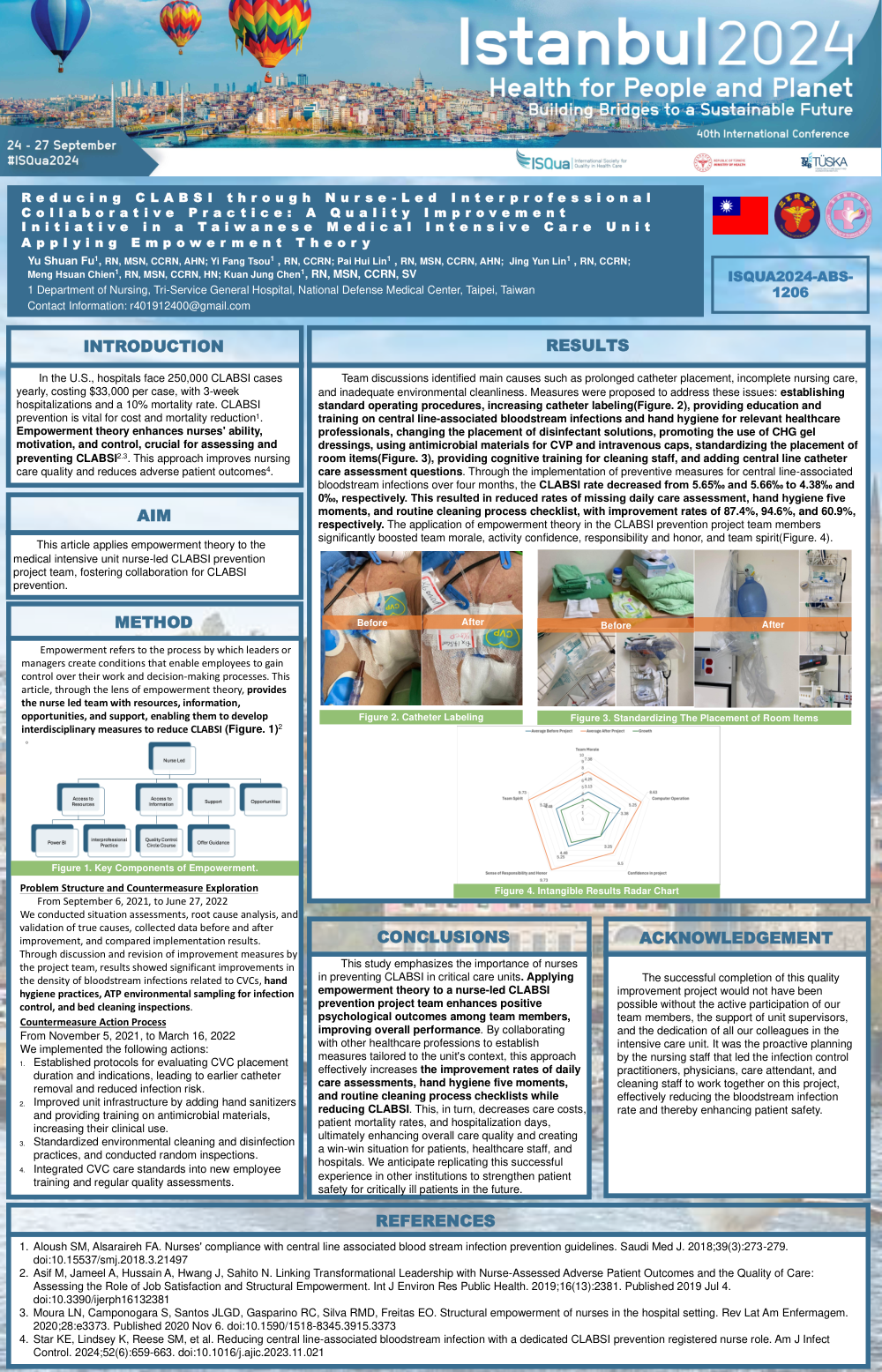
Reducing CLABSI through Nurse-Led Interprofessional Collaborative Practice: A Quality Improvement Initiative in a Taiwanese Medical Intensive Care Unit Applying Empowerment Theory.
Part of Topic
Patient Safety & Quality Improvement
INTRODUCTION
In the U.S., hospitals face 250,000 CLABSI cases yearly, costing $33,000 per case, with 3-week hospitalizations and a 10% mortality rate. CLABSI prevention is vital for cost and mortality reduction1. Empowerment theory enhances nurses' ability, motivation, and control, crucial for assessing and preventing CLABSI2.3. This approach improves nursing care quality and reduces adverse patient outcomes4.
AIM
This article applies empowerment theory to the medical intensive unit nurse-led CLABSI prevention project team, fostering collaboration for CLABSI prevention.
METHOD
Empowerment refers to the process by which leaders or managers create conditions that enable employees to gain control over their work and decision-making processes. This article, through the lens of empowerment theory, provides the nurse led team with resources, information, opportunities, and support, enabling them to develop interdisciplinary measures to reduce CLABSI (Figure. 1)2。
Problem Structure and Countermeasure Exploration
From September 6, 2021, to June 27, 2022
We conducted situation assessments, root cause analysis, and validation of true causes, collected data before and after improvement, and compared implementation results. Through discussion and revision of improvement measures by the project team, results showed significant improvements in the density of bloodstream infections related to CVCs, hand hygiene practices, ATP environmental sampling for infection control, and bed cleaning inspections.
Countermeasure Action Process
From November 5, 2021, to March 16, 2022
We implemented the following actions:
RESULTS
Team discussions identified main causes such as prolonged catheter placement, incomplete nursing care, and inadequate environmental cleanliness. Measures were proposed to address these issues: establishing standard operating procedures, increasing catheter labeling(Figure. 2), providing education and training on central line-associated bloodstream infections and hand hygiene for relevant healthcare professionals, changing the placement of disinfectant solutions, promoting the use of CHG gel dressings, using antimicrobial materials for CVP and intravenous caps, standardizing the placement of room items(Figure. 3), providing cognitive training for cleaning staff, and adding central line catheter care assessment questions. Through the implementation of preventive measures for central line-associated bloodstream infections over four months, the CLABSI rate decreased from 5.65‰ and 5.66‰ to 4.38‰ and 0‰, respectively. This resulted in reduced rates of missing daily care assessment, hand hygiene five moments, and routine cleaning process checklist, with improvement rates of 87.4%, 94.6%, and 60.9%, respectively. The application of empowerment theory in the CLABSI prevention project team members significantly boosted team morale, activity confidence, responsibility and honor, and team spirit(Figure. 4).
CONCLUSIONS
This study emphasizes the importance of nurses in preventing CLABSI in critical care units. Applying empowerment theory to a nurse-led CLABSI prevention project team enhances positive psychological outcomes among team members, improving overall performance. By collaborating with other healthcare professions to establish measures tailored to the unit's context, this approach effectively increases the improvement rates of daily care assessments, hand hygiene five moments, and routine cleaning process checklists while reducing CLABSI. This, in turn, decreases care costs, patient mortality rates, and hospitalization days, ultimately enhancing overall care quality and creating a win-win situation for patients, healthcare staff, and hospitals. We anticipate replicating this successful experience in other institutions to strengthen patient safety for critically ill patients in the future.
ACKNOWLEDGEMENT
The successful completion of this quality improvement project would not have been possible without the active participation of our team members, the support of unit supervisors, and the dedication of all our colleagues in the intensive care unit. It was the proactive planning by the nursing staff that led the infection control practitioners, physicians, care attendant, and cleaning staff to work together on this project, effectively reducing the bloodstream infection rate and thereby enhancing patient safety.