586 posters, 8 topics, 23 sessions, 1,077 authors, 622 institutions
ePostersLive by SciGen Technologies S.A. All rights reserved.
ISQua's 40th International Conference 2024
24th - 27th September 2024 | Istanbul, Türkiye

P167
Development and validation of interpretable Bayes machine learning model for risk adjustment of general outcome indicators: An example from Urology
Poster Presenter
Authors
Harvey Jia Wei Koh, Dragan Gasevic, David Rankin, Stephane Heritier, Mark Frydenberg, Stella Talic
Affiliations
Part of Topic
Patient Safety & Quality Improvement
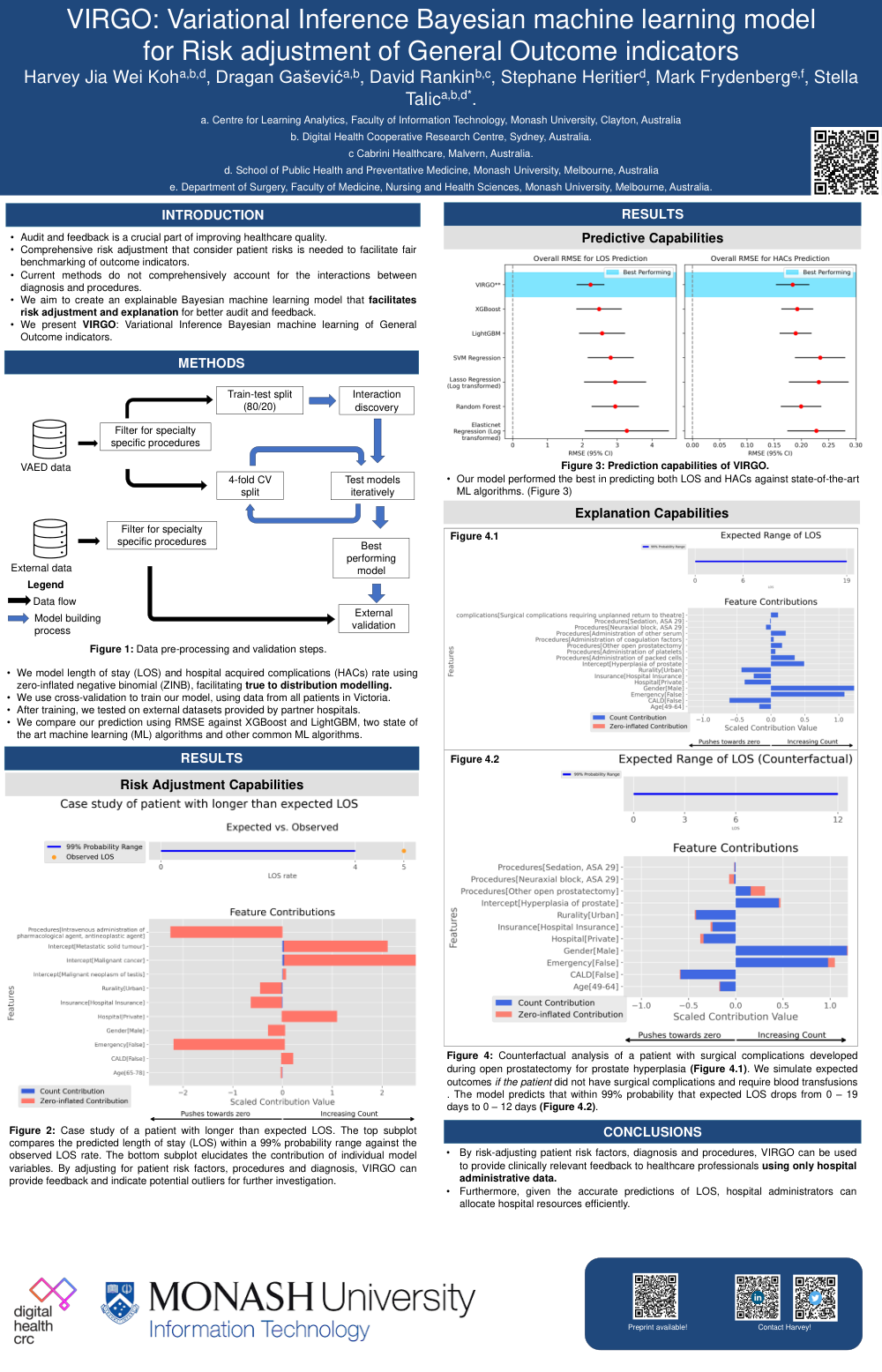
Figure 2: Case study of a patient with longer than expected LOS. The top subplot compares the predicted length of stay (LOS) within a 99% probability range against the observed LOS rate. The bottom subplot elucidates the contribution of individual model variables. By adjusting for patient risk factors, procedures and diagnosis, VIRGO can provide feedback and indicate potential outliers for further investigation.
Figure 4: Counterfactual analysis of a patient with surgical complications developed during open prostatectomy for prostate hyperplasia (Figure 4.1). We simulate expected outcomes if the patient did not have surgical complications and require blood transfusions . The model predicts that within 99% probability that expected LOS drops from 0 – 19 days to 0 – 12 days (Figure 4.2).