586 posters, 8 topics, 23 sessions, 1,077 authors, 622 institutions
ePostersLive by SciGen Technologies S.A. All rights reserved.
ISQua's 40th International Conference 2024
24th - 27th September 2024 | Istanbul, Türkiye

ISQUA2024-ABS-3388
Root Cause Analysis and strategies to implementing actions based on lessons learned from sentinel events
Poster Presenter
Part of Topic
Patient Safety & Quality Improvement
Root Cause Analysis and strategies to Implement actions based on lessons learned from sentinel events
Moura Tralli, LC; SANTOS, MOS; Simões, RO; Mendes, AS; Pedroso, AC; Fernandes, FP
INTRODUCTION AND AIM
STRATEGY FOR CHANGE
Aiming to improve the action design and implementation stage, we will deal with the strategy based on the implementation of the Action Center with time dedicated to improving processes.
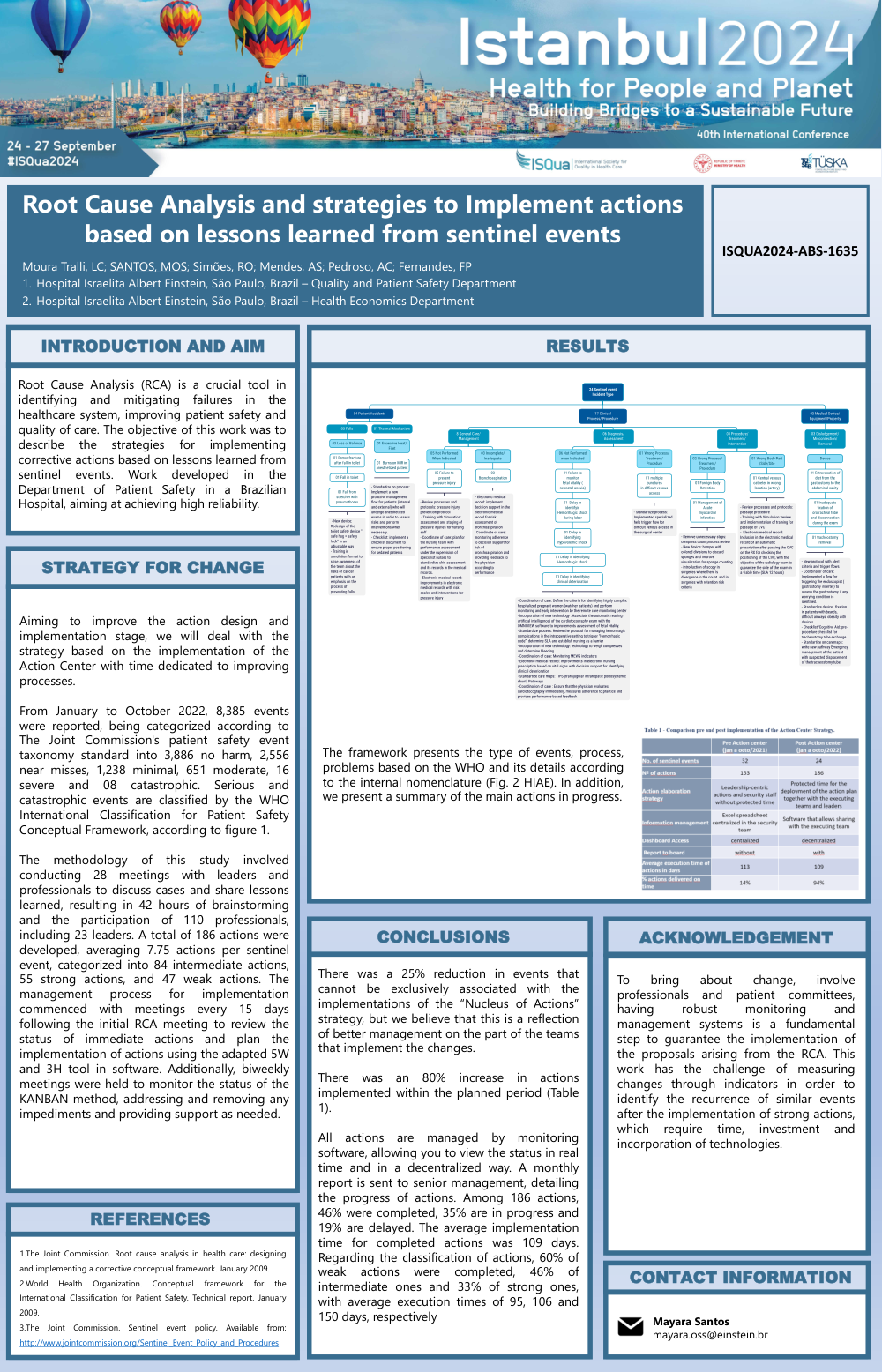
From January to October 2022, 8,385 events were reported, being categorized according to The Joint Commission's patient safety event taxonomy standard into 3,886 no harm, 2,556 near misses, 1,238 minimal, 651 moderate, 16 severe and 08 catastrophic. Serious and catastrophic events are classified by the WHO International Classification for Patient Safety Conceptual Framework, according to figure 1.
The methodology of this study involved conducting 28 meetings with leaders and professionals to discuss cases and share lessons learned, resulting in 42 hours of brainstorming and the participation of 110 professionals, including 23 leaders. A total of 186 actions were developed, averaging 7.75 actions per sentinel event, categorized into 84 intermediate actions, 55 strong actions, and 47 weak actions. The management process for implementation commenced with meetings every 15 days following the initial RCA meeting to review the status of immediate actions and plan the implementation of actions using the adapted 5W and 3H tool in software. Additionally, biweekly meetings were held to monitor the status of the KANBAN method, addressing and removing any impediments and providing support as needed
CONCLUSIONS
There was a 25% reduction in events that cannot be exclusively associated with the implementations of the “Nucleus of Actions” strategy, but we believe that this is a reflection of better management on the part of the teams that implement the changes.
There was an 80% increase in actions implemented within the planned period (Table 1).
All actions are managed by monitoring software, allowing you to view the status in real time and in a decentralized way. A monthly report is sent to senior management, detailing the progress of actions. Among 186 actions, 46% were completed, 35% are in progress and 19% are delayed. The average implementation time for completed actions was 109 days. Regarding the classification of actions, 60% of weak actions were completed, 46% of intermediate ones and 33% of strong ones, with average execution times of 95, 106 and 150 days, respectively
ACKNOWLEDGEMENT
To bring about change, involve professionals and patient committees, having robust monitoring and management systems is a fundamental step to guarantee the implementation of the proposals arising from the RCA. This work has the challenge of measuring changes through indicators in order to identify the recurrence of similar events after the implementation of strong actions, which require time, investment and incorporation of technologies