586 posters, 8 topics, 23 sessions, 1,077 authors, 622 institutions
ePostersLive by SciGen Technologies S.A. All rights reserved.
ISQua's 40th International Conference 2024
24th - 27th September 2024 | Istanbul, Türkiye

ISQUA2024-ABS-3278
Privacy as a Ruse? Reframing legal and ethical challenges to improve engagement with quality improvement using health data
Poster Presenter
Authors
Affiliations
Part of Topic
Patient Safety & Quality Improvement
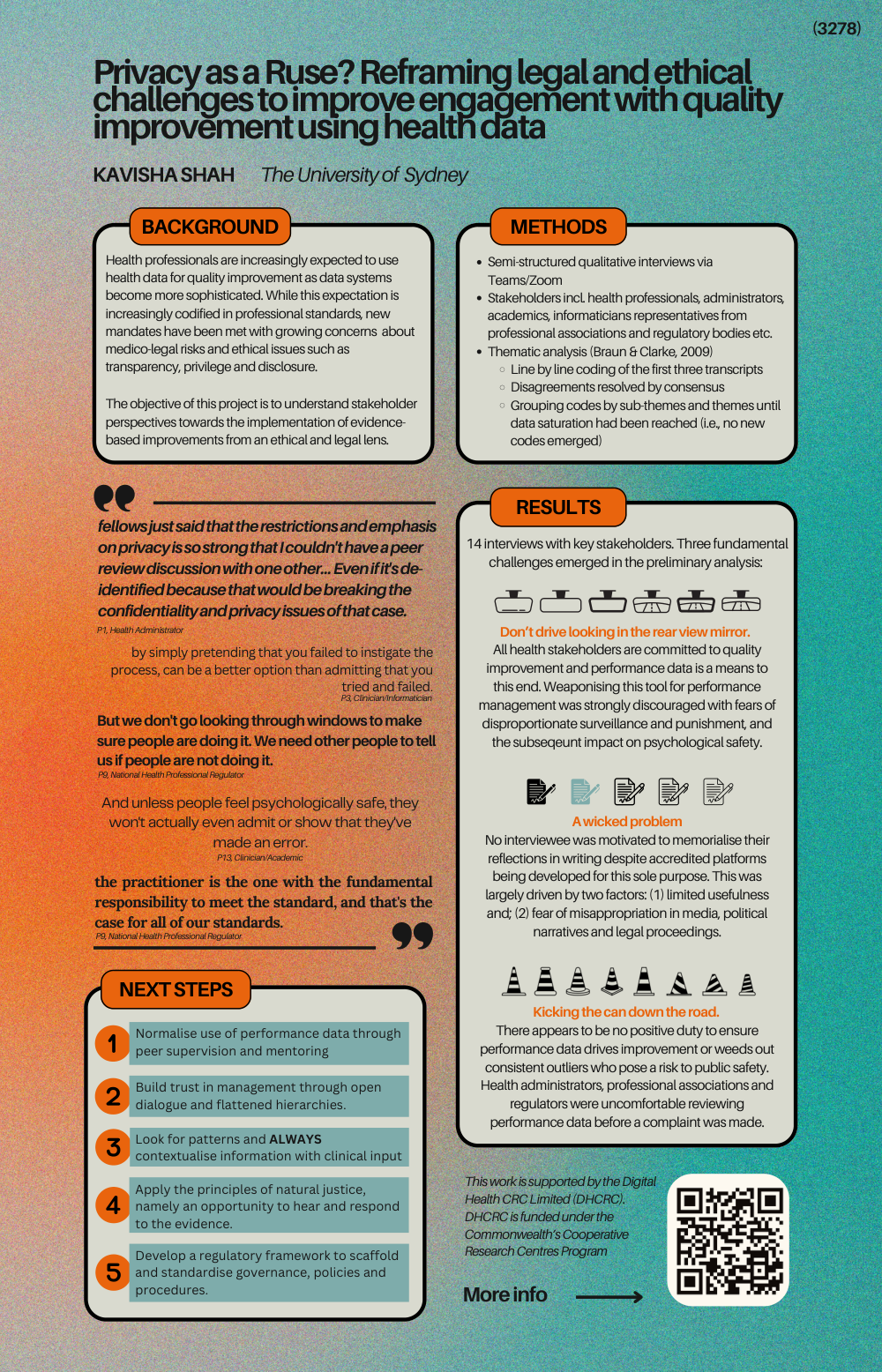
Privacy as a Ruse? Reframing legal and ethical challenges to improve engagement with quality improvement using health data
Kavisha Shah, The University of Sydney
BACKGROUND
Health professionals are increasingly expected to use health data for quality improvement as data systems become more sophisticated. While this expectation is increasingly codified in professional standards, new mandates have been met with growing concernsabout medico-legal risks and ethical issues such as transparency, privilege and disclosure.
The objective of this project is to understand stakeholder perspectives towards the implementation of evidence-based improvements from an ethical and legal lens.
METHODS
- Semi-structured qualitative interviews via Teams/Zoom
- Stakeholders incl. health professionals, administrators, academics, informaticians representatives from professional associations and regulatory bodies etc.
- Thematic analysis (Braun & Clarke, 2009)
- Line by line coding of the first three transcripts
- Disagreements resolved by consensus
- Grouping codes by sub-themes and themes until data saturation had been reached (i.e., no new codes emerged)
RESULTS
14 interviews with key stakeholders. Three fundamental challenges emerged in the preliminary analysis:
Don’t drive looking in the rear view mirror.
All health stakeholders are committed to quality improvement and performance data is a means to this end. Weaponising this tool for performance management was strongly discouraged with fears of disproportionate surveillance and punishment, and the subseqeunt impact on psychological safety.
A wicked problem
No interviewee was motivated to memorialise their reflections in writing despite accredited platforms being developed for this sole purpose. This was largely driven by two factors: (1) limited usefulness and; (2) fear of misappropriation in media, political narratives and legal proceedings.
Kicking the can down the road.
There appears to be no positive duty to ensure performance data drives improvement or weeds out consistent outliers who pose a risk to public safety. Health administrators, professional associations and regulators were uncomfortable reviewing performance data before a complaint was made.
NEXT STEPS
1. Normalise use of performance data through peer supervision and mentoring.
2. Build trust in management through open dialogue and flattened hierarchies.
3. Look for patterns and ALWAYS contextualise information with clinical input.
4. Apply the principles of natural justice, namely an opportunity to hear and respond to the evidence.
5. Develop a regulatory framework to scaffold and standardise governance, policies and procedures.
This work is supported by the Digital Health CRC Limited (DHCRC). DHCRC is funded under the Commonwealth’s Cooperative Research Centres Program
More Info --> kavisha.shah@sydney.edu.au