586 posters, 8 topics, 23 sessions, 1,077 authors, 622 institutions
ePostersLive by SciGen Technologies S.A. All rights reserved.
ISQua's 40th International Conference 2024
24th - 27th September 2024 | Istanbul, Türkiye

ISQUA2024-ABS-3277
Improve the correctness of patient self-care after joint replacement surgery
Poster Presenter
Authors
Chen-Chan Kuo, Shu-Wei HSU, Zi- Ting DING, Hsiao-Yun CHIEN, Chiu-Tzu Lin
Affiliations
NATIONAL TAIPEI UNIVERSITY OF NURSING AND HEALTH SCIENCES,/ DEPARTMENT OF NURSING, LINKOU CHANG GUNG MEMORIAL HOSPITAL, Linkou Chang-Gung Memorial Hospital Nursing Department, and National Taipei University of Nursing and Health Sciences, Linkou Chang-Gung Memorial Hospital Nursing Department
Part of Topic
Patient Safety & Quality Improvement
mprove the correctness of patient self-care after joint replacement surgery
Chen-Chan Kuo.1.2 Shu-Wei HSU1, Zi- Ting DING1, Hsiao-Yun CHIEN1, Chiu-Tzu Lin1
1. Linkou Chang-Gung Memorial Hospital, Taoyuan, Taiwan 2. National Taipei University of Nursing and Health Sciences, Taipei, Taiwan
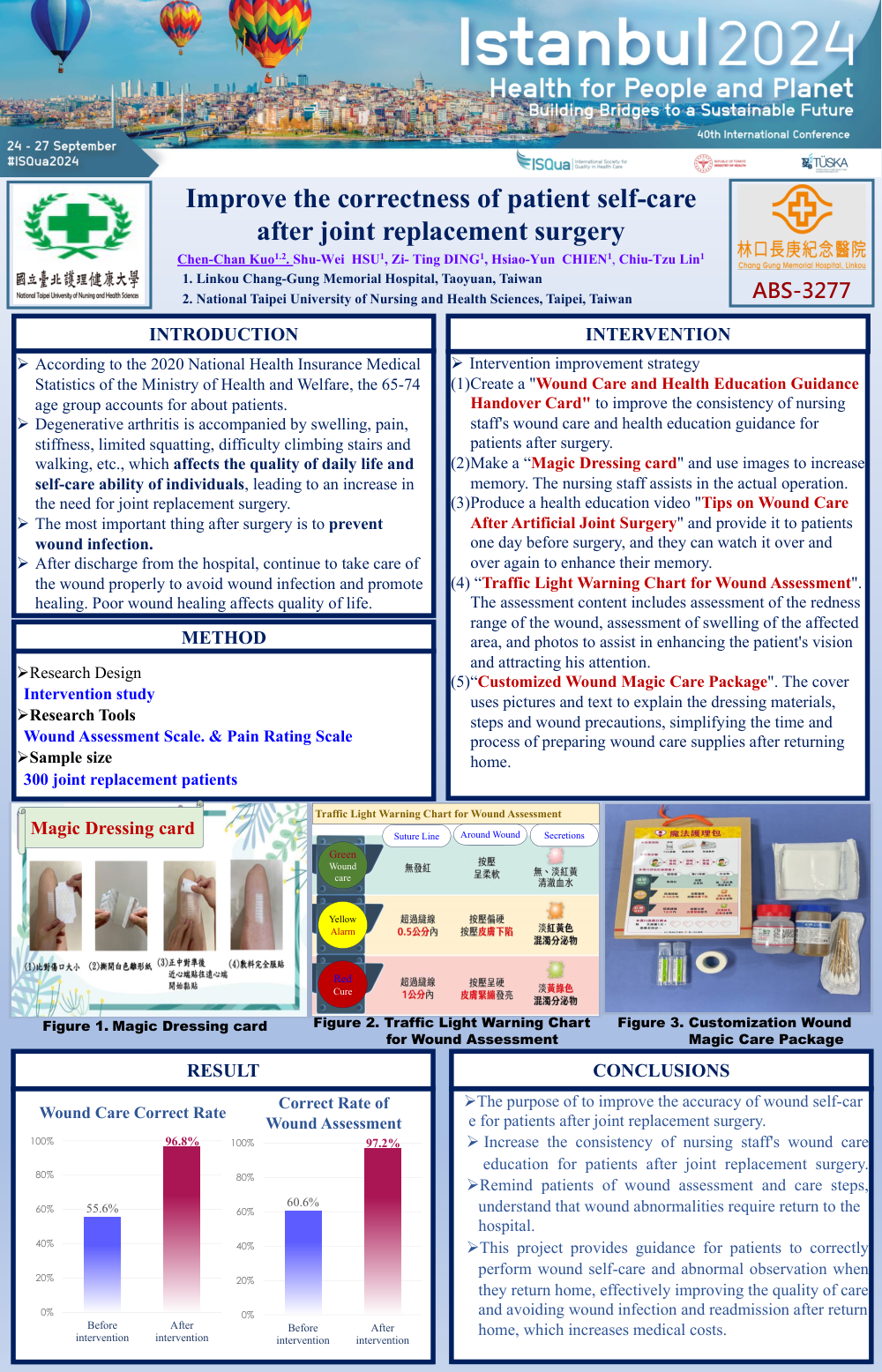
According to the 2020 National Health Insurance Medical Statistics of the Ministry of Health and Welfare, the 65-74 age group accounts for about patients. Degenerative arthritis is accompanied by swelling, pain, stiffness, limited squatting, difficulty climbing stairs and walking, etc., which affects the quality of daily life and self-care ability of individuals, leading to an increase in the need for joint replacement surgery. The most important thing after surgery is to prevent wound infection. After discharge from the hospital, continue to take care of the wound properly to avoid wound infection and promote healing. Poor wound healing affects quality of life.
METHOD:Research Design Intervention study Research Tools Wound Assessment Scale. & Pain Rating Scale Sample size 300 joint replacement patients.
INTERVENTION:Intervention improvement strategy Create a "Wound Care and Health Education Guidance Handover Card" to improve the consistency of nursing staff's wound care and health education guidance for patients after surgery. Make a “Magic Dressing card" and use images to increase memory. The nursing staff assists in the actual operation. Produce a health education video "Tips on Wound Care After Artificial Joint Surgery" and provide it to patients one day before surgery, and they can watch it over and over again to enhance their memory. “Traffic Light Warning Chart for Wound Assessment". The assessment content includes assessment of the redness range of the wound, assessment of swelling of the affected area, and photos to assist in enhancing the patient's vision and attracting his attention. “Customized Wound Magic Care Package". The cover uses pictures and text to explain the dressing materials, steps and wound precautions, simplifying the time and process of preparing wound care supplies after returning home.
Results: The result showed the proper wound care rate performed by a joint replacement patient at home has raised to 96.8%, which effectively improved the post operation wound care quality.
Conclusion: The purpose of this project is to improve the accuracy of wound self-care for patients after joint replacement surgery, increase the consistency of nursing staff's wound care education for patients after joint replacement surgery, remind patients of wound assessment and care steps, and understand that wound abnormalities require immediate return to the hospital. This project provides guidance for patients to correctly perform wound self-care and abnormal observation when they return home, effectively improving the quality of care and avoiding wound infection and readmission after returning home, which increases medical costs.