586 posters, 8 topics, 23 sessions, 1,077 authors, 622 institutions
ePostersLive by SciGen Technologies S.A. All rights reserved.
ISQua's 40th International Conference 2024
24th - 27th September 2024 | Istanbul, Türkiye

ISQUA2024-ABS-3245
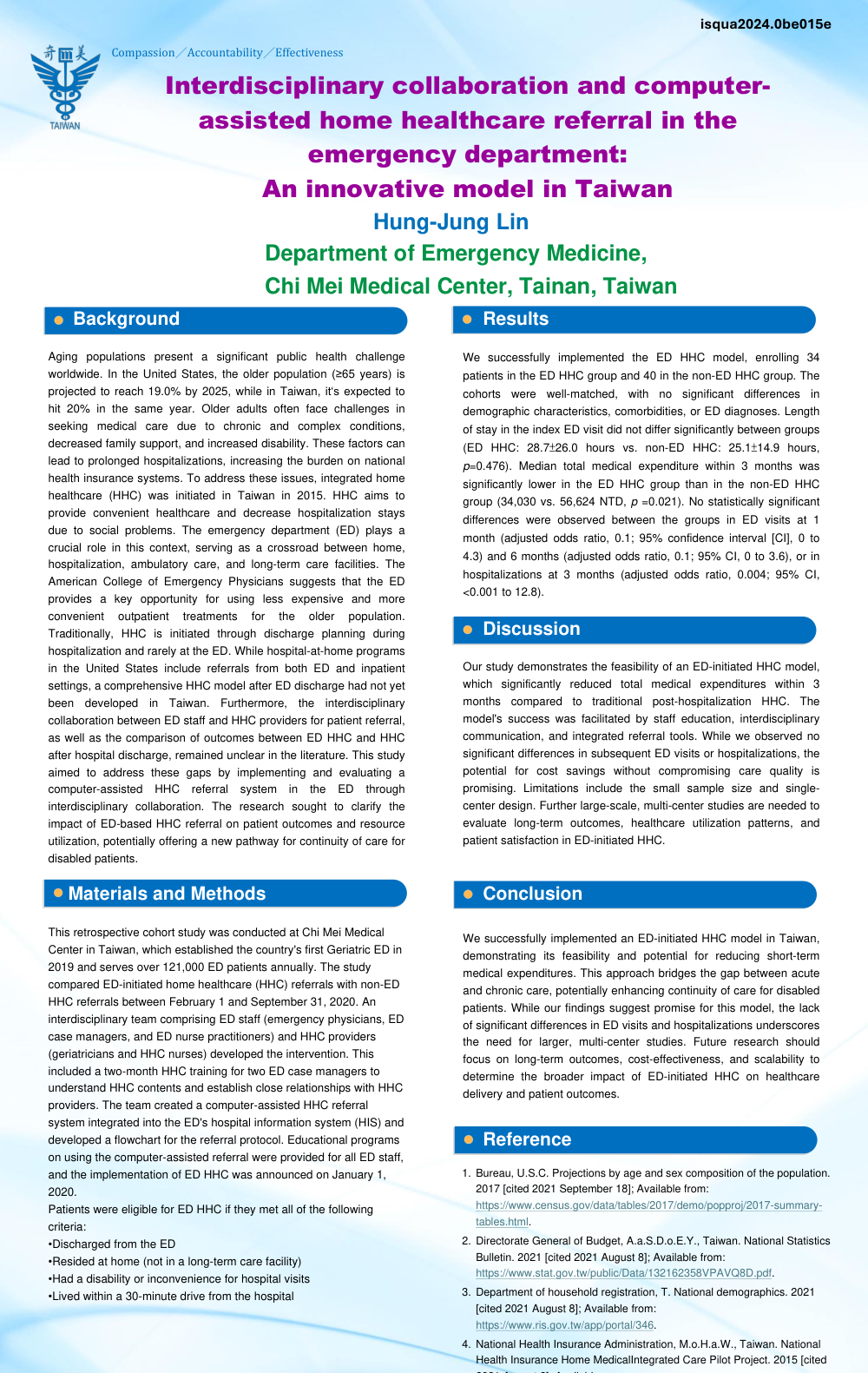
Interdisciplinary collaboration and computer-assisted home healthcare referral in the emergency department: An innovative model in Taiwan
Poster Presenter
Authors
Affiliations
Part of Topic
Integrated Care Communities
Interdisciplinary collaboration and computer-assisted home healthcare referral in the emergency department: An innovative model in Taiwan
Hung-Jung Lin
Department of Emergency Medicine, Chi Mei Medical Center, Tainan, Taiwan
Background
Aging populations present a significant public health challenge worldwide. In the United States, the older population (≥65 years) is projected to reach 19.0% by 2025, while in Taiwan, it‘s expected to hit 20% in the same year. Older adults often face challenges in seeking medical care due to chronic and complex conditions, decreased family support, and increased disability. These factors can lead to prolonged hospitalizations, increasing the burden on national health insurance systems. To address these issues, integrated home healthcare (HHC) was initiated in Taiwan in 2015. HHC aims to provide convenient healthcare and decrease hospitalization stays due to social problems. The emergency department (ED) plays a crucial role in this context, serving as a crossroad between home, hospitalization, ambulatory care, and long-term care facilities. The American College of Emergency Physicians suggests that the ED provides a key opportunity for using less expensive and more convenient outpatient treatments for the older population. Traditionally, HHC is initiated through discharge planning during hospitalization and rarely at the ED. While hospital-at-home programs in the United States include referrals from both ED and inpatient settings, a comprehensive HHC model after ED discharge had not yet been developed in Taiwan. Furthermore, the interdisciplinary collaboration between ED staff and HHC providers for patient referral, as well as the comparison of outcomes between ED HHC and HHC after hospital discharge, remained unclear in the literature. This study aimed to address these gaps by implementing and evaluating a computer-assisted HHC referral system in the ED through interdisciplinary collaboration. The research sought to clarify the impact of ED-based HHC referral on patient outcomes and resource utilization, potentially offering a new pathway for continuity of care for disabled patients.
Materials and Methods
This retrospective cohort study was conducted at Chi Mei Medical Center in Taiwan, which established the country's first Geriatric ED in 2019 and serves over 121,000 ED patients annually. The study compared ED-initiated home healthcare (HHC) referrals with non-ED HHC referrals between February 1 and September 31, 2020. An interdisciplinary team comprising ED staff (emergency physicians, ED case managers, and ED nurse practitioners) and HHC providers (geriatricians and HHC nurses) developed the intervention. This included a two-month HHC training for two ED case managers to understand HHC contents and establish close relationships with HHC providers. The team created a computer-assisted HHC referral system integrated into the ED's hospital information system (HIS) and developed a flowchart for the referral protocol. Educational programs on using the computer-assisted referral were provided for all ED staff, and the implementation of ED HHC was announced on January 1, 2020.
Patients were eligible for ED HHC if they met all of the following criteria:
We successfully implemented the ED HHC model, enrolling 34 patients in the ED HHC group and 40 in the non-ED HHC group. The cohorts were well-matched, with no significant differences in demographic characteristics, comorbidities, or ED diagnoses. Length of stay in the index ED visit did not differ significantly between groups (ED HHC: 28.7±26.0 hours vs. non-ED HHC: 25.1±14.9 hours, p=0.476). Median total medical expenditure within 3 months was significantly lower in the ED HHC group than in the non-ED HHC group (34,030 vs. 56,624 NTD, p =0.021). No statistically significant differences were observed between the groups in ED visits at 1 month (adjusted odds ratio, 0.1; 95% confidence interval [CI], 0 to 4.3) and 6 months (adjusted odds ratio, 0.1; 95% CI, 0 to 3.6), or in hospitalizations at 3 months (adjusted odds ratio, 0.004; 95% CI, <0.001 to 12.8).
Discussion
Our study demonstrates the feasibility of an ED-initiated HHC model, which significantly reduced total medical expenditures within 3 months compared to traditional post-hospitalization HHC. The model's success was facilitated by staff education, interdisciplinary communication, and integrated referral tools. While we observed no significant differences in subsequent ED visits or hospitalizations, the potential for cost savings without compromising care quality is promising. Limitations include the small sample size and single-center design. Further large-scale, multi-center studies are needed to evaluate long-term outcomes, healthcare utilization patterns, and patient satisfaction in ED-initiated HHC.
Conclusion
We successfully implemented an ED-initiated HHC model in Taiwan, demonstrating its feasibility and potential for reducing short-term medical expenditures. This approach bridges the gap between acute and chronic care, potentially enhancing continuity of care for disabled patients. While our findings suggest promise for this model, the lack of significant differences in ED visits and hospitalizations underscores the need for larger, multi-center studies. Future research should focus on long-term outcomes, cost-effectiveness, and scalability to determine the broader impact of ED-initiated HHC on healthcare delivery and patient outcomes.