586 posters, 8 topics, 23 sessions, 1,077 authors, 622 institutions
ePostersLive by SciGen Technologies S.A. All rights reserved.
ISQua's 40th International Conference 2024
24th - 27th September 2024 | Istanbul, Türkiye

ISQUA2024-ABS-3199
Assessment of Antimicrobial Stewardship Program Implementation in Hermina Hospital Group, Indonesia: A Survey-Based Study
Part of Topic
Patient Safety & Quality Improvement
Assessment of Antimicrobial Stewardship Program Implementation in Hermina Hospital Group, Indonesia: A Survey-Based Study
Introduction
In May 2015, the World Health Assembly endorsed a global action plan on antimicrobial resistance called Antimicrobial Stewardship (AMS) program. In Indonesia, AMS has been integrated into a nationally accredited program since 2019. However, the implementation of AMS has not been fully integrated at the hospital level, and national reporting about this program has not been conducted. Within the Hermina Hospital Group, AMS has been extensively implemented by using e-AMS application. This e-AMS application was an electronic-based and integrated into a hospital's electronic medical records. This application allowed us to monitor antibiotic used (both in terms of dosage, duration, and escalation) in the hospital. The outcome of this application was to help the analysis of the AMS team in the hospital to reduce antibiotic resistance. The e-AMS application began to be tested in some of Hermina hospitals at the end of September 2023.
Aim
Since lacked of reporting data related to the AMS program in Indonesia, we aimed to conduct a small-scale survey that includes hospitals under the Hermina Hospital Group. This survey was to evaluate the implementation of the AMS program. Some of the hospitals from the Hermina Hospital Group have run the e-AMS application for implementing the AMS program, and some have not used the application. In this study, we will present the results of the comparison descriptively.
Method
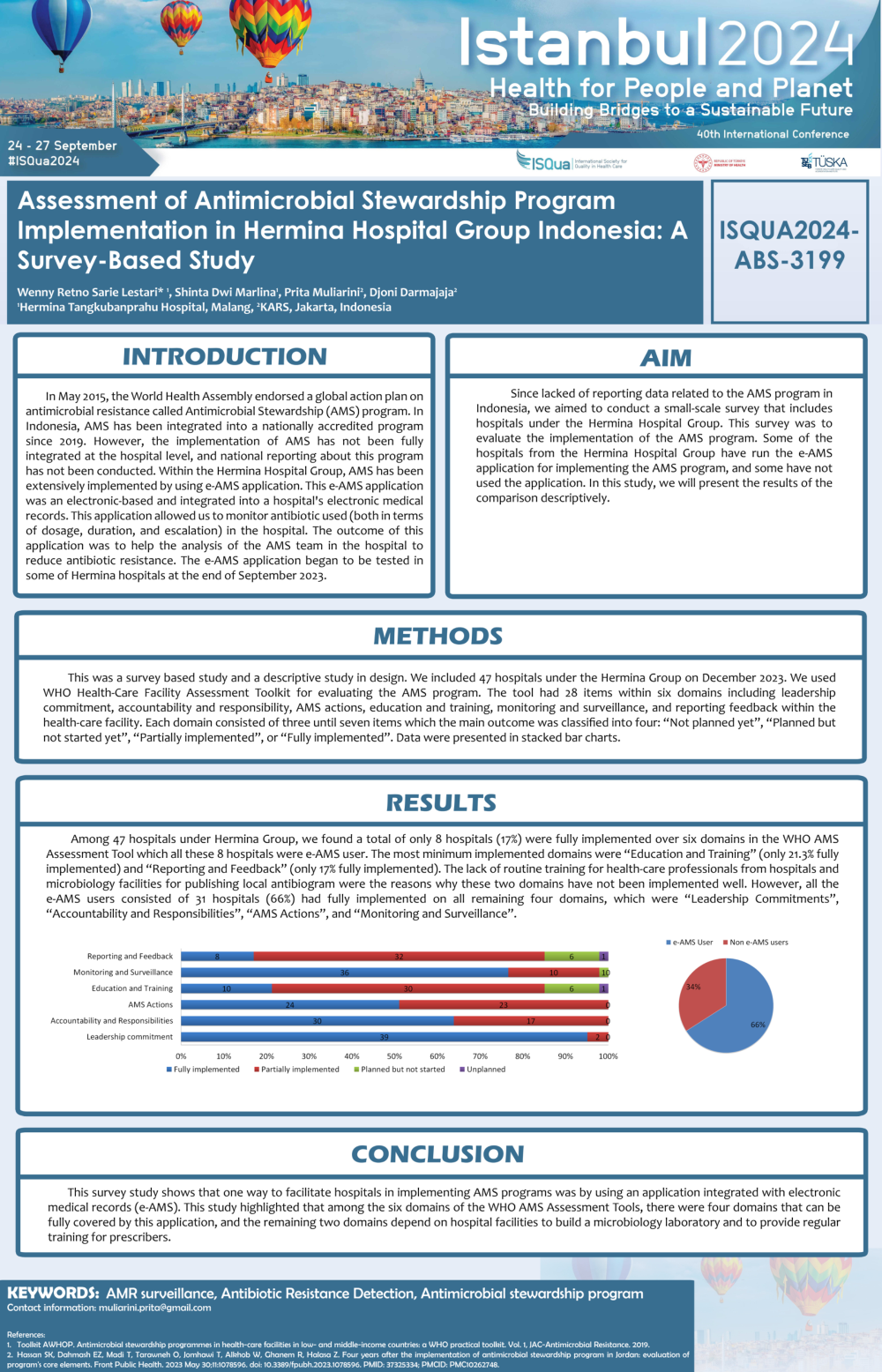
This was a survey based study and a descriptive study in design. We included 47 hospitals under the Hermina Group on December 2023. We used WHO Health-Care Facility Assessment Toolkit for evaluating the AMS program. The tool had 28 items within six domains including leadership commitment, accountability and responsibility, AMS actions, education and training, monitoring and surveillance, and reporting feedback within the health-care facility. Each domain consisted of three until seven items which the main outcome was classified into four: "Not planned yet", "Planned but not started yet", "Partially implemented", or "Fully implemented". Data were presented in stacked bar charts.
RESULTS
Among 47 hospitals under Hermina Group, we found a total of only 8 hospitals (17%) were fully implemented over six domains in the WHO AMS Assessment Tool which all these 8 hospitals were e-AMS user. The most minimum implemented domains were "Education and Training" (only 21.3% fully implemented) and "Reporting and Feedback" (only 17% fully implemented). The lack of routine training for health-care professionals from hospitals and microbiology facilities for publishing local antibiogram were the reasons why these two domains have not been implemented well. However, all the e-AMS users consisted of 31 hospitals (66%) had fully implemented on all remaining four domains, which were "Leadership Commitments", "Accountability and Responsibilities", "AMS Actions", and "Monitoring and Surveillance".