586 posters, 8 topics, 23 sessions, 1,077 authors, 622 institutions
ePostersLive by SciGen Technologies S.A. All rights reserved.
ISQua's 40th International Conference 2024
24th - 27th September 2024 | Istanbul, Türkiye

ISQUA2024-ABS-3189
The impact of nurse outcomes on nurse-perceived patient outcomes in South African hospitals
Poster Presenter
Authors
Alwiena Johanna Blignaut, Siedine Knobloch Coetzee, Erika Fourie
Affiliations
Part of Topic
Patient Safety & Quality Improvement
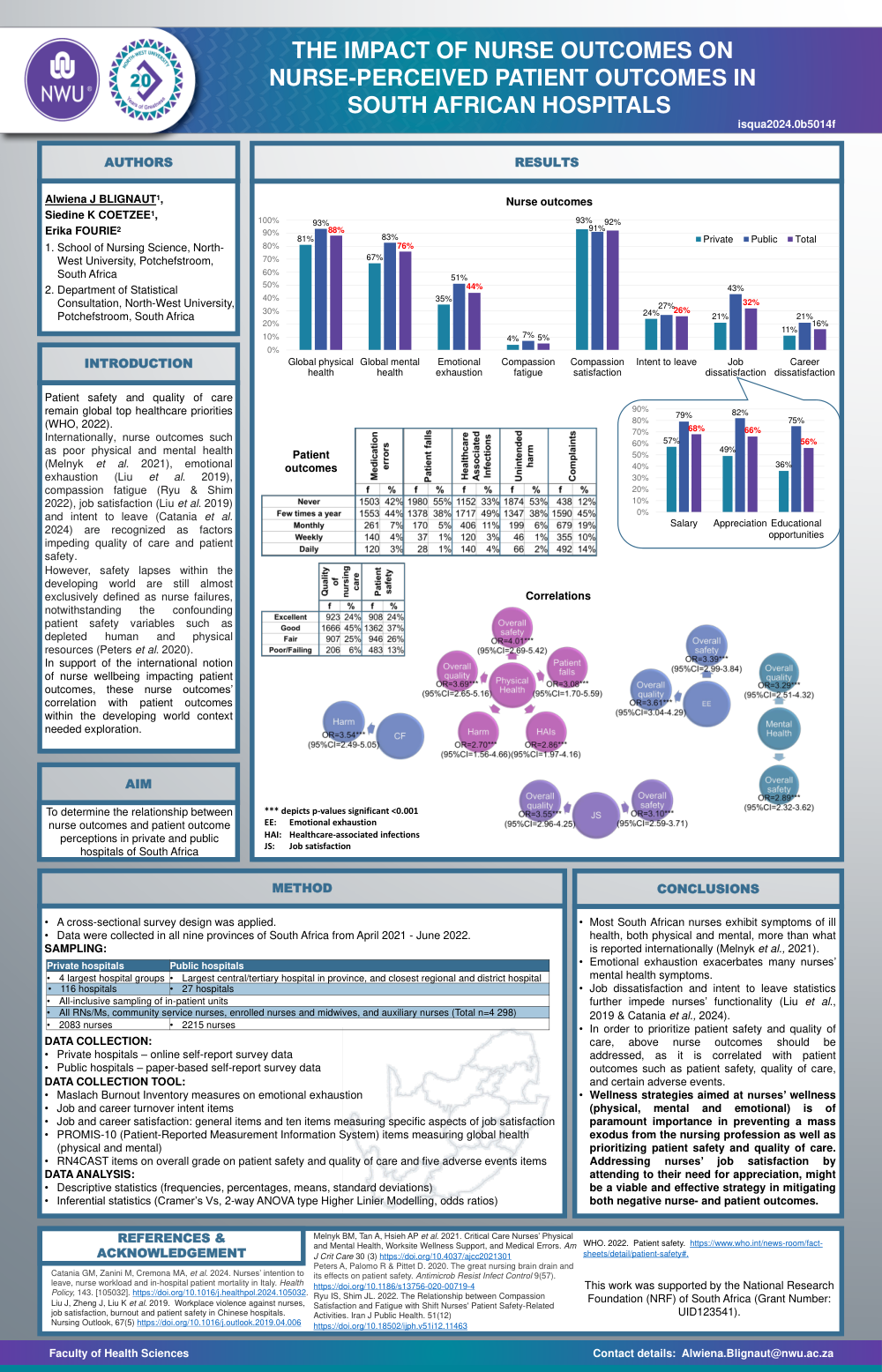
THE IMPACT OF NURSE OUTCOMES ON NURSE-PERCEIVED PATIENT OUTCOMES IN SOUTH AFRICAN HOSPITALS
Authors:
Alwiena J BLIGNAUT1,
Siedine K COETZEE1,
Erika FOURIE2
Patient safety and quality of care remain global top healthcare priorities (WHO, 2022).
Internationally, nurse outcomes such as poor physical and mental health (Melnyk et al. 2021), emotional exhaustion (Liu et al. 2019), compassion fatigue (Ryu & Shim 2022), job satisfaction (Liu et al. 2019) and intent to leave (Catania et al. 2024) are recognized as factors impeding quality of care and patient safety.
However, safety lapses within the developing world are still almost exclusively defined as nurse failures, notwithstanding the confounding patient safety variables such as depleted human and physical resources (Peters et al. 2020).
In support of the international notion of nurse wellbeing impacting patient outcomes, these nurse outcomes’ correlation with patient outcomes within the developing world context needed exploration.
Aim:
To determine the relationship between nurse outcomes and patient outcome perceptions in private and public hospitals of South Africa
Method:
SAMPLING:
Private hospitals: 116 hospitals, 2083 nurses
Public hospitals: 27 hospitals, 2215 nurses
DATA COLLECTION:
DATA COLLECTION TOOL:
DATA ANALYSIS:
Inferential statistics (Cramer’s Vs, 2-way ANOVA type Higher Linier Modelling, odds ratios)
Conclusions:
Catania GM, Zanini M, Cremona MA, et al. 2024. Nurses’ intention to leave, nurse workload and in-hospital patient mortality in Italy. Health Policy, 143. [105032]. https://doi.org/10.1016/j.healthpol.2024.105032.
Liu J, Zheng J, Liu K et al. 2019. Workplace violence against nurses, job satisfaction, burnout and patient safety in Chinese hospitals. Nursing Outlook, 67(5) https://doi.org/10.1016/j.outlook.2019.04.006
Melnyk BM, Tan A, Hsieh AP et al. 2021. Critical Care Nurses’ Physical and Mental Health, Worksite Wellness Support, and Medical Errors. Am J Crit Care 30 (3) https://doi.org/10.4037/ajcc2021301
Peters A, Palomo R & Pittet D. 2020. The great nursing brain drain and its effects on patient safety. Antimicrob Resist Infect Control 9(57). https://doi.org/10.1186/s13756-020-00719-4
Ryu IS, Shim JL. 2022. The Relationship between Compassion Satisfaction and Fatigue with Shift Nurses' Patient Safety-Related Activities. Iran J Public Health. 51(12) https://doi.org/10.18502/ijph.v51i12.11463
WHO. 2022. Patient safety. https://www.who.int/news-room/fact-sheets/detail/patient-safety#.
This work was supported by the National Research Foundation (NRF) of South Africa (Grant Number: UID123541).