586 posters, 8 topics, 23 sessions, 1,077 authors, 622 institutions
ePostersLive by SciGen Technologies S.A. All rights reserved.
ISQua's 40th International Conference 2024
24th - 27th September 2024 | Istanbul, Türkiye

ISQUA2024-ABS-3130
How we can learn from mistakes - health and social care safety investigation as a fostering patient and client safety
Part of Topic
Patient Safety & Quality Improvement
How We Can Learn from Mistakes - Health and Social Care Safety Investigation Fostering Patient and Client Safety
Authors:
PhD Hanna Tiirinki, Chief Safety Investigator, Health and social care safety investigation, Safety Investigation Authority, Helsinki, and Professor of Practice, Department of Social Research, University of Turku,Finland.
Dr. Krista Lyyra, special Investigator, Health and social care safety investigation, Safety Investigation Authority, Helsinki Finland.
Introduction
Safety Investigation Authority, Finland (SIAF) has launched an investigative branch tasked with investigating health and social care accidents and serious so called never events in 2021. The branch investigates both events with far-reaching consequences and accidents suffered by individual clients or patients.
The purpose of a health and social care safety investigation is to improve patient and client safety as well as general safety of the health and social care system and services. Recommendations intended to prevent the reoccurrence of similar incidents and decrease the number of incidence of accidents in general stem from each safety investigation.
Methods
Safety investigations are conducted independently and objectively applying investigation methods from traditional safety critical fields, such as aviation, railroad or maritime safety. An investigation team appointed for each specific health and social care investigation determines the course, causes and consequences of the events. It also determines whether management, supervision and auditing has been arranged and performed appropriately.
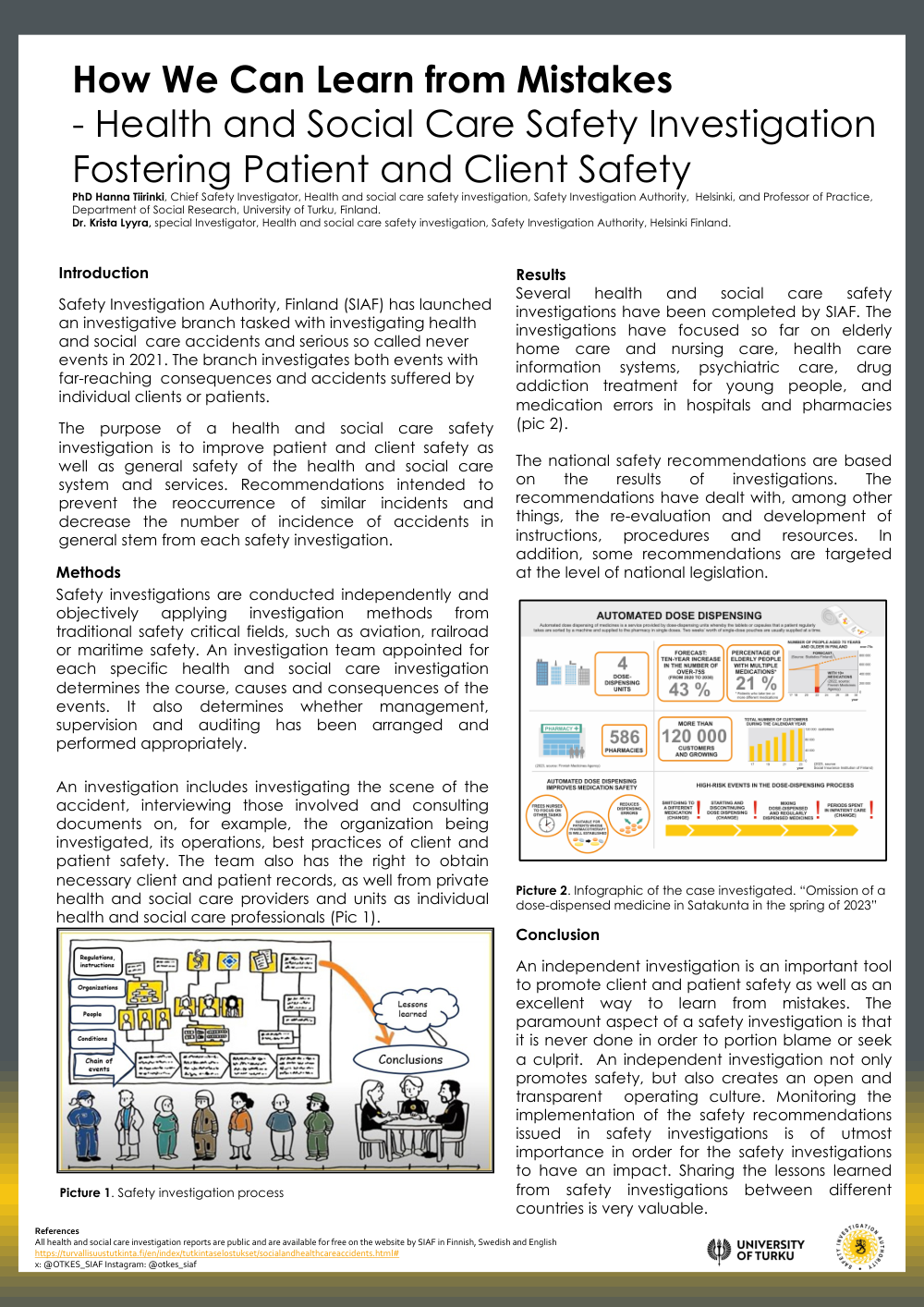
An investigation includes investigating the scene of the accident, interviewing those involved and consulting documents on, for example, the organization being investigated, its operations, best practices of client and patient safety. The team also has the right to obtain necessary client and patient records, as well from private health and social care providers and units as individual health and social care professionals (Pic 1).
Results
Several health and social care safety investigations have been completed by SIAF. The investigations have focused so far on elderly home care and nursing care, health care information systems, psychiatric care, drug addiction treatment for young people, and medication errors in hospitals and pharmacies (pic 2).
The national safety recommendations are based on the results of investigations. The recommendations have dealt with, among other things, the re-evaluation and development of instructions, procedures and resources. In addition, some recommendations are targeted at the level of national legislation.
An independent investigation is an important tool to promote client and patient safety as well as an excellent way to learn from mistakes. The paramount aspect of a safety investigation is that it is never done in order to portion blame or seek a culprit. An independent investigation not only promotes safety, but also creates an open and transparent operating culture. Monitoring the implementation of the safety recommendations issued in safety investigations is of utmost importance in order for the safety investigations to have an impact. Sharing the lessons learned from safety investigations between different countries is very valuable.
References
All health and social care investigation reports are public and are available for free on the website by SIAF in Finnish, Swedish and English https://turvallisuustutkinta.fi/en/index/tutkintaselostukset/socialandhealthcareaccidents.html#
x: @OTKES_SIAF Instagram: @otkes_siaf