586 posters, 8 topics, 23 sessions, 1,077 authors, 622 institutions
ePostersLive by SciGen Technologies S.A. All rights reserved.
ISQua's 40th International Conference 2024
24th - 27th September 2024 | Istanbul, Türkiye

ISQUA2024-ABS-3010
Longitudinal relationship between Vitamin D supplementation and falls incidents in residential aged care: Implications for Falls Prevention Programs
Poster Presenter
Authors
Nasir Wabe, Isabelle Meulenbroeks, Desiree Chantelle Firempong, Magdalena Raban, Amy Nguyen, Jacqueline CT Close, Stephen Lord
Affiliations
Macquarie University, Centre for Health Systems and Safety Research, Australian Institute of Health Innovation, Macquarie University, Australia, Neuroscience Research Australia, UNSW Sydney, Sydney, Australia; Prince of Wales Clinical School, University of New South Wales, Sydney, Australia, Neuroscience Research Australia, UNSW Sydney, Sydney, Australia; School of Population Health, UNSW, Sydney, Australia
Part of Topic
Patient Safety & Quality Improvement
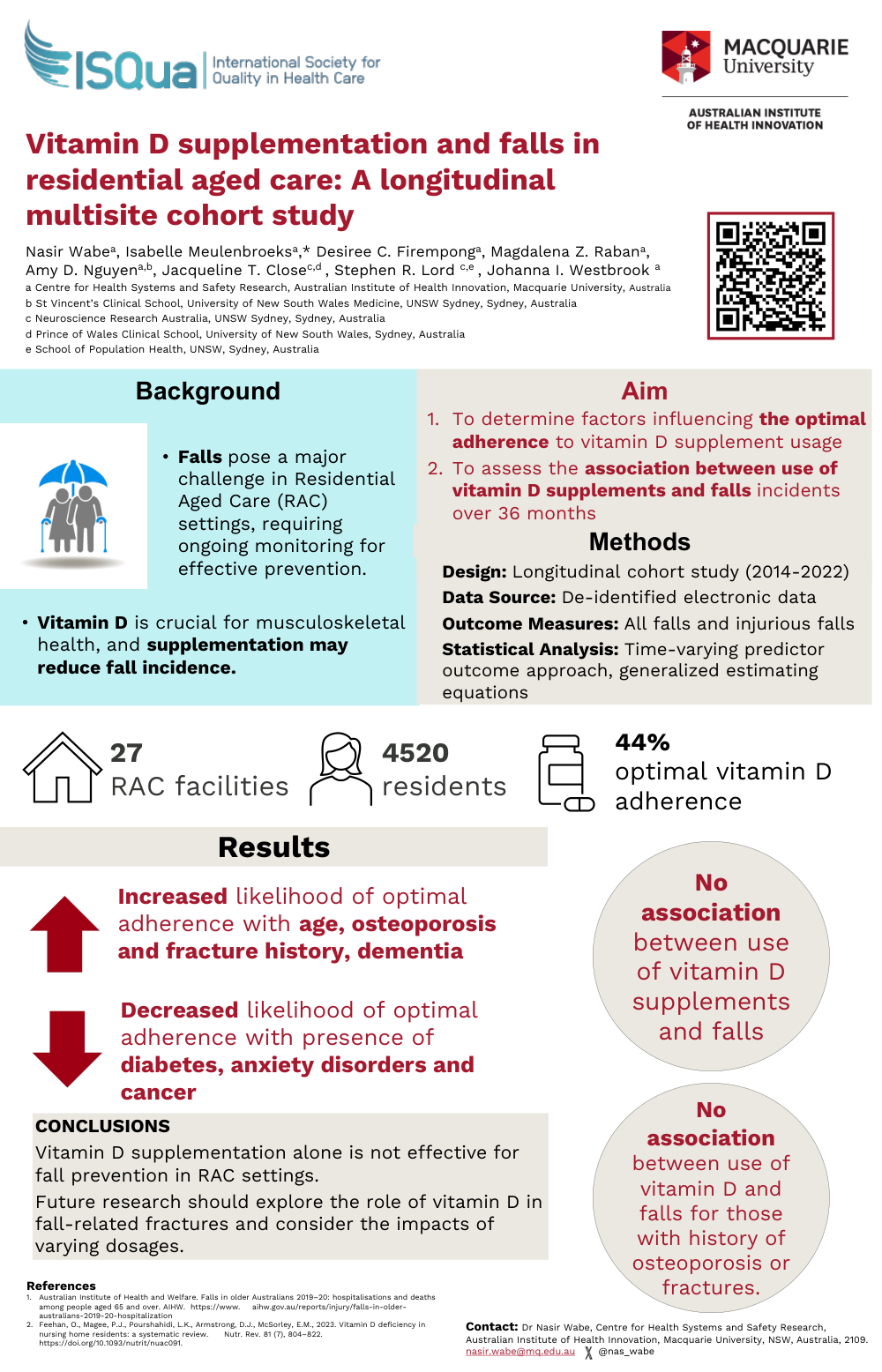
Introduction: Vitamin D plays an essential role in supporting musculoskeletal health, and supplementation may lower the risk of falls. Vitamin D supplementation may be particularly beneficial in residential aged care (RAC) settings, given the high prevalence of Vitamin D deficiency within this population. However, past research on the effects of vitamin D supplementation on falls in RAC has reported inconclusive findings, partly due to study design limitations. We utilised a longitudinal study design to assess the association between the use of vitamin D and falls over 36 months in RAC.
Methods: A longitudinal cohort study was conducted using routinely collected electronic data extracted from 27 RAC facilities in Sydney, New South Wales, Australia. Study inclusion criteria were residents who: were permanent residents aged 65 years or older; admitted for the first time on or after the study start period of July 1, 2014, and were long-term residents (>30 days admission). We identified daily vitamin D usage over 36 months, and measured adherence using the Proportion of Days Covered (PDC) metric. PDC represents the proportion of days that residents were covered by vitamin D supplements with a value of ≥80% signifying optimal adherence. Primary outcomes were the number of all falls and injurious falls. We employed Generalized Estimating Equations (GEE) to investigate the longitudinal association between the use of vitamin D supplements and the subsequent risk of falls. This study was reviewed and approved by the Macquarie University Human Research Ethics Committee (ref: 52019614412614).
Results: A total of 4,520 participants were included, with over two-thirds of residents (67.8%; n=3,063) receiving vitamin D supplements during their stay. The median PDC was 74.8%, signifying that approximately half of the residents received daily vitamin D supplements for three-quarters of their total time spent in the RAC facilities. The proportion of residents achieving optimal adherence was 44.6% (n=1,365). Increasing age, osteoporosis or fracture history, and dementia were associated with a greater likelihood of achieving optimal adherence. After accounting for relevant demographics (e.g., age) and health conditions (e.g., dementia status), no significant relationship was observed between vitamin D supplement usage and fall outcomes: all falls (Incident Rate Ratio [IRR] 1.01; 95% CI 1.00-1.02; P=0.237) and injurious falls (IRR 1.01; 95% CI 1.00-1.02; P=0.091).
Conclusion: Vitamin D supplementation was prevalent in RAC settings; however, it did not demonstrate an association with a reduced risk of falls. This suggests that it may not be an effective standalone intervention for preventing falls in RAC. While clinicians should prioritise ensuring adequate vitamin D intake for residents' musculoskeletal health, other comprehensive measures may be necessary for falls prevention in RAC populations.