586 posters, 8 topics, 23 sessions, 1,077 authors, 622 institutions
ePostersLive by SciGen Technologies S.A. All rights reserved.
ISQua's 40th International Conference 2024
24th - 27th September 2024 | Istanbul, Türkiye

ISQUA2024-ABS-3004
Towards patient -centred communication in the management of older patients' medications across transitions of care: A focused ethnographic study
Poster Presenter
Authors
Affiliations
Deakin University/Alfred Health, Deakin University, Melbourne, Australia
Part of Topic
Patient Safety & Quality Improvement
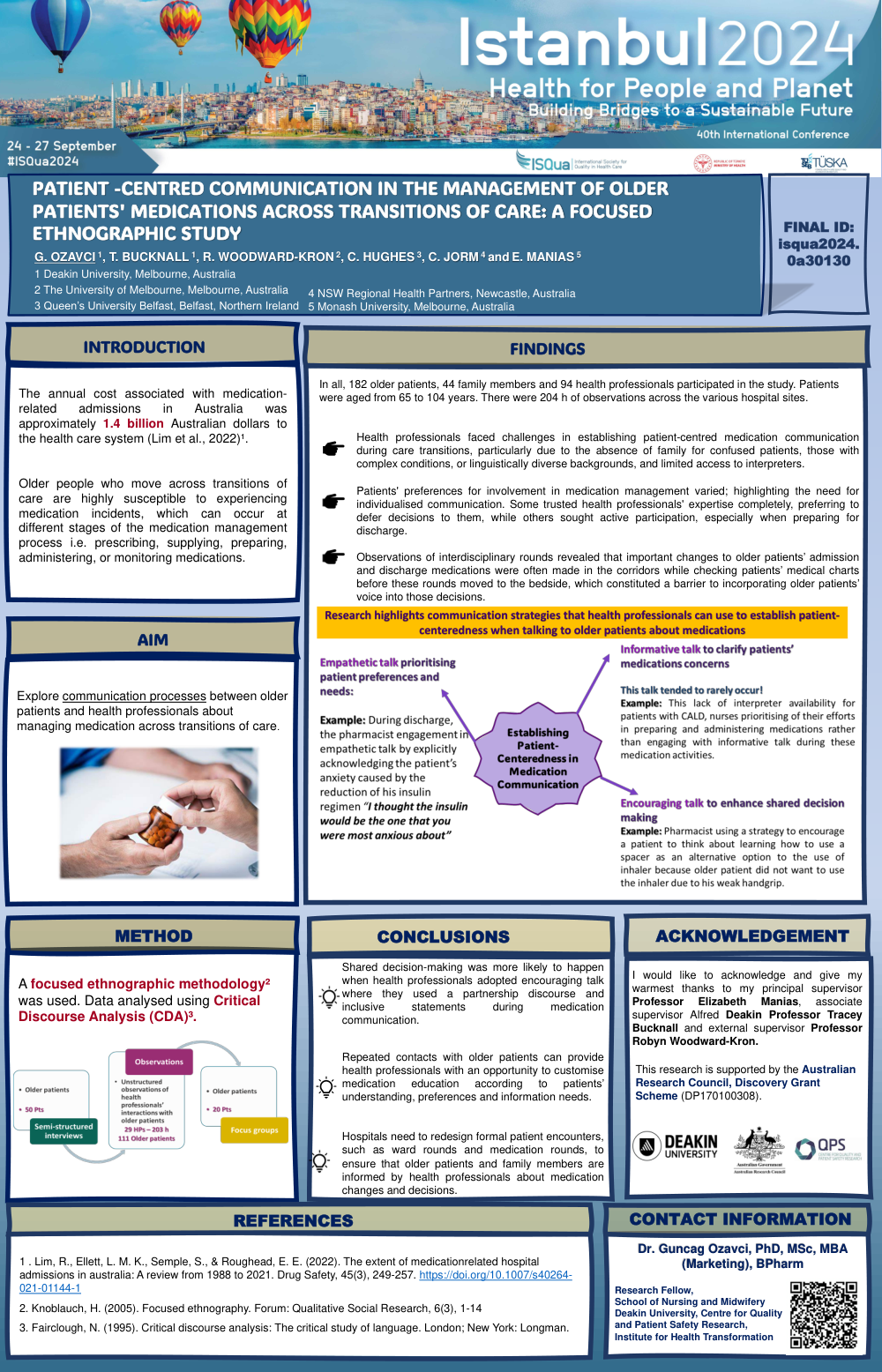
PATIENT -CENTRED COMMUNICATION IN THE MANAGEMENT OF OLDER PATIENTS' MEDICATIONS ACROSS TRANSITIONS OF CARE: A FOCUSED ETHNOGRAPHIC STUDY
G. OZAVCI 1, T. BUCKNALL 1, R. WOODWARD-KRON 2, C. HUGHES 3, C. JORM 4 and E. MANIAS 5
1 Deakin University, Melbourne, Australia
2 The University of Melbourne, Melbourne, Australia
3 Queen’s University Belfast, Belfast, Northern Ireland
4 NSW Regional Health Partners, Newcastle, Australia
5 Monash University, Melbourne, Australia
INTRODUCTION:
The annual cost associated with medication-related admissions in Australia was approximately 1.4 billion Australian dollars to the health care system (Lim et al., 2022)¹.
Older people who move across transitions of care are highly susceptible to experiencing medication incidents, which can occur at different stages of the medication management process i.e. prescribing, supplying, preparing, administering, or monitoring medications.
AIM: Explore communication processes between older patients and health professionals about managing medication across transitions of care
METHOD:
A focused ethnographic methodology² was used. Data analysed using Critical Discourse Analysis (CDA)³.
RESULTS:
In all, 182 older patients, 44 family members and 94 health professionals participated in the study. Patients were aged from 65 to 104 years. There were 204 h of observations across the various hospital sites.
Health professionals faced challenges in establishing patient-centred medication communication during care transitions, particularly due to the absence of family for confused patients, those with complex conditions, or linguistically diverse backgrounds, and limited access to interpreters.
Patients' preferences for involvement in medication management varied; highlighting the need for individualised communication. Some trusted health professionals' expertise completely, preferring to defer decisions to them, while others sought active participation, especially when preparing for discharge.
Observations of interdisciplinary rounds revealed that important changes to older patients’ admission and discharge medications were often made in the corridors while checking patients’ medical charts before these rounds moved to the bedside, which constituted a barrier to incorporating older patients’ voice into those decisions.
Shared decision-making was more likely to happen when health professionals adopted encouraging talk where they used a partnership discourse and inclusive statements during medication communication.
Repeated contacts with older patients can provide health professionals with an opportunity to customise medication education according to patients’ understanding, preferences and information needs.
Hospitals need to redesign formal patient encounters, such as ward rounds and medication rounds, to ensure that older patients and family members are informed by health professionals about medication changes and decisions.
Dr. Guncag Ozavci, PhD, MSc, MBA (Marketing), BPharm
Research Fellow,
School of Nursing and Midwifery
Deakin University, Centre for Quality and Patient Safety Research, Institute for Health Transformation