586 posters, 8 topics, 23 sessions, 1,077 authors, 622 institutions
ePostersLive by SciGen Technologies S.A. All rights reserved.
ISQua's 40th International Conference 2024
24th - 27th September 2024 | Istanbul, Türkiye

ISQUA2024-ABS-2973
Evaluation of the Use of Quality Improvement Tools by Quality Managers of Hospitals in Turkey
Poster Presenter
Part of Topic
Patient Safety & Quality Improvement
Introduction
Healthcare organizations use various techniques, methods and tools while working on quality and quality improvement. These tools are frequently used to identify and assess problems, address errors and increased costs, change practices, generate/develop new ideas, obtain data, visualize problems or solutions, make decisions and conduct analyses. It is known that there are many quality improvement tools in health services. This study aims to investigate the frequency and reasons for the use of quality improvement tools by quality managers of hospitals.
Method
The study population consists of quality managers of hospitals operating in Turkiye. The study did not use sampling, aiming to reach all quality managers in the hospitals within the population. Reminder emails were sent a total of three times to hospital quality managers who did not respond to the survey. Quality managers from 248 hospitals who answered all questions completely were included in the study.
In this descriptive and cross-sectional study, the frequency and purposes of use of the most commonly used quality improvement tools identified in the literature (Soković et al. 2009; American Society for Quality, 2024; Healthcare Quality Improvement Partnership, 2021; New South Wales Clinical Excellence Commission, 2024) —Brainstorming, Fishbone Diagram, Five Whys, Flowchart, Control Chart, Plan-Do-Check-Act (PDCA) Cycle, Failure Mode Effects Analysis (FMEA), Histogram, Scatter Diagram, Process Mapping, Interrelationship Diagram, Mapping the Last Ten Patients, Quality Function Migration (House of Quality), Pareto Chart, Tree diagram, Spaghetti Diagram, Six Thinking Hats, and Swiss Cheese Model—by hospital quality managers were examined. When asked about the frequency of use, hospital quality managers were asked to choose one of the following response options: "I don't know," "Never," "Rarely," "Sometimes," and "Frequently." Those who indicated that they used the quality improvement tools "Rarely," "Sometimes," or "Frequently" were asked for what objectives they used them, with response options being "Analysis," "Identify Issue or Problem," "Develop Ideas," "Obtain Data," " Visualise," and "Decision Making." In addition to the frequency and purposes of use of quality improvement tools, the survey also included questions about the individual characteristics of hospital quality managers.
The data for the study were collected via an electronic survey method between March 1, 2024, and April 1, 2024. Descriptive statistics and statistical analyses were conducted using the Statistical Package for the Social Sciences (SPSS) 23.0. The level of statistical significance was set at 0.05.
Findings
When the individual characteristics of the participants were examined, it was found that 81.5% of the participants were female, 76.2% were aged between 31 and 50, 64.1% had a bachelor's degree, 52% had 15 years or more of professional experience, 45.2% had 3 to 10 years of experience in quality, and 66.1% worked in a public hospital.
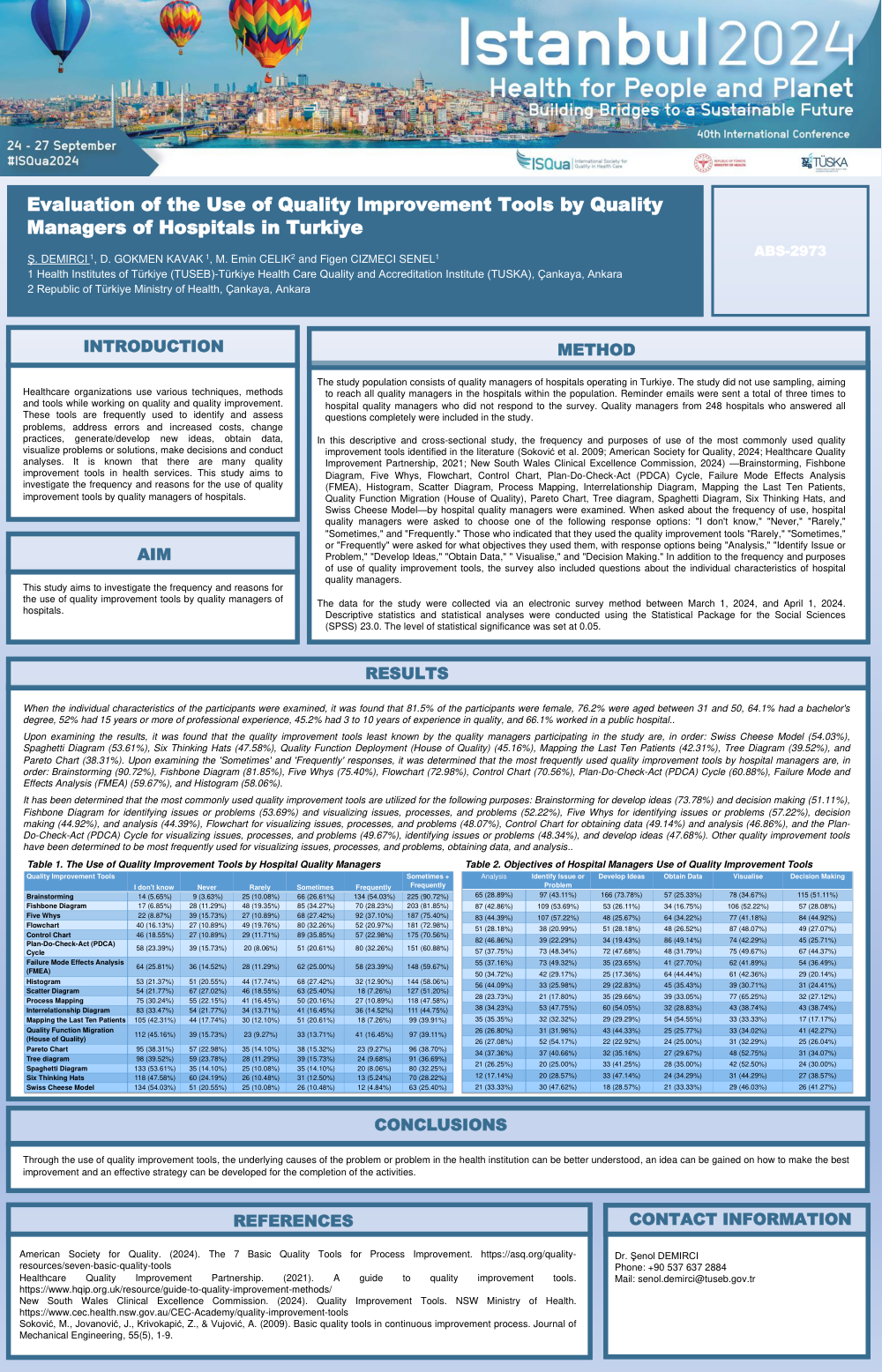
Upon examining the results, it was found that the quality improvement tools least known by the quality managers participating in the study are, in order: Swiss Cheese Model (54.03%), Spaghetti Diagram (53.61%), Six Thinking Hats (47.58%), Quality Function Deployment (House of Quality) (45.16%), Mapping the Last Ten Patients (42.31%), Tree Diagram (39.52%), and Pareto Chart (38.31%). Upon examining the 'Sometimes' and 'Frequently' responses, it was determined that the most frequently used quality improvement tools by hospital managers are, in order: Brainstorming (90.72%), Fishbone Diagram (81.85%), Five Whys (75.40%), Flowchart (72.98%), Control Chart (70.56%), Plan-Do-Check-Act (PDCA) Cycle (60.88%), Failure Mode and Effects Analysis (FMEA) (59.67%), and Histogram (58.06%).
It has been determined that the most commonly used quality improvement tools are utilized for the following purposes: Brainstorming for develop ideas (73.78%) and decision making (51.11%), Fishbone Diagram for identifying issues or problems (53.69%) and visualizing issues, processes, and problems (52.22%), Five Whys for identifying issues or problems (57.22%), decision making (44.92%), and analysis (44.39%), Flowchart for visualizing issues, processes, and problems (48.07%), Control Chart for obtaining data (49.14%) and analysis (46.86%), and the Plan-Do-Check-Act (PDCA) Cycle for visualizing issues, processes, and problems (49.67%), identifying issues or problems (48.34%), and develop ideas (47.68%). Other quality improvement tools have been determined to be most frequently used for visualizing issues, processes, and problems, obtaining data, and analysis.
Conclusion
Through the use of quality improvement tools, the underlying causes of the problem or problem in the health institution can be better understood, an idea can be gained on how to make the best improvement and an effective strategy can be developed for the completion of the activities.
Keywords: Quality Improvement Tools, Quality Managers, Hospital.
Reference
American Society for Quality. (2024). The 7 Basic Quality Tools for Process Improvement. https://asq.org/quality-resources/seven-basic-quality-tools
Healthcare Quality Improvement Partnership. (2021). A guide to quality improvement tools. https://www.hqip.org.uk/resource/guide-to-quality-improvement-methods/
New South Wales Clinical Excellence Commission. (2024). Quality Improvement Tools. NSW Ministry of Health. https://www.cec.health.nsw.gov.au/CEC-Academy/quality-improvement-tools
Soković, M., Jovanović, J., Krivokapić, Z., & Vujović, A. (2009). Basic quality tools in continuous improvement process. Journal of Mechanical Engineering, 55(5), 1-9.