586 posters, 8 topics, 23 sessions, 1,077 authors, 622 institutions
ePostersLive by SciGen Technologies S.A. All rights reserved.
ISQua's 40th International Conference 2024
24th - 27th September 2024 | Istanbul, Türkiye

ISQUA2024-ABS-2884
Improving the quality of hospital care for mothers and children in Kyrgyzstan
Poster Presenter
Authors
Affiliations
Part of Topic
Patient Safety & Quality Improvement
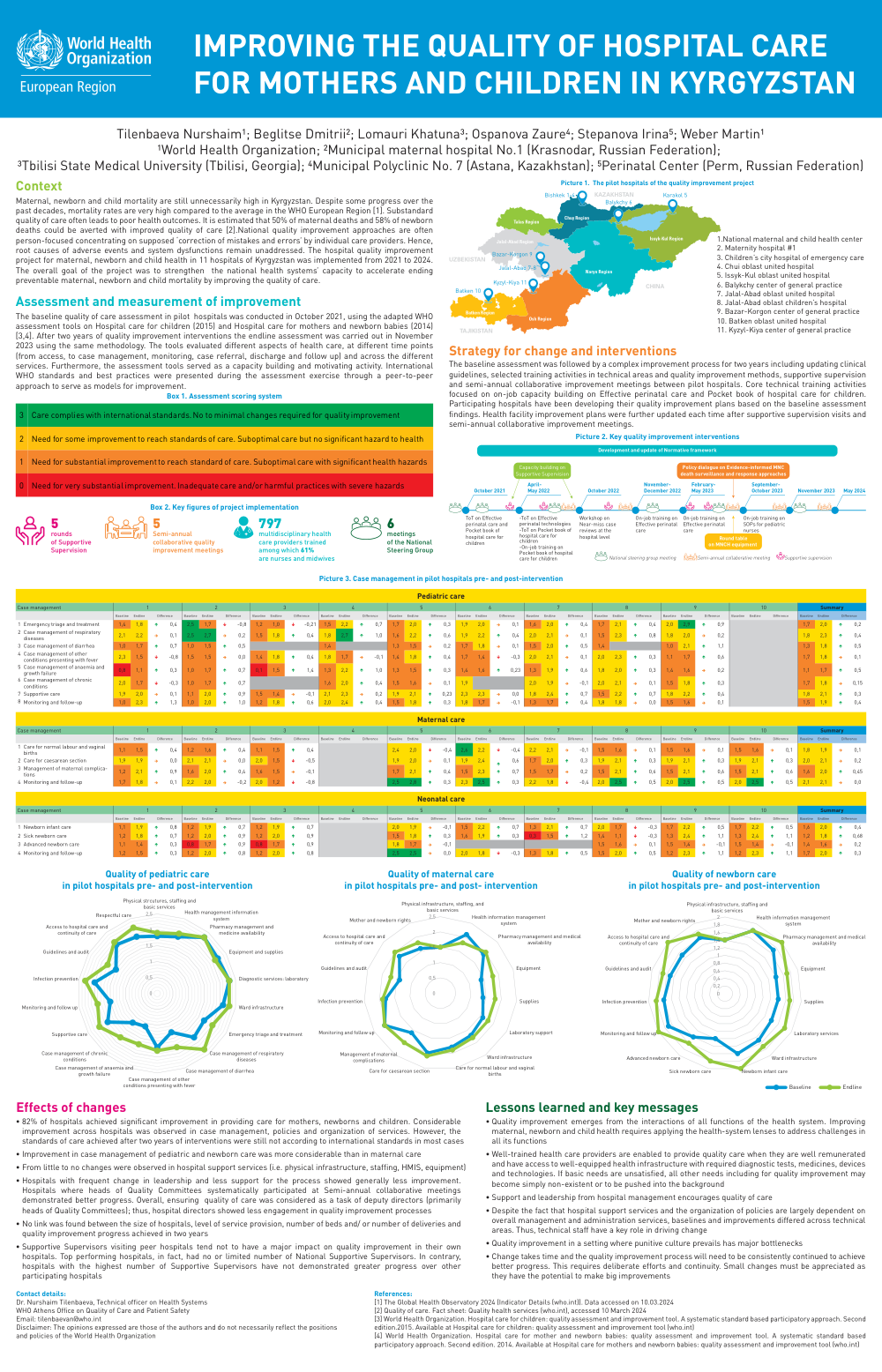
IMPROVING THE QUALITY OF HOSPITAL CARE FOR MOTHERS AND CHILDREN IN KYRGYZSTAN
Tilenbaeva Nurshaim¹; Beglitse Dmitrii²; Lomauri Khatuna³; Ospanova Zaure⁴; Stepanova Irina⁵; Weber Martin¹ ¹World Health Organization; ²Municipal maternal hospital No.1 (Krasnodar, Russian Federation); ³Tbilisi State Medical University (Tbilisi, Georgia); ⁴Municipal Polyclinic No. 7 (Astana, Kazakhstan); ⁵Perinatal Center (Perm, Russian Federation)
Context
Maternal, newborn and child mortality are still unnecessarily high in Kyrgyzstan. Despite some progress over the past decades, mortality rates are very high compared to the average in the WHO European Region [1]. Substandard quality of care often leads to poor health outcomes. It is estimated that 50% of maternal deaths and 58% of newborn deaths could be averted with improved quality of care [2].National quality improvement approaches are often person-focused concentrating on supposed ‘correction of mistakes and errors’ by individual care providers. Hence, root causes of adverse events and system dysfunctions remain unaddressed. The hospital quality improvement project for maternal, newborn and child health in 11 hospitals of Kyrgyzstan was implemented from 2021 to 2024. The overall goal of the project was to strengthen the national health systems’ capacity to accelerate ending preventable maternal, newborn and child mortality by improving the quality of care.
Assessment and measurement of improvement
The baseline quality of care assessment in pilot hospitals was conducted in October 2021, using the adapted WHO assessment tools on Hospital care for children (2015) and Hospital care for mothers and newborn babies (2014) [3,4]. After two years of quality improvement interventions the endline assessment was carried out in November 2023 using the same methodology. The tools evaluated different aspects of health care, at different time points (from access, to case management, monitoring, case referral, discharge and follow up) and across the different services. Furthermore, the assessment tools served as a capacity building and motivating activity. International WHO standards and best practices were presented during the assessment exercise through a peer-to-peer approach to serve as models for improvement.
Strategy for change and interventions
The baseline assessment was followed by a complex improvement process for two years including updating clinical guidelines, selected training activities in technical areas and quality improvement methods, supportive supervision and semi-annual collaborative improvement meetings between pilot hospitals. Core technical training activities focused on on-job capacity building on Effective perinatal care and Pocket book of hospital care for children. Participating hospitals have been developing their quality improvement plans based on the baseline assessment findings. Health facility improvement plans were further updated each time after supportive supervision visits and semi-annual collaborative improvement meetings.
Effects of change
82% of hospitals achieved significant improvement in providing care for mothers, newborns and children. Considerable improvement across hospitals was observed in case management, policies and organization of services. However, the standards of care achieved after two years of interventions were still not according to international standards in most cases • Improvement in case management of pediatric and newborn care was more considerable than in maternal care • From little to no changes were observed in hospital support services (i.e. physical infrastructure, staffing, HMIS, equipment) • Hospitals with frequent change in leadership and less support for the process showed generally less improvement. Hospitals where heads of Quality Committees systematically participated at Semi-annual collaborative meetings demonstrated better progress. Overall, ensuring quality of care was considered as a task of deputy directors (primarily heads of Quality Committees); thus, hospital directors showed less engagement in quality improvement processes • No link was found between the size of hospitals, level of service provision, number of beds and/ or number of deliveries and quality improvement progress achieved in two years • Supportive Supervisors visiting peer hospitals tend not to have a major impact on quality improvement in their own hospitals. Top performing hospitals, in fact, had no or limited number of National Supportive Supervisors. In contrary, hospitals with the highest number of Supportive Supervisors have not demonstrated greater progress over other participating hospitals
Lessons learned and key messages
Quality improvement emerges from the interactions of all functions of the health system. Improving maternal, newborn and child health requires applying the health-system lenses to address challenges in all its functions • Well-trained health care providers are enabled to provide quality care when they are well remunerated and have access to well-equipped health infrastructure with required diagnostic tests, medicines, devices and technologies. If basic needs are unsatisfied, all other needs including for quality improvement may become simply non-existent or to be pushed into the background • Support and leadership from hospital management encourages quality of care • Despite the fact that hospital support services and the organization of policies are largely dependent on overall management and administration services, baselines and improvements differed across technical areas. Thus, technical staff have a key role in driving change • Quality improvement in a setting where punitive culture prevails has major bottlenecks • Change takes time and the quality improvement process will need to be consistently continued to achieve better progress. This requires deliberate efforts and continuity. Small changes must be appreciated as they have the potential to make big improvements
References
[1] The Global Health Observatory 2024 (Indicator Details (who.int)). Data accessed on 10.03.2024 [2] Quality of care. Fact sheet: Quality health services (who.int), accessed 10 March 2024 [3] World Health Organization. Hospital care for children: quality assessment and improvement tool. A systematic standard based participatory approach. Second edition.2015. Available at Hospital care for children: quality assessment and improvement tool (who.int) [4] World Health Organization. Hospital care for mother and newborn babies: quality assessment and improvement tool. A systematic standard based participatory approach. Second edition. 2014. Available at Hospital care for mothers and newborn babies: quality assessment and improvement tool (who.int)