586 posters, 8 topics, 23 sessions, 1,077 authors, 622 institutions
ePostersLive by SciGen Technologies S.A. All rights reserved.
ISQua's 40th International Conference 2024
24th - 27th September 2024 | Istanbul, Türkiye

ISQUA2024-ABS-2691
To Determine Nurses' Attitudes Towards Convicted Patients
Poster Presenter
Part of Topic
Patient Safety & Quality Improvement
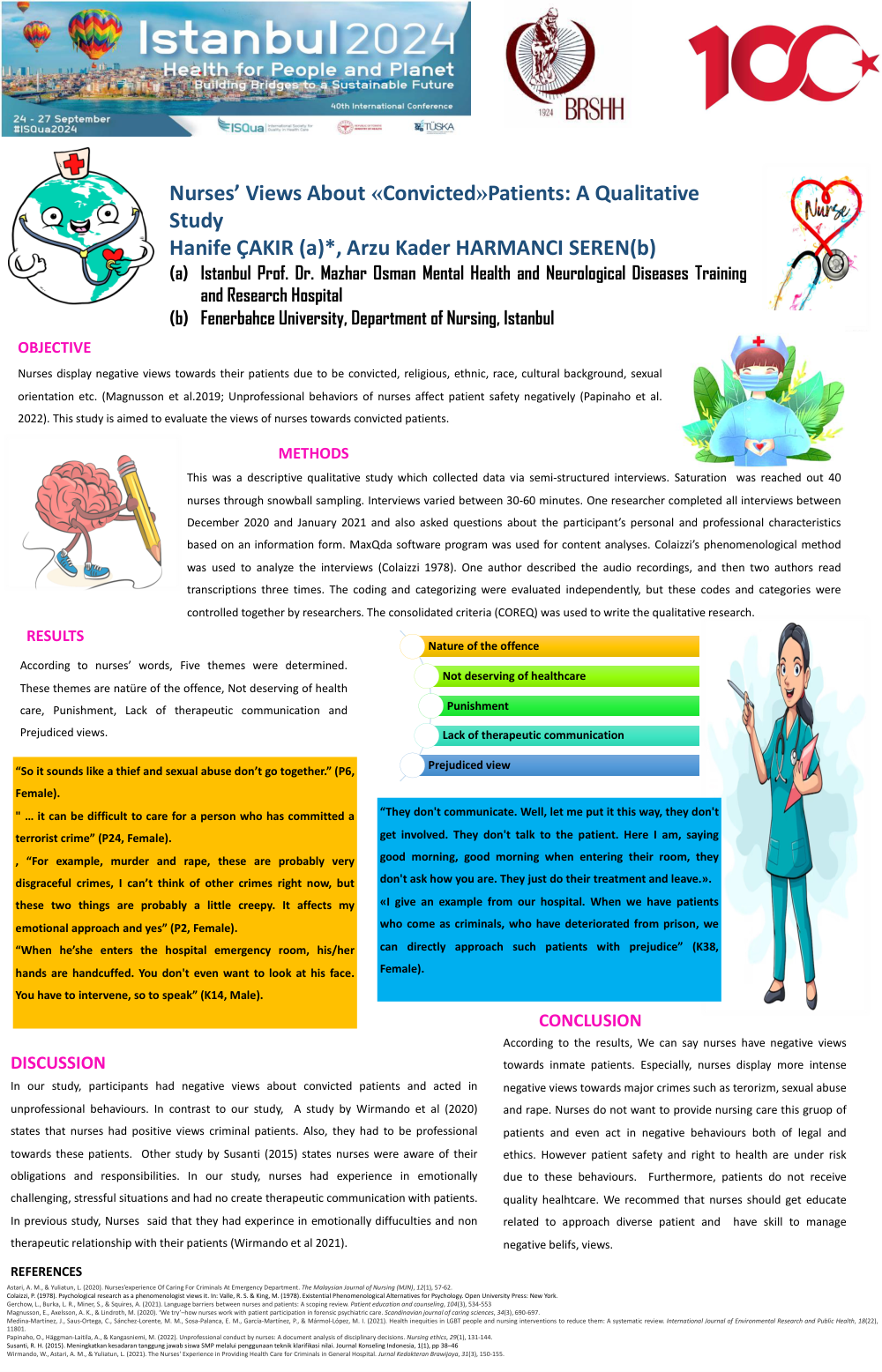
Nurses’ Views About «Convicted»Patients: A Qualitative Study
OBJECTIVE
Nurses display negative views towards their patients due to be convicted, religious, ethnic, race, cultural background, sexual orientation etc. (Magnusson et al.2019; Unprofessional behaviors of nurses affect patient safety negatively (Papinaho et al. 2022). This study is aimed to evaluate the views of nurses towards convicted patients.
METHODS
This was a descriptive qualitative study which collected data via semi-structured interviews. Saturation was reached out 40 nurses through snowball sampling. Interviews varied between 30-60 minutes. One researcher completed all interviews between December 2020 and January 2021 and also asked questions about the participant’s personal and professional characteristics based on an information form. MaxQda software program was used for content analyses. Colaizzi’s phenomenological method was used to analyze the interviews (Colaizzi 1978). One author described the audio recordings, and then two authors read transcriptions three times. The coding and categorizing were evaluated independently, but these codes and categories were controlled together by researchers. The consolidated criteria (COREQ) was used to write the qualitative research.
RESULTS
According to nurses’ words, Five themes were determined. These themes are natüre of the offence, Not deserving of health care, Punishment, Lack of therapeutic communication and Prejudiced views.
“So it sounds like a thief and sexual abuse don’t go together.” (P6, Female).
" … it can be difficult to care for a person who has committed a terrorist crime” (P24, Female).
, “For example, murder and rape, these are probably very disgraceful crimes, I can’t think of other crimes right now, but these two things are probably a little creepy. It affects my emotional approach and yes” (P2, Female).
“When he’she enters the hospital emergency room, his/her hands are handcuffed. You don't even want to look at his face. You have to intervene, so to speak” (K14, Male).
“They don't communicate. Well, let me put it this way, they don't get involved. They don't talk to the patient. Here I am, saying good morning, good morning when entering their room, they don't ask how you are. They just do their treatment and leave.».
«I give an example from our hospital. When we have patients who come as criminals, who have deteriorated from prison, we can directly approach such patients with prejudice” (K38, Female).
DISCUSSION
In our study, participants had negative views about convicted patients and acted in unprofessional behaviours. In contrast to our study, A study by Wirmando et al (2020) states that nurses had positive views criminal patients. Also, they had to be professional towards these patients. Other study by Susanti (2015) states nurses were aware of their obligations and responsibilities. In our study, nurses had experience in emotionally challenging, stressful situations and had no create therapeutic communication with patients. In previous study, Nurses said that they had experince in emotionally diffuculties and non therapeutic relationship with their patients (Wirmando et al 2021).
CONCLUSION
According to the results, We can say nurses have negative views towards inmate patients. Especially, nurses display more intense negative views towards major crimes such as terorizm, sexual abuse and rape. Nurses do not want to provide nursing care this gruop of patients and even act in negative behaviours both of legal and ethics. However patient safety and right to health are under risk due to these behaviours. Furthermore, patients do not receive quality healhtcare. We recommed that nurses should get educate related to approach diverse patient and have skill to manage negative belifs, views.
REFERENCES
Astari, A. M., & Yuliatun, L. (2020). Nurses’experience Of Caring For Criminals At Emergency Department. The Malaysian Journal of Nursing (MJN), 12(1), 57-62.
Colaizzi, P. (1978). Psychological research as a phenomenologist views it. In: Valle, R. S. & King, M. (1978). Existential Phenomenological Alternatives for Psychology. Open University Press: New York.
Gerchow, L., Burka, L. R., Miner, S., & Squires, A. (2021). Language barriers between nurses and patients: A scoping review. Patient education and counseling, 104(3), 534-553
Magnusson, E., Axelsson, A. K., & Lindroth, M. (2020). ‘We try’–how nurses work with patient participation in forensic psychiatric care. Scandinavian journal of caring sciences, 34(3), 690-697.
Medina-Martínez, J., Saus-Ortega, C., Sánchez-Lorente, M. M., Sosa-Palanca, E. M., García-Martínez, P., & Mármol-López, M. I. (2021). Health inequities in LGBT people and nursing interventions to reduce them: A systematic review. International Journal of Environmental Research and Public Health, 18(22), 11801.
Papinaho, O., Häggman-Laitila, A., & Kangasniemi, M. (2022). Unprofessional conduct by nurses: A document analysis of disciplinary decisions. Nursing ethics, 29(1), 131-144.
Susanti, R. H. (2015). Meningkatkan kesadaran tanggung jawab siswa SMP melalui penggunaan teknik klarifikasi nilai. Journal Konseling Indonesia, 1(1), pp 38–46
Wirmando, W., Astari, A. M., & Yuliatun, L. (2021). The Nurses' Experience in Providing Health Care for Criminals in General Hospital. Jurnal Kedokteran Brawijaya, 31(3), 150-155.