586 posters, 8 topics, 23 sessions, 1,077 authors, 622 institutions
ePostersLive by SciGen Technologies S.A. All rights reserved.
ISQua's 40th International Conference 2024
24th - 27th September 2024 | Istanbul, Türkiye

ISQUA2024-ABS-2622
Enhancing Diversity in Health Research through Research Engagement Network (REN): A Hyperlocal Community- Based Approach in Northwest London (NWL)
Poster Presenter
Part of Topic
Integrated Care Communities
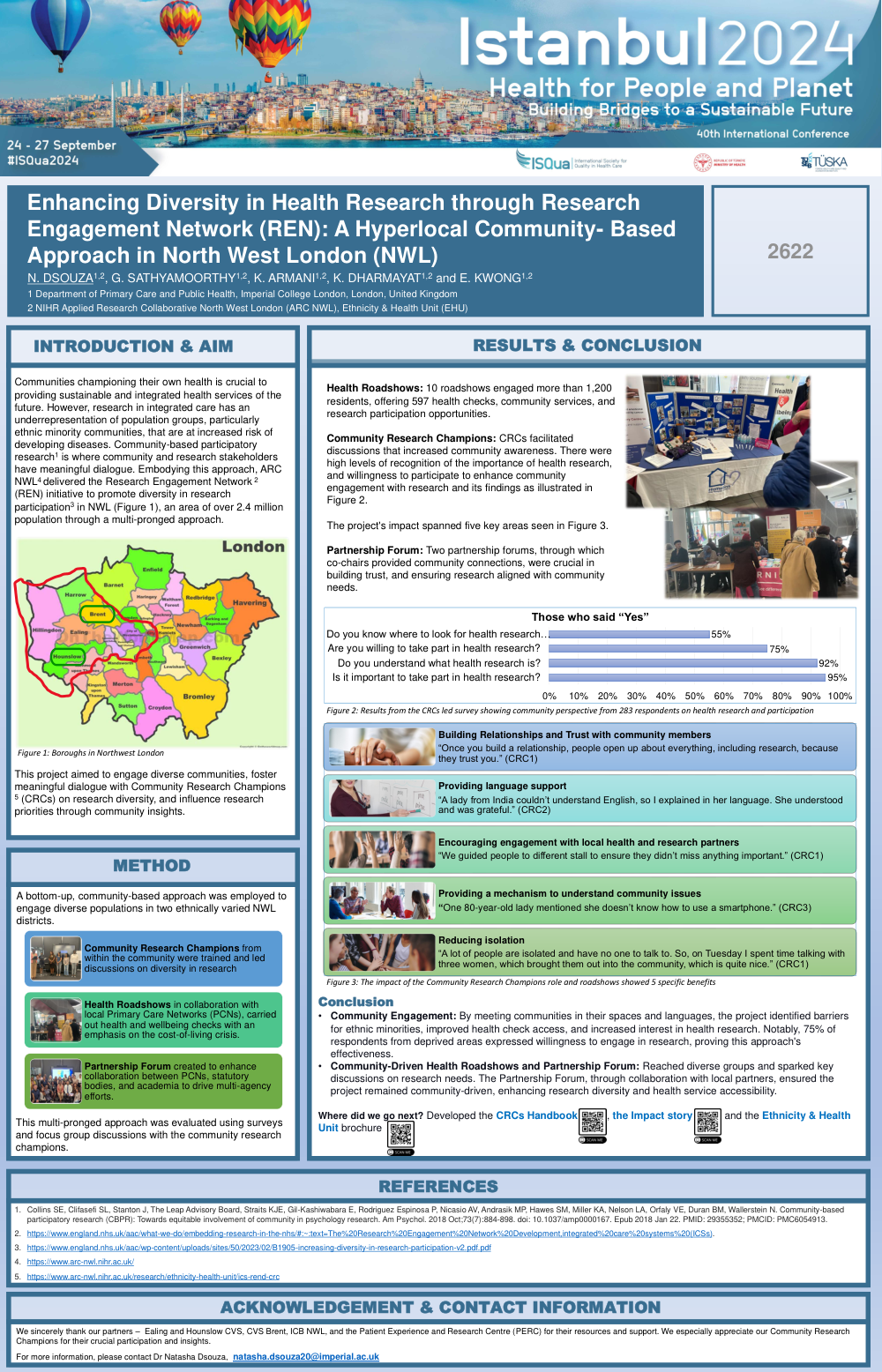
Enhancing Diversity in Health Research through Research Engagement Network (REN): A Hyperlocal Community- Based Approach in North West London (NWL)
N. DSOUZA1,2, G. SATHYAMOORTHY1,2, K. ARMANI1,2, K. DHARMAYAT1,2 and E. KWONG1,2
1 Department of Primary Care and Public Health, Imperial College London, London, United Kingdom
2 NIHR Applied Research Collaborative North West London (ARC NWL), Ethnicity & Health Unit (EHU)
Introduction & Aim
Communities championing their own health is crucial to providing sustainable and integrated health services of the future. However, research in integrated care has an underrepresentation of population groups, particularly ethnic minority communities, that are at increased risk of developing diseases. Community-based participatory research1 is where community and research stakeholders have meaningful dialogue. Embodying this approach, ARC NWL4 delivered the Research Engagement Network 2 (REN) initiative to promote diversity in research participation3 in NWL (Figure 1), an area of over 2.4 million population through a multi-pronged approach.
This project aimed to engage diverse communities, foster meaningful dialogue with Community Research Champions 5 (CRCs) on research diversity, and influence research priorities through community insights.
Method
A bottom-up, community-based approach was employed to engage diverse populations in two ethnically varied NWL districts.
1. Community Research Champions from within the community were trained and led discussions on diversity in research
2. Health Roadshows in collaboration with local Primary Care Networks (PCNs), carried out health and wellbeing checks with an emphasis on the cost-of-living crisis.
This multi-pronged approach was evaluated using surveys and focus group discussions with the community research champions.
Results & Conclusion
Health Roadshows: 10 roadshows engaged more than 1,200 residents, offering 597 health checks, community services, and research participation opportunities.
Community Research Champions: CRCs facilitated discussions that increased community awareness. There were high levels of recognition of the importance of health research, and willingness to participate to enhance community engagement with research and its findings as illustrated in Figure 2.
The project's impact spanned five key areas seen in Figure 3.
Partnership Forum: Two partnership forums, through which co-chairs provided community connections, were crucial in building trust, and ensuring research aligned with community needs.
Conclusion
Where did we go next? Developed the CRCs Handbook, the Impact story and the Ethnicity & Health Unit brochure