586 posters, 8 topics, 23 sessions, 1,077 authors, 622 institutions
ePostersLive by SciGen Technologies S.A. All rights reserved.
ISQua's 40th International Conference 2024
24th - 27th September 2024 | Istanbul, Türkiye

ISQUA2024-ABS-2557
Validating rates of nursing-sensitive adverse events in administrative healthcare data in Ireland: A retrospective chart review study
Poster Presenter
Authors
Affiliations
Part of Topic
Patient Safety & Quality Improvement
Validating rates of nursing-sensitive adverse events in administrative healthcare data in Ireland: A retrospective chart review study
Anna Connolly1 , Maria Unbeck2 , Fiachra Bane 3 , Kasia Bail 4 , Margaret Craig 1 , Anne Matthews 1 , Anthony Staines 1 , Marcia Kirwan 1 1School of Nursing, Psychotherapy and Community Health, Dublin City University, Ireland 2School of Health and Welfare, Dalarna University, Sweden 3Healthcare Pricing Office, Dublin, Ireland 4 Department of Nursing and Midwifery, University of Canberra, Australia
Introduction
Adverse events (AEs) present an ongoing patient safety challenge for health systems. They are disproportionately experienced by patients aged over 65 given the complexity of their care due to co-morbidities and emergency admissions. Pneumonia, urinary tract infections, pressure ulcers and delirium, known collectively as failure to maintain (F2M) events, commonly occur in older patients when the demand for nursing care exceeds supply (Bail and Grealish, 2016). Hospital in-patient enquiry (HIPE) data, Ireland’s primary source of information on hospital discharges, is used to inform the planning, provision and measurement of acute hospital services. Accurate monitoring and measurement of AEs is key to improving patient safety and healthcare quality and reducing the economic and human cost of these events. Retrospective chart reviews are commonly used to validate administrative healthcare data as medical charts are often considered a gold standard source of patient information (Vassar and Holzmann, 2013).
Objectives
To determine prevalence of F2M events in older adults in Ireland. To quantify the rates of F2M events in HIPE data in one model 4 hospital in Ireland. To validate F2M event rates by comparing the chart review findings to HIPE data.
Methodology
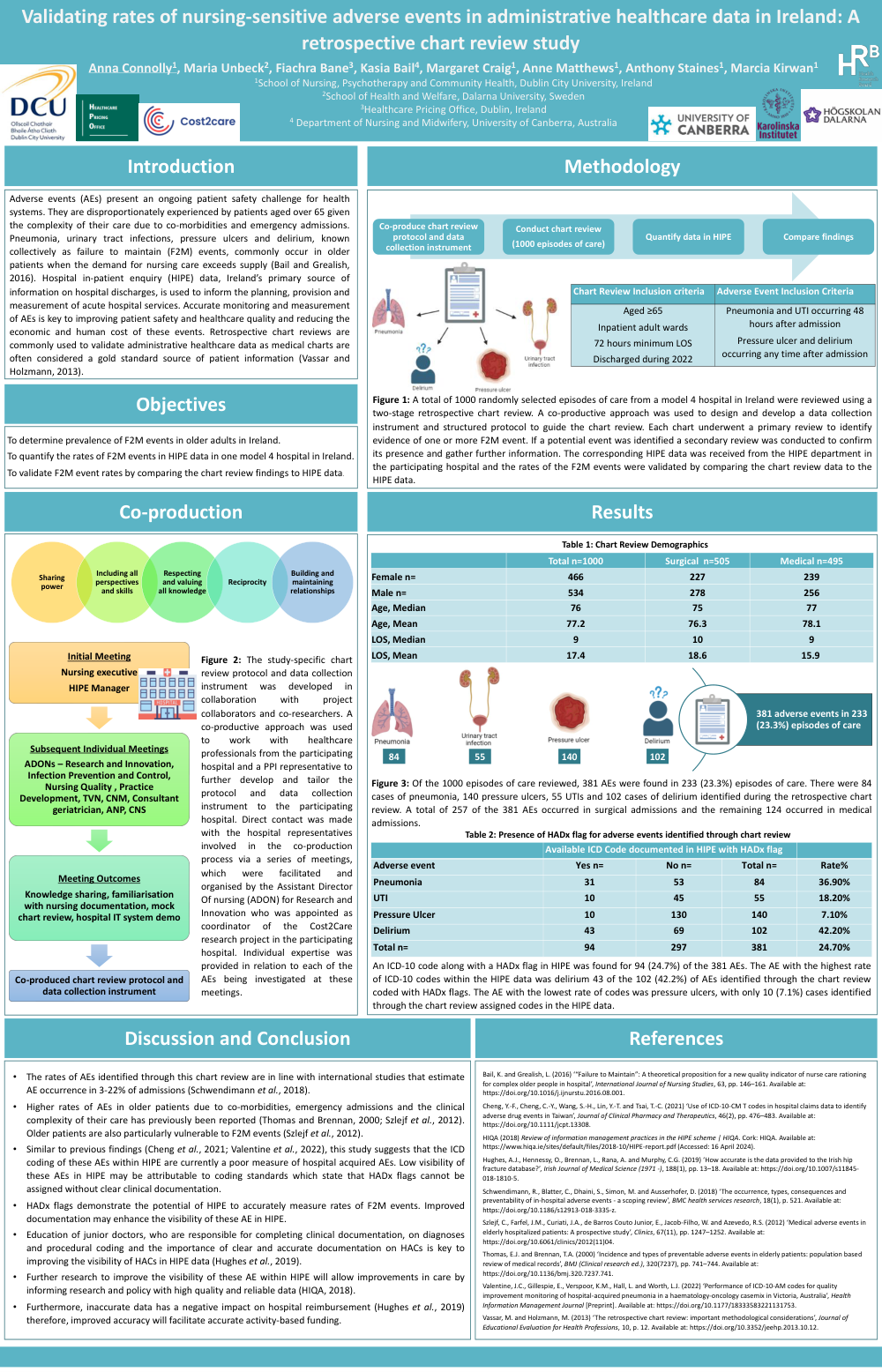
A total of 1000 randomly selected episodes of care from a model 4 hospital in Ireland were reviewed using a two-stage retrospective chart review. A co-productive approach was used to design and develop a data collection instrument and structured protocol to guide the chart review. Each chart underwent a primary review to identify evidence of one or more F2M event. If a potential event was identified a secondary review was conducted to confirm its presence and gather further information. The corresponding HIPE data was received from the HIPE department in the participating hospital and the rates of the F2M events were validated by comparing the chart review data to the HIPE data.
Co-production
The study-specific chart review protocol and data collection instrument was developed in collaboration with project collaborators and co-researchers. A co-productive approach was used to work with healthcare professionals from the participating hospital and a PPI representative to further develop and tailor the protocol and data collection instrument to the participating hospital. Direct contact was made with the hospital representatives involved in the co-production process via a series of meetings, which were facilitated and organised by the Assistant Director Of nursing (ADON) for Research and Innovation who was appointed as coordinator of the Cost2Care research project in the participating hospital. Individual expertise was provided in relation to each of the AEs being investigated at these meetings.
Results
Of the 1000 episodes of care reviewed, 381 AEs were found in 233 (23.3%) episodes of care. There were 84 cases of pneumonia, 140 pressure ulcers, 55 UTIs and 102 cases of delirium identified during the retrospective chart review. A total of 257 of the 381 AEs occurred in surgical admissions and the remaining 124 occurred in medical admissions.
An ICD-10 code along with a HADx flag in HIPE was found for 94 (24.7%) of the 381 AEs. The AE with the highest rate of ICD-10 codes within the HIPE data was delirium 43 of the 102 (42.2%) of AEs identified through the chart review coded with HADx flags. The AE with the lowest rate of codes was pressure ulcers, with only 10 (7.1%) cases identified through the chart review assigned codes in the HIPE data.
Discussion and Conclusion
References
Bail, K. and Grealish, L. (2016) ‘“Failure to Maintain”: A theoretical proposition for a new quality indicator of nurse care rationing for complex older people in hospital’, International Journal of Nursing Studies, 63, pp. 146–161. Available at: https://doi.org/10.1016/j.ijnurstu.2016.08.001.
Cheng, Y.-F., Cheng, C.-Y., Wang, S.-H., Lin, Y.-T. and Tsai, T.-C. (2021) ‘Use of ICD-10-CM T codes in hospital claims data to identify adverse drug events in Taiwan’, Journal of Clinical Pharmacy and Therapeutics, 46(2), pp. 476–483. Available at: https://doi.org/10.1111/jcpt.13308.
HIQA (2018) Review of information management practices in the HIPE scheme | HIQA. Cork: HIQA. Available at: https://www.hiqa.ie/sites/default/files/2018-10/HIPE-report.pdf (Accessed: 16 April 2024).
Hughes, A.J., Hennessy, O., Brennan, L., Rana, A. and Murphy, C.G. (2019) ‘How accurate is the data provided to the Irish hip fracture database?’, Irish Journal of Medical Science (1971 -), 188(1), pp. 13–18. Available at: https://doi.org/10.1007/s11845-018-1810-5.
Schwendimann, R., Blatter, C., Dhaini, S., Simon, M. and Ausserhofer, D. (2018) ‘The occurrence, types, consequences and preventability of in-hospital adverse events - a scoping review’, BMC health services research, 18(1), p. 521. Available at: https://doi.org/10.1186/s12913-018-3335-z.
Szlejf, C., Farfel, J.M., Curiati, J.A., de Barros Couto Junior, E., Jacob-Filho, W. and Azevedo, R.S. (2012) ‘Medical adverse events in elderly hospitalized patients: A prospective study’, Clinics, 67(11), pp. 1247–1252. Available at: https://doi.org/10.6061/clinics/2012(11)04.
Thomas, E.J. and Brennan, T.A. (2000) ‘Incidence and types of preventable adverse events in elderly patients: population based review of medical records’, BMJ (Clinical research ed.), 320(7237), pp. 741–744. Available at: https://doi.org/10.1136/bmj.320.7237.741.
Valentine, J.C., Gillespie, E., Verspoor, K.M., Hall, L. and Worth, L.J. (2022) ‘Performance of ICD-10-AM codes for quality improvement monitoring of hospital-acquired pneumonia in a haematology-oncology casemix in Victoria, Australia’, Health Information Management Journal [Preprint]. Available at: https://doi.org/10.1177/18333583221131753.
Vassar, M. and Holzmann, M. (2013) ‘The retrospective chart review: important methodological considerations’, Journal of Educational Evaluation for Health Professions, 10, p. 12. Available at: https://doi.org/10.3352/jeehp.2013.10.12.