586 posters, 8 topics, 23 sessions, 1,077 authors, 622 institutions
ePostersLive by SciGen Technologies S.A. All rights reserved.
ISQua's 40th International Conference 2024
24th - 27th September 2024 | Istanbul, Türkiye

ISQUA2024-ABS-2540
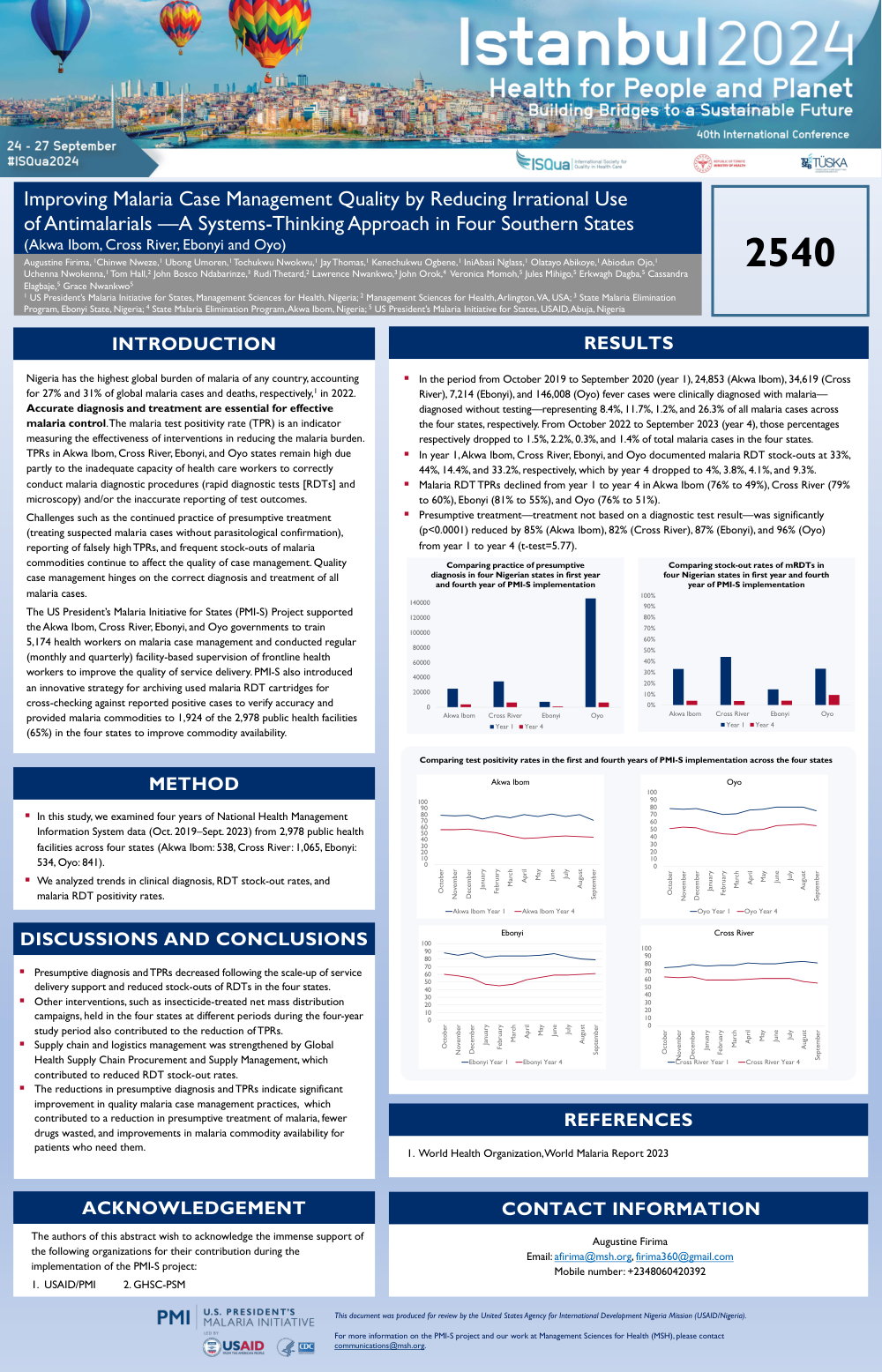
Improving malaria case management quality by reducing irrational use of antimalarials - A systems thinking approach in four southern states (Akwa Ibom, Cross River, Ebonyi, and Oyo) in Nigeria
Poster Presenter
Authors
Augustine Firima, Chinwe Nweze, Ubong Umoren, Tochukwu Nwokwu, Jay Thomas, Kenechukwu Ogbene, IniAbasi Nglass, Olatayo Abikoye, Abiodun Ojo, Uchenna Nwokenna, Thomas Hall, John Bosco Ndabarinze, Rudi Thetard, Lawrence Nwankwo, John Orok, Veronica Momoh, Jules Mihigo, Erkwagh Dagba, Grace Nwankwo, Cassandra Elagbaje
Affiliations
US President’s Malaria Initiative for States, Management Sciences for Health, Nigeria, Management Sciences for Health, USA, State Malaria Elimination Program, Ebonyi State, Nigeria, State Malaria Elimination Program, Akwa Ibom State, Nigeria, US President’s Malaria Initiative for States, USAID, Nigeria
Part of Topic
Patient Safety & Quality Improvement
Nigeria has the highest global burden of malaria of any country, accounting
for 27% and 31% of global malaria cases and deaths, respectively,1 in 2022.
Accurate diagnosis and treatment are essential for effective
malaria control. The malaria test positivity rate (TPR) is an indicator
measuring the effectiveness of interventions in reducing the malaria burden.
TPRs in Akwa Ibom, Cross River, Ebonyi, and Oyo states remain high due
partly to the inadequate capacity of health care workers to correctly
conduct malaria diagnostic procedures (rapid diagnostic tests [RDTs] and
microscopy) and/or the inaccurate reporting of test outcomes.
Challenges such as the continued practice of presumptive treatment
(treating suspected malaria cases without parasitological confirmation),
reporting of falsely high TPRs, and frequent stock-outs of malaria
commodities continue to affect the quality of case management. Quality
case management hinges on the correct diagnosis and treatment of all
malaria cases.
The US President’s Malaria Initiative for States (PMI-S) Project supported
the Akwa Ibom, Cross River, Ebonyi, and Oyo governments to train
5,174 health workers on malaria case management and conducted regular
(monthly and quarterly) facility-based supervision of frontline health
workers to improve the quality of service delivery. PMI-S also introduced
an innovative strategy for archiving used malaria RDT cartridges for
cross-checking against reported positive cases to verify accuracy and
provided malaria commodities to 1,924 of the 2,978 public health facilities
(65%) in the four states to improve commodity availabilit