586 posters, 8 topics, 23 sessions, 1,077 authors, 622 institutions
ePostersLive by SciGen Technologies S.A. All rights reserved.
ISQua's 40th International Conference 2024
24th - 27th September 2024 | Istanbul, Türkiye

ISQUA2024-ABS-2494
Advancing Patient Safety and Quality Education for a Sustainable Future
Poster Presenter
Authors
Affiliations
Part of Topic
Patient Safety & Quality Improvement
Advancing Patient Safety and Quality Education for a Sustainable Future
Mabel SIM1, Annabel LOH1, Farhana Abdul HATHI1, Zann FOO1, Kok Hian TAN1
1. SingHealth Duke-NUS Institute for Patient Safety & Quality (IPSQ), Singapore Health Services Pte Ltd, Singapore
1. The Patient Safety and Quality Landscape
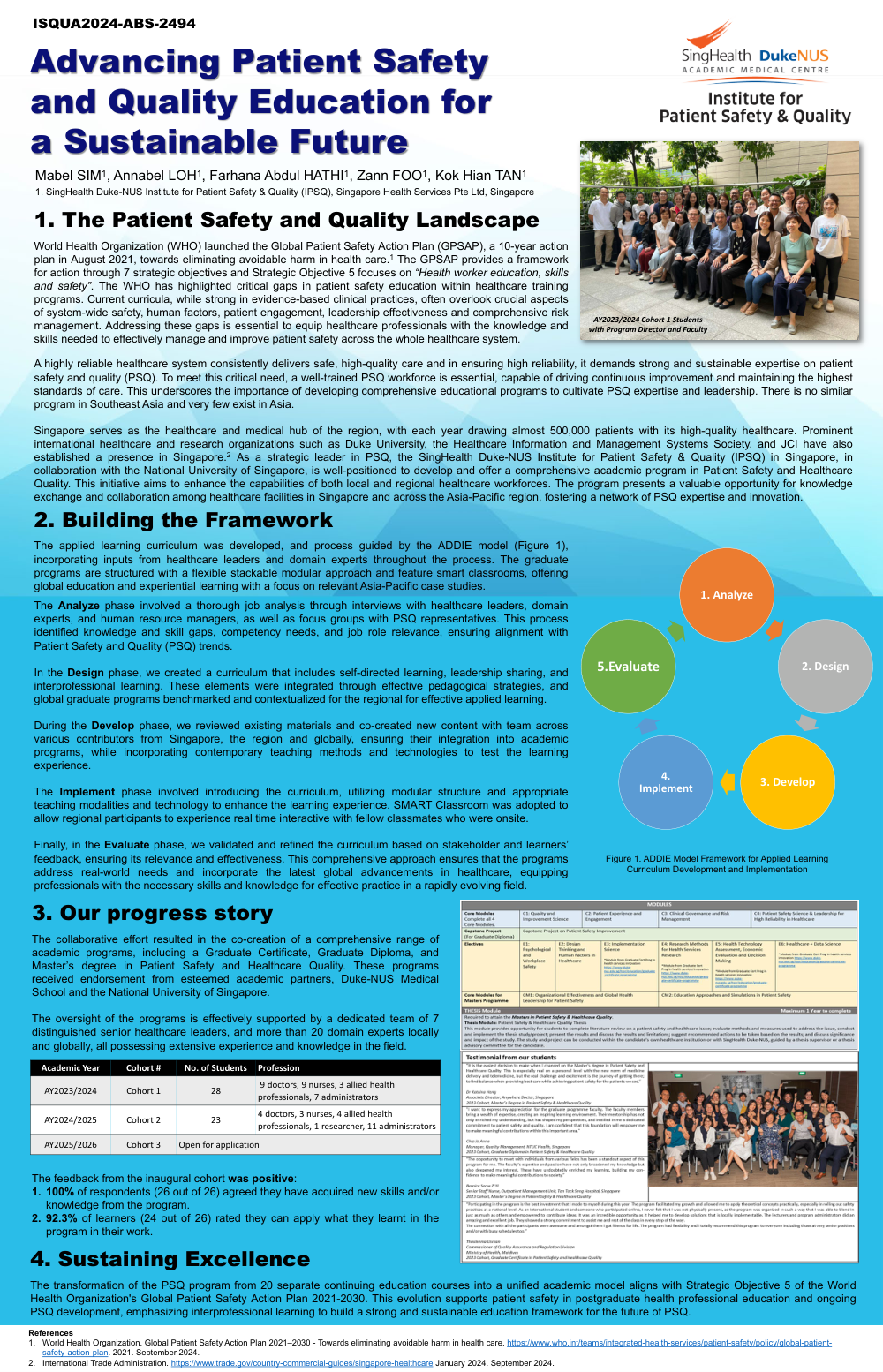
World Health Organization (WHO) launched the Global Patient Safety Action Plan (GPSAP), a 10-year action plan in August 2021, towards eliminating avoidable harm in health care.1 The GPSAP provides a framework for action through 7 strategic objectives and Strategic Objective 5 focuses on “Health worker education, skills and safety”. The WHO has highlighted critical gaps in patient safety education within healthcare training programs. Current curricula, while strong in evidence-based clinical practices, often overlook crucial aspects of system-wide safety, human factors, patient engagement, leadership effectiveness and comprehensive risk management. Addressing these gaps is essential to equip healthcare professionals with the knowledge and skills needed to effectively manage and improve patient safety across the whole healthcare system.
A highly reliable healthcare system consistently delivers safe, high-quality care and in ensuring high reliability, it demands strong and sustainable expertise on patient safety and quality (PSQ). To meet this critical need, a well-trained PSQ workforce is essential, capable of driving continuous improvement and maintaining the highest standards of care. This underscores the importance of developing comprehensive educational programs to cultivate PSQ expertise and leadership. There is no similar program in Southeast Asia and very few exist in Asia.
Singapore serves as the healthcare and medical hub of the region, with each year drawing almost 500,000 patients with its high-quality healthcare. Prominent international healthcare and research organizations such as Duke University, the Healthcare Information and Management Systems Society, and JCI have also established a presence in Singapore.2 As a strategic leader in PSQ, the SingHealth Duke-NUS Institute for Patient Safety & Quality (IPSQ) in Singapore, in collaboration with the National University of Singapore, is well-positioned to develop and offer a comprehensive academic program in Patient Safety and Healthcare Quality. This initiative aims to enhance the capabilities of both local and regional healthcare workforces. The program presents a valuable opportunity for knowledge exchange and collaboration among healthcare facilities in Singapore and across the Asia-Pacific region, fostering a network of PSQ expertise and innovation.
2. Building the Framework
The applied learning curriculum was developed, and process guided by the ADDIE model (Figure 1), incorporating inputs from healthcare leaders and domain experts throughout the process. The graduate programs are structured with a flexible stackable modular approach and feature smart classrooms, offering global education and experiential learning with a focus on relevant Asia-Pacific case studies.
The Analyze phase involved a thorough job analysis through interviews with healthcare leaders, domain experts, and human resource managers, as well as focus groups with PSQ representatives. This process identified knowledge and skill gaps, competency needs, and job role relevance, ensuring alignment with Patient Safety and Quality (PSQ) trends.
In the Design phase, we created a curriculum that includes self-directed learning, leadership sharing, and interprofessional learning. These elements were integrated through effective pedagogical strategies, and global graduate programs benchmarked and contextualized for the regional for effective applied learning.
During the Develop phase, we reviewed existing materials and co-created new content with team across various contributors from Singapore, the region and globally, ensuring their integration into academic programs, while incorporating contemporary teaching methods and technologies to test the learning experience.
The Implement phase involved introducing the curriculum, utilizing modular structure and appropriate teaching modalities and technology to enhance the learning experience. SMART Classroom was adopted to allow regional participants to experience real time interactive with fellow classmates who were onsite.
Finally, in the Evaluate phase, we validated and refined the curriculum based on stakeholder and learners’ feedback, ensuring its relevance and effectiveness. This comprehensive approach ensures that the programs address real-world needs and incorporate the latest global advancements in healthcare, equipping professionals with the necessary skills and knowledge for effective practice in a rapidly evolving field.
3. Our progress story
The collaborative effort resulted in the co-creation of a comprehensive range of academic programs, including a Graduate Certificate, Graduate Diploma, and Master’s degree in Patient Safety and Healthcare Quality. These programs received endorsement from esteemed academic partners, Duke-NUS Medical School and the National University of Singapore.
The oversight of the programs is effectively supported by a dedicated team of 7 distinguished senior healthcare leaders, and more than 20 domain experts locally and globally, all possessing extensive experience and knowledge in the field.
The feedback from the inaugural cohort was positive:
4. Sustaining Excellence
The transformation of the PSQ program from 20 separate continuing education courses into a unified academic model aligns with Strategic Objective 5 of the World Health Organization's Global Patient Safety Action Plan 2021-2030. This evolution supports patient safety in postgraduate health professional education and ongoing PSQ development, emphasizing interprofessional learning to build a strong and sustainable education framework for the future of PSQ.
References