586 posters, 8 topics, 23 sessions, 1,077 authors, 622 institutions
ePostersLive by SciGen Technologies S.A. All rights reserved.
ISQua's 40th International Conference 2024
24th - 27th September 2024 | Istanbul, Türkiye

ISQUA2024-ABS-2417
The burden of potential drug-drug interactions in a large tertiary care teaching hospital in rural India and suggested interventions
Poster Presenter
Authors
Affiliations
Part of Topic
Patient Safety & Quality Improvement
The burden of potential drug-drug interactions in a large tertiary care teaching hospital in rural India and suggested interventions
Pratheesh Ravindran* 1 , Kavitha Arumugam1 , Hemapriyadarshini Kandeeban1 , Johan Pandian2 , Priyadharshini Kulanchiappan1 , Ezhumalai G3
1Quality Management Services, 2Pharmacology, Mahatma Gandhi Medical College and Research Institute, Sri Balaji Vidyapeeth University,
3Biostatistics, Sri Balaji Vidyapeeth University, Pondicherry, India
Abstract
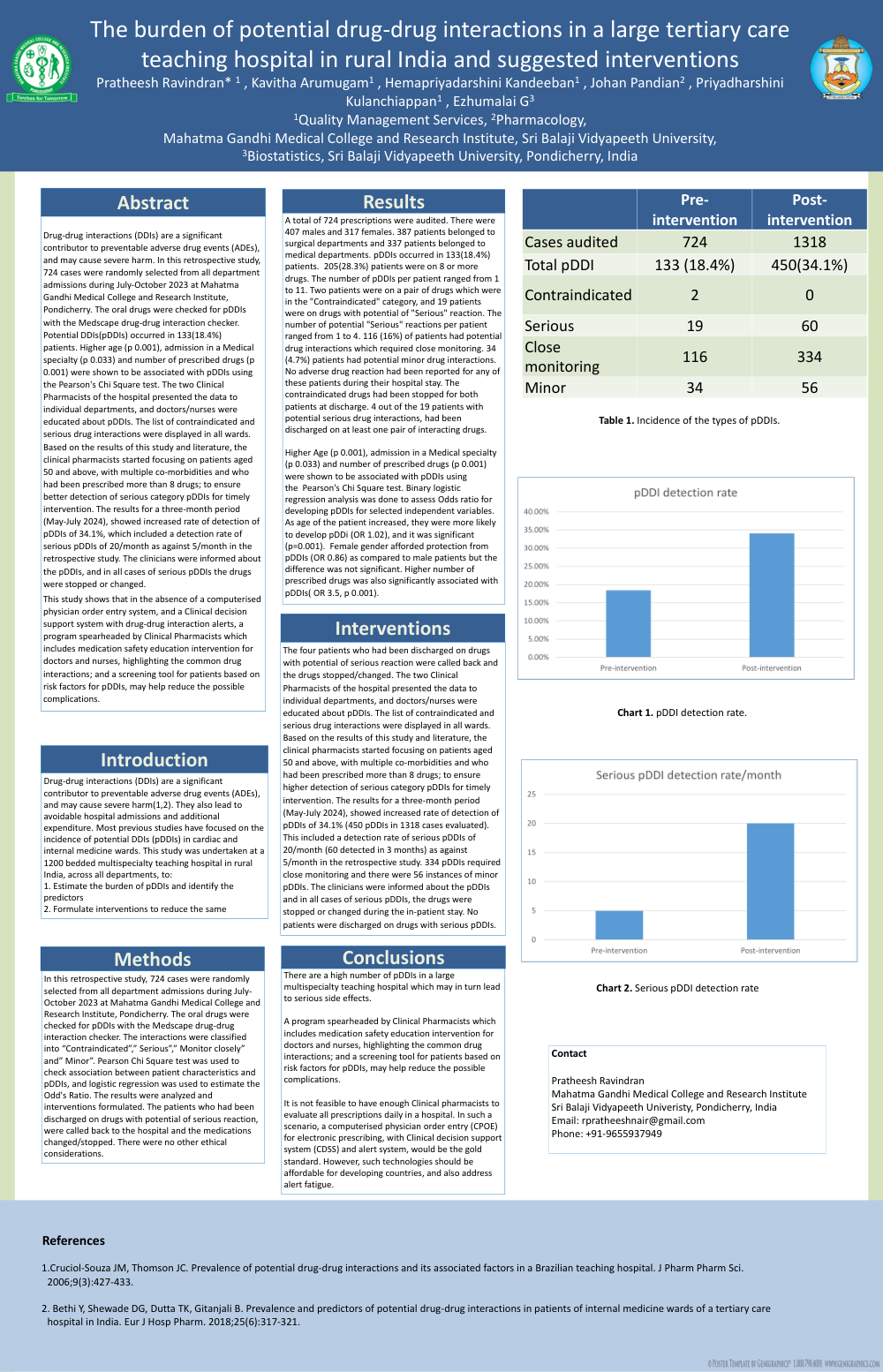
Drug-drug interactions (DDIs) are a significant contributor to preventable adverse drug events (ADEs), and may cause severe harm. In this retrospective study, 724 cases were randomly selected from all department admissions during July-October 2023 at Mahatma Gandhi Medical College and Research Institute, Pondicherry. The oral drugs were checked for pDDIs with the Medscape drug-drug interaction checker. Potential DDIs(pDDIs) occurred in 133(18.4%) patients. Higher age (p 0.001), admission in a Medical specialty (p 0.033) and number of prescribed drugs (p 0.001) were shown to be associated with pDDIs using the Pearson's Chi Square test. The two Clinical Pharmacists of the hospital presented the data to individual departments, and doctors/nurses were educated about pDDIs. The list of contraindicated and serious drug interactions were displayed in all wards. Based on the results of this study and literature, the clinical pharmacists started focusing on patients aged 50 and above, with multiple co-morbidities and who had been prescribed more than 8 drugs; to ensure better detection of serious category pDDIs for timely intervention. The results for a three-month period (May-July 2024), showed increased rate of detection of pDDIs of 34.1%, which included a detection rate of serious pDDIs of 20/month as against 5/month in the retrospective study. The clinicians were informed about the pDDIs, and in all cases of serious pDDIs the drugs were stopped or changed.
This study shows that in the absence of a computerised physician order entry system, and a Clinical decision support system with drug-drug interaction alerts, a program spearheaded by Clinical Pharmacists which includes medication safety education intervention for doctors and nurses, highlighting the common drug interactions; and a screening tool for patients based on risk factors for pDDIs, may help reduce the possible complications.
Introduction
Drug-drug interactions (DDIs) are a significant contributor to preventable adverse drug events (ADEs), and may cause severe harm(1,2). They also lead to avoidable hospital admissions and additional expenditure. Most previous studies have focused on the incidence of potential DDIs (pDDIs) in cardiac and internal medicine wards. This study was undertaken at a 1200 bedded multispecialty teaching hospital in rural India, across all departments, to:
1. Estimate the burden of pDDIs and identify the predictors
2. Formulate interventions to reduce the same
Methods
In this retrospective study, 724 cases were randomly selected from all department admissions during July-October 2023 at Mahatma Gandhi Medical College and Research Institute, Pondicherry. The oral drugs were checked for pDDIs with the Medscape drug-drug interaction checker. The interactions were classified into “Contraindicated”,” Serious”,” Monitor closely” and” Minor”. Pearson Chi Square test was used to check association between patient characteristics and pDDIs, and logistic regression was used to estimate the Odd's Ratio. The results were analyzed and interventions formulated. The patients who had been discharged on drugs with potential of serious reaction, were called back to the hospital and the medications changed/stopped. There were no other ethical considerations.
Results
A total of 724 prescriptions were audited. There were 407 males and 317 females. 387 patients belonged to surgical departments and 337 patients belonged to medical departments. pDDIs occurred in 133(18.4%) patients. 205(28.3%) patients were on 8 or more drugs. The number of pDDIs per patient ranged from 1 to 11. Two patients were on a pair of drugs which were in the "Contraindicated" category, and 19 patients were on drugs with potential of "Serious" reaction. The number of potential "Serious" reactions per patient ranged from 1 to 4. 116 (16%) of patients had potential drug interactions which required close monitoring. 34 (4.7%) patients had potential minor drug interactions. No adverse drug reaction had been reported for any of these patients during their hospital stay. The contraindicated drugs had been stopped for both patients at discharge. 4 out of the 19 patients with potential serious drug interactions, had been discharged on at least one pair of interacting drugs.
Higher Age (p 0.001), admission in a Medical specialty (p 0.033) and number of prescribed drugs (p 0.001) were shown to be associated with pDDIs using the Pearson's Chi Square test. Binary logistic regression analysis was done to assess Odds ratio for developing pDDIs for selected independent variables. As age of the patient increased, they were more likely to develop pDDi (OR 1.02), and it was significant (p=0.001). Female gender afforded protection from pDDIs (OR 0.86) as compared to male patients but the difference was not significant. Higher number of prescribed drugs was also significantly associated with pDDIs( OR 3.5, p 0.001).
Interventions
The four patients who had been discharged on drugs with potential of serious reaction were called back and the drugs stopped/changed. The two Clinical Pharmacists of the hospital presented the data to individual departments, and doctors/nurses were educated about pDDIs. The list of contraindicated and serious drug interactions were displayed in all wards. Based on the results of this study and literature, the clinical pharmacists started focusing on patients aged 50 and above, with multiple co-morbidities and who had been prescribed more than 8 drugs; to ensure higher detection of serious category pDDIs for timely intervention. The results for a three-month period (May-July 2024), showed increased rate of detection of pDDIs of 34.1% (450 pDDIs in 1318 cases evaluated). This included a detection rate of serious pDDIs of 20/month (60 detected in 3 months) as against 5/month in the retrospective study. 334 pDDIs required close monitoring and there were 56 instances of minor pDDIs. The clinicians were informed about the pDDIs and in all cases of serious pDDIs, the drugs were stopped or changed during the in-patient stay. No patients were discharged on drugs with serious pDDIs.
Conclusions
There are a high number of pDDIs in a large multispecialty teaching hospital which may in turn lead to serious side effects.
A program spearheaded by Clinical Pharmacists which includes medication safety education intervention for doctors and nurses, highlighting the common drug interactions; and a screening tool for patients based on risk factors for pDDIs, may help reduce the possible complications.
It is not feasible to have enough Clinical pharmacists to evaluate all prescriptions daily in a hospital. In such a scenario, a computerised physician order entry (CPOE) for electronic prescribing, with Clinical decision support system (CDSS) and alert system, would be the gold standard. However, such technologies should be affordable for developing countries, and also address alert fatigue.
References