708 posters, 8 topics, 16 sessions, 1,190 authors, 600 institutions
ePostersLive by SciGen Technologies S.A. All rights reserved.
ISQua's 39th International Conference 2023
August 27 - 30, 2023 | Seoul, Republic of Korea

ISQUA2023-ABS-1823
THE EFFECTS OF DAYCARE SERVICES FOR THE USERS AND CAREGIVERS
Poster Presenter
Authors
Affiliations
Part of Topic
Complexity, Emergencies, and Sustainability
The Effects of Daycare Services for the Users and Caregivers
Introduction
According to the forecast from the National Development Council, Taiwan was the aged society in 2018 and will soon become a super-aged society by 2025. There is an increased demand for long-term care (LTC) services in Taiwan because of its rapidly aging population. Aging in place is one of the most important policies nowadays for LTC services. Daycare is one type of the Community-Based Home Supportive Care (CBHSC) which provides services both for the elder and the caregiver in family. Compared with homecare or institutional care, daycare is relatively late development of LTC in Taiwan. Only few studies investigate the factors of daycare services quality for the elderly, and the lack of measurement of psychological, social, quality of services and satisfaction (Tsai, Chang, & Chan, 2015). The research aims to explore the daycare service quality from users and caregivers, in order to satisfy the users and to reach the ideal of aging in place.
Research Methods
This study takes 6 daycare centers in southern Taiwan as the main research field. The data were collected by questionnaire survey and focus group interview respectively, from the point of view of daycare service users and providers. The questionnaires were according to the principle of SERVQUAL scale, which is basic on the five gaps of PZB model (Parasuraman, Zeithaml, & Berry, 1984), and the international literatures on daycare. The questionnaire includes the basic information of participators (age, gender, education level, marital status, number of children, living conditions, disability and dementia), the content of daycare services: tangibility, reliability, responsiveness, caring and reassuring (34 questions), and the physical, psychological and social impact of participating in daycare center services on the Quality of Life (QoL) (12 questions). A convenient sampling method was adopted to conduct a structured questionnaire survey on users who had used daycare services. Then use the purposive sampling method, first inform the purpose of the research, and conduct focus group interviews with service providers to collect data. The service quality of the daycare center was evaluated based on the quality of care model of Donabedian in 1988 has 3 dimensions (Figure 1), which are structure, process and outcome, so as to provide views and practices that meet the user's perception of the care services quality. There were 5 service providers including 4 care workers and 1 nurse were interviewed and 227 valid questionnaires were received. SPSS 20.0 was used for descriptive and inferential statistical analysis.
Results
Quantitative Results
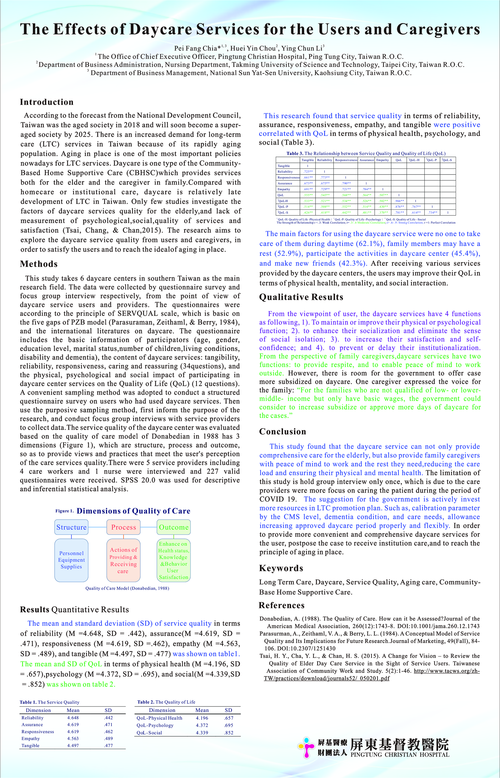
The mean and standard deviation (SD) of service quality in terms of reliability (M =4.648, SD = .442), assurance (M =4.619, SD = .471), responsiveness (M =4.619, SD = .462), empathy (M =4.563, SD = .489), and tangible (M =4.497, SD = .477) was shown on table1.The mean and SD of quality of life in terms of physical health (M =4.196, SD = .657), psychology (M =4.372, SD = .695), and social (M =4.339, SD = .852) was shown on table 2.
This research found that service quality in terms of reliability, assurance, responsiveness, empathy, and tangible of service quality were positive correlated with quality of life in terms of physical health, psychology, and social (Table 3).
The main factors for using the daycare service were no one to take care of them during daytime (62.1%), family members may have a rest (52.9%), participate the activities in daycare center (45.4%), and make new friends (42.3%). After receiving various services provided by the daycare centers, the users may improve their quality of life in terms of physical health, mentality, and social interaction.
Qualitative Results
From the viewpoint of user, the daycare services have 4 functions as following, 1). To maintain or improve their physical or psychological function; 2) to enhance their socialization and eliminate the sense of social isolation; 3) to increase their satisfaction and self-confidence; and 4) to prevent or delay their institutionalization. From the perspective of family caregivers, daycare services have two functions: to provide respite, and to enable peace of mind to work outside. However, there is room for the government to offer case more subsidized on daycare. One caregiver expressed the voice for the family: “For the families who are not qualified of low- or lower-middle- income but only have basic wages, the government could consider to increase subsidize or approve more days of daycare for the cases.”
Conclusion
This study found that the daycare service can not only provide comprehensive care for the elderly, but also provide family caregivers with peace of mind to work and the rest they need, reducing the care load and ensuring their physical and mental health. The limitation of this study is hold group interview only once, which is due to the care providers were more focus on caring the patient during the period of COVID 19. The suggestion for the government is actively invest more resources in LTC promotion plan. Such as, calibration parameter by the CMS level, dementia condition, and care needs, allowance increasing approved daycare period properly and flexibly. In order to provide more convenient and comprehensive daycare services for the user, postpose the case to receive institution care, and to reach the principle of aging in place.
References
Donabedian, A. (1988). The Quality of Care. How can it be Assessed? Journal of the American Medical Association, 260(12):1743-8. DOI: 10.1001/jama.260.12.1743
Parasurman, A., Zeithaml, V. A., & Berry, L. L. (1984). A Conceptual Model of Service Quality and Its Implications for Future Research. Journal of Marketing, 49(Fall), 84-106. DOI:10.2307/1251430
Tsai, H. Y., Cha, Y. L., & Chan, H. S. (2015). A Change for Vision – to Review the Quality of Elder Day Care Service in the Sight of Service Users. Taiwanese Association of Community Work and Study. 5(2): 1-46. http://www.tacws.org/zh-TW/practices/download/journals52/050201.pdf
Keywords: Long Term Care, Daycare, Service Quality, Aging care, Community-Base Home Supportive Care