708 posters, 8 topics, 16 sessions, 1,190 authors, 600 institutions
ePostersLive by SciGen Technologies S.A. All rights reserved.
ISQua's 39th International Conference 2023
August 27 - 30, 2023 | Seoul, Republic of Korea

ISQUA2023-ABS-3032
EFFECTS OF ANTIMICROBIAL STEWARDSHIP PROGRAM AT TERTIARY AND SECONDARY HOSPITALS IN SOUTH KOREA: AN INTERRUPTED TIME-SERIES ANALYSIS
Poster Presenter
Authors
Part of Topic
Complexity, Emergencies, and Sustainability
[Introduction]
■ With the global spread of antibiotic-resistant bacteria, WHO urges nations to address indiscriminate antibiotic use and resistance with an international action plan.
■ Antimicrobial stewardship programs (ASPs) are effective in curbing antimicrobial resistance by reducing inappropriate use.
■ In 2020, Korea’s antimicrobial consumption (21.0DDD) was higher than the OECD average (15.6DDD).
■ To promote ASP, the Korean Society of Infectious Diseases and Health Insurance Review & Assessment (HIRA) collaboratively launched the Korea National Antimicrobial Use Analysis System (KONAS).
■ The KONAS system enables hospitals to assess their data in comparison with others, fostering self-evaluation, benchmarking, and collaborative efforts to enhance stewardship.
■ In 2020, KONAS initiated a pilot project with 26 institutions; and presently, 110 tertiary and general hospitals are actively participating.
[Aim]
■ Comparing antibiotic usage trends and assess the impact of KONAS on antibiotic utilization, categorized by antibiotics type, between participating (tertiary and secondary) hospitals and non-participating ones.
[Method]
■ Utilizing national health insurance claims data for both tertiary and secondary hospitals, covering the period from January 1, 2018, to December 31, 2022. primary outcome measures in-hospital antibiotic usage, quantified as days of therapy (DOT) per 1,000 patient days.
• DOT: Cumulative days of administration of specific antimicrobial agents to individual patients.
■ To equalize antibiotic usage differences across hospitals based on their characteristics, propensity score matching(1:1) is implemented for adjustment.
■ Conducting a retrospective interrupted time series analysis with ARIMA model over a 60-month period to evaluate the antibiotic usage in participating hospitals of the KONAS system compared to non-participating hospitals.
[Result]
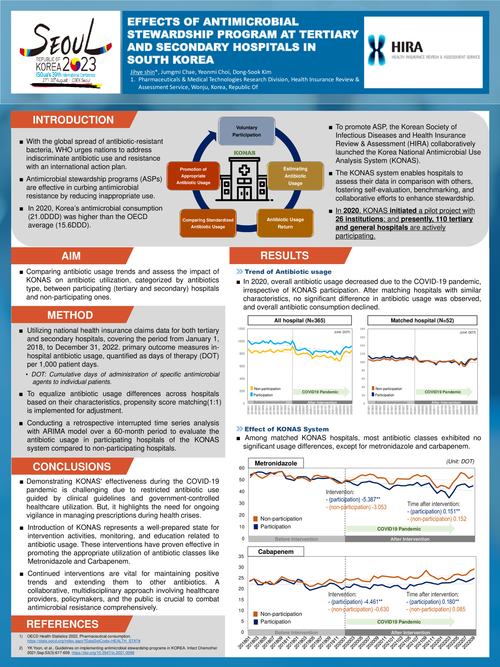
■ In 2020, overall antibiotic usage decreased due to the COVID-19 pandemic, irrespective of KONAS participation. After matching hospitals with similar characteristics, no significant difference in antibiotic usage was observed, and overall antibiotic consumption declined.
■ Among matched KONAS hospitals, most antibiotic classes exhibited no significant usage differences, except for metronidazole and carbapenem.
[Conclusion]
■ Demonstrating KONAS' effectiveness during the COVID-19 pandemic is challenging due to restricted antibiotic use guided by clinical guidelines and government-controlled healthcare utilization. But, it highlights the need for ongoing vigilance in managing prescriptions during health crises.
■ Introduction of KONAS represents a well-prepared state for intervention activities, monitoring, and education related to antibiotic usage. These interventions have proven effective in promoting the appropriate utilization of antibiotic classes like Metronidazole and Carbapenem.
■ Continued interventions are vital for maintaining positive trends and extending them to other antibiotics. A collaborative, multidisciplinary approach involving healthcare providers, policymakers, and the public is crucial to combat antimicrobial resistance comprehensively.
[Reference]
1) OECD Health Statistics 2022, Pharmaceutical consumption. https://stats.oecd.org/index.aspx?DataSetCode=HEALTH_STAT#
2) YK Yoon, et al., Guidelines on implementing antimicrobial stewardship programs in KOREA. Infect Chemother2021;Sep;53(3):617-659. https://doi.org/10.3947/ic.2021.0098