708 posters, 8 topics, 16 sessions, 1,190 authors, 600 institutions
ePostersLive by SciGen Technologies S.A. All rights reserved.
ISQua's 39th International Conference 2023
August 27 - 30, 2023 | Seoul, Republic of Korea

ISQUA2023-ABS-2200
CONTINUOUS POSITIVE AIRWAY PRESSURE (CPAP) IN PRETERM & TERM NEONATES
Part of Topic
Complexity, Emergencies, and Sustainability
Introduction
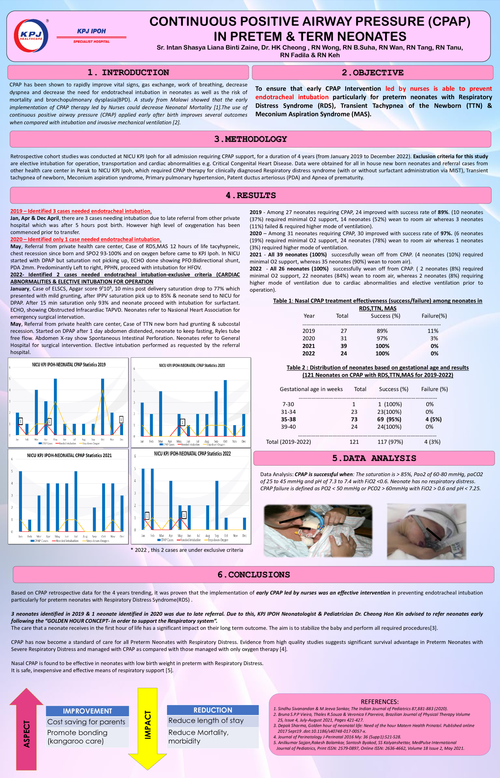
CPAP has been shown to rapidly improve vital signs, gas exchange, work of breathing, decrease dyspnea and decrease the need for endotracheal intubation in neonates as well as the risk of mortality and bronchopulmonary dysplasia(BPD). A study from Malawi showed that the early implementation of CPAP therapy led by Nurses could decrease Neonatal Mortality [1].The use of continuous positive airway pressure (CPAP) applied early after birth improves several outcomes when compared with intubation and invasive mechanical ventilation [2].
Objective
To ensure that early CPAP Intervention led by nurses is able to prevent endotracheal intubation particularly for preterm neonates with Respiratory Distress Syndrome (RDS), Transient Tachypnea of the Newborn (TTN) & Meconium Aspiration Syndrome (MAS).
Methodology
Retrospective cohort studies was conducted at NICU KPJ Ipoh for all admission requiring CPAP support, for a duration of 4 years (from January 2019 to December 2022). Exclusion criteria for this study are elective intubation for operation, transportation and cardiac abnormalities e.g. Critical Congenital Heart Disease. Data were obtained for all in house new born neonates and referral cases from other health care center in Perak to NICU KPJ Ipoh, which required CPAP therapy for clinically diagnosed Respiratory distress syndrome (with or without surfactant administration via MIST), Transient tachypnea of newborn, Meconium aspiration syndrome, Primary pulmonary hypertension, Patent ductus arteriosus (PDA) and Apnea of prematurity.
Results
2019 – Identified 3 cases needed endotracheal intubation.
Jan, Apr & Dec April, there are 3 cases needing intubation due to late referral from other private hospital which was after 5 hours post birth. However high level of oxygenation has been commenced prior to transfer.
2020 – Identified only 1 case needed endotracheal intubation.
May, Referral from private health care center, Case of RDS,MAS 12 hours of life tacyhypneic, chest recession since born and SPO2 93-100% and on oxygen before came to KPJ Ipoh. In NICU started with DPAP but saturation not picking up, ECHO done showing PFO:Bidirectional shunt, PDA 2mm. Predominantly Left to right, PPHN, proceed with intubation for HFOV.
2022- Identified 2 cases needed endotracheal intubation-exclusive criteria (CARDIAC ABNORMALITIES & ELECTIVE INTUBATION FOR OPERATION
January, Case of ELSCS, Apgar score 9¹10⁵, 10 mins post delivery saturation drop to 77% which presented with mild grunting, after IPPV saturation pick up to 85% & neonate send to NICU for DPAP. After 15 min saturation only 93% and neonate proceed with intubation for surfactant. ECHO, showing Obstructed Infracardiac TAPVD. Neonates refer to Nasional Heart Association for emergency surgical intervation.
May, Referral from private health care center, Case of TTN new born had grunting & subcostal recession. Started on DPAP after 1 day abdomen distended, neonate to keep fasting, Ryles tube free flow. Abdomen X-ray show Spontaneous Intestinal Perforation. Neonates refer to General Hospital for surgical intervention. Elective intubation performed as requested by the referral hospital.
Data Analysis
Data Analysis: CPAP is successful when: The saturation is > 85%, Pao2 of 60-80 mmHg, paCO2 of 25 to 45 mmHg and pH of 7.3 to 7.4 with FiO2 <0.6. Neonate has no respiratory distress. CPAP failure is defined as PO2 < 50 mmHg or PCO2 > 60mmHg with FiO2 > 0.6 and pH < 7.25.
Conclusions
Based on CPAP retrospective data for the 4 years trending, it was proven that the implementation of early CPAP led by nurses was an effective intervention in preventing endotracheal intubation particularly for preterm neonates with Respiratory Distress Syndrome(RDS) .
3 neonates identified in 2019 &1 neonate identified in 2020 was due to late referral. Due to this, KPJ IPOH Neonatologist & Pediatrician Dr. Cheong Hon Kin advised to refer neonates early following the “GOLDEN HOUR CONCEPT- in order to support the Respiratory system”.
The care that a neonate receives in the first hour of life has a significant impact on their long term outcome. The aim is to stabilize the baby and perform all required procedures[3].
CPAP has now become a standard of care for all Preterm Neonates with Respiratory Distress. Evidence from high quality studies suggests significant survival advantage in Preterm Neonates with Severe Respiratory Distress and managed with CPAP as compared with those managed with only oxygen therapy [4].
Nasal CPAP is found to be effective in neonates with low birth weight in preterm with Respiratory Distress.
It is safe, inexpensive and effective means of respiratory support [5].
Aspect: Improvement
1) Cost saving for parents
2) Promote bonding (kangaroo care)
Impact: Reduction
1) Reduce length of stay
2) Reduce Mortality, morbidity
References
1. Sindhu Sivanandan & M Jeeva Sankar, The Indian Journal of Pediatrics 87,881-883 (2020).
2. Bruna S.P.P Vieira, Thales R.Souza & Veronica F.Parreira, Brazilian Journal of Physical Therapy Volume
25, Issue 4, July-August 2021, Pages 421-427.
3. Depak Sharma, Golden hour of neonatal life: Need of the hour Matern Health Prinatol. Published online
2017 Sept19 .dot:10.1186/s40748-017-0057-x.
4. Journal of Perinatology J-Perinatal 2016 My: 36 (Supp1):S21-S28.
5. Anilkumar Sajjan,Rakesh Balamkar, Santosh Byakod, SS Kalyanshettar, MedPulse International
Journal of Pediatrics, Print ISSN: 2579-0897, Online ISSN: 2636-4662, Volume 18 Issue 2, May 2021.