708 posters, 8 topics, 16 sessions, 1,190 authors, 600 institutions
ePostersLive by SciGen Technologies S.A. All rights reserved.
ISQua's 39th International Conference 2023
August 27 - 30, 2023 | Seoul, Republic of Korea

ISQUA2023-ABS-2019
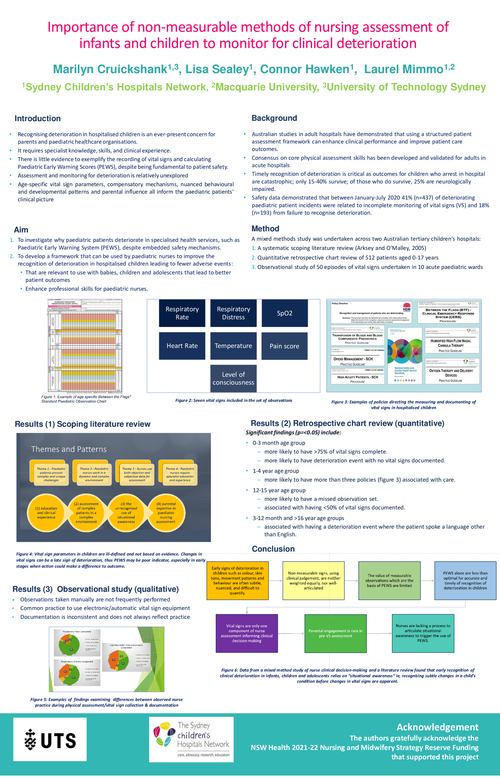
IMPORTANCE OF NON-MEASURABLE METHODS OF NURSING ASSESSMENT OF INFANTS AND CHILDREN TO MONITOR FOR CLINICAL DETERIORATION
Poster Presenter
Authors
Affiliations
Part of Topic
Complexity, Emergencies, and Sustainability
Introduction
•Recognising deterioration in hospitalised children is an ever-present concern for parents and paediatric healthcare organisations.
•It requires specialist knowledge, skills, and clinical experience.
•There is little evidence to exemplify the recording of vital signs and calculating Paediatric Early Warning Scores (PEWS), despite being fundamental to patient safety.
•Assessment and monitoring for deterioration is relatively unexplored
•Age-specific vital sign parameters, compensatory mechanisms, nuanced behavioural and developmental patterns and parental influence all inform the paediatric patients’ clinical picture
Background
•Australian studies in adult hospitals have demonstrated that using a structured patient assessment framework can enhance clinical performance and improve patient care outcomes.
•Consensus on core physical assessment skills has been developed and validated for adults in acute hospitals
•Timely recognition of deterioration is critical as outcomes for children who arrest in hospital are catastrophic; only 15-40% survive; of those who do survive, 25% are neurologically impaired.
•Safety data demonstrated that between January-July 2020 41% (n=437) of deteriorating paediatric patient incidents were related to incomplete monitoring of vital signs (VS) and 18% (n=193) from failure to recognise deterioration.
Aim
1.To investigate why paediatric patients deteriorate in specialised health services, such as Paediatric Early Warning System (PEWS), despite embedded safety mechanisms.
2.To develop a framework that can be used by paediatric nurses to improve the recognition of deterioration in hospitalised children leading to fewer adverse events:
•That are relevant to use with babies, children and adolescents that lead to better patient outcomes
Enhance professional skills for paediatric nurses.
Method
A mixed methods study was undertaken across two Australian tertiary children’s hospitals:
1.A systematic scoping literature review (Arksey and O’Malley, 2005)
2.Quantitative retrospective chart review of 512 patients aged 0-17 years
3.Observational study of 50 episodes of vital signs undertaken in 10 acute paediatric wards