708 posters, 8 topics, 16 sessions, 1,190 authors, 600 institutions
ePostersLive by SciGen Technologies S.A. All rights reserved.
ISQua's 39th International Conference 2023
August 27 - 30, 2023 | Seoul, Republic of Korea

P902
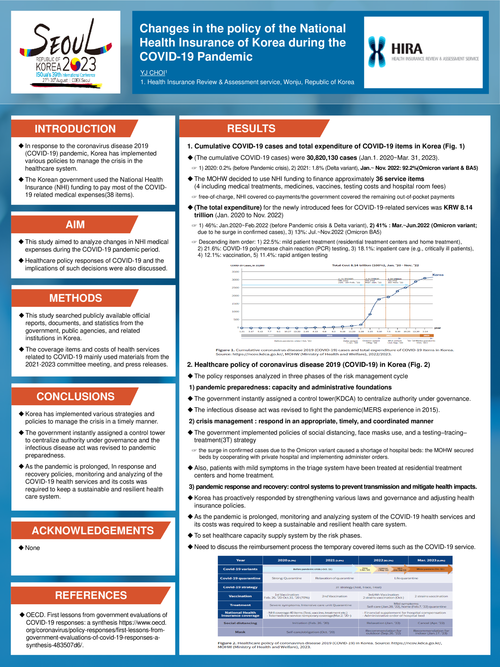
CHANGES IN HEALTHCARE POLICY AND EXPENDITURES OF THE NATIONAL HEALTH INSURANCE OF KOREA DURING THE COVID-19 PANDEMIC
Poster Presenter
Authors
Affiliations
Part of Topic
Complexity, Emergencies, and Sustainability
INTRODUCTION
■ In response to the coronavirus disease 2019 (COVID-19) pandemic, Korea has implemented various policies to manage the crisis in the healthcare system.
■ The Korean government used the National Health Insurance (NHI) funding to pay most of the COVID-19 related medical expenses(38 items).
AIM
■ This study aimed to analyze changes in NHI medical expenses during the COVID-19 pandemic period.
■ Healthcare policy responses of COVID-19 and the implications of such decisions were also discussed.
METHODS
■ This study searched publicly available official reports, documents, and statistics from the government, public agencies, and related institutions in Korea.
■ The coverage items and costs of health services related to COVID-19 mainly used materials from the 2021-2023 committee meeting, and press releases.
RESULTS
1. Cumulative COVID-19 cases and total expenditure of COVID-19 items in Korea (Fig. 1)
■ (The cumulative COVID-19 cases) were 30,820,130 cases (Jan.1. 2020~Mar. 31, 2023).
☞ 1) 2020: 0.2% (before Pandemic crisis), 2) 2021: 1.8% (Delta variant), Jan.~ Nov. 2022: 92.2%(Omicron variant & BA5)
■ The MOHW decided to use NHI funding to finance approximately 36 service items (4 cluding medical treatments, medicines, vaccines, testing costs and hospital room fees)
☞ free-of-charge, NHI covered co-payments/the government covered the remaining out-of-pocket payments
■ (The total expenditure) for the newly introduced fees for COVID-19-related services was KRW 8.14 trillion (Jan. 2020 to Nov. 2022)
☞ 1) 46%: Jan.2020~Feb.2022 (before Pandemic crisis & Delta variant), 2) 41% : Mar.~Jun.2022 (Omicron variant) due to he surge in confirmed cases), 3) 13%: Jul.~Nov.2022 (Omicron BA5)
☞ Descending item order: 1) 22.5%: mild patient treatment (residential treatment centers and home treatment), 2) 21.6%: COVID-19 polymerase chain reaction (PCR) testing, 3) 18.1%: inpatient care (e.g., critically ill patients), 4) 12.1%: vaccination, 5) 11.4%: rapid antigen testing
2. Healthcare policy of coronavirus disease 2019 (COVID-19) in Korea (Fig. 2)
■ The policy responses analyzed in three phases of the risk management cycle.
1) pandemic preparedness: capacity and administrative foundations
■ The government instantly assigned a control tower(KDCA) to centralize authority under governance.
■ The infectious disease act was revised to fight the pandemic(MERS experience in 2015).
2) crisis management : respond in an appropriate, timely, and coordinated manner
■ The government implemented policies of social distancing, face masks use, and a testing–tracing–treatment(3T) strategy
☞ the surge in confirmed cases due to the Omicron variant caused a shortage of hospital beds: the MOHW secured beds by cooperating with private hospital and implementing administer orders.
■ Also, patients with mild symptoms in the triage system have been treated at residential treatment centers and home treatment.
3) pandemic response and recovery: control systems to prevent transmission and mitigate health impacts.
■ Korea has proactively responded by strengthening various laws and governance and adjusting health insurance policies.
■ As the pandemic is prolonged, monitoring and analyzing system of the COVID-19 health services and its costs was required to keep a sustainable and resilient health care system.
■ To set healthcare capacity supply system by the risk phases.
■ Need to discuss the reimbursement process the temporary covered items such as the COVID-19 service.
CONCLUSIONS
■ Korea has implemented various strategies and policies to manage the crisis in a timely manner.
■ The government instantly assigned a control tower to centralize authority under governance and the infectious disease act was revised to pandemic preparedness.
■ As the pandemic is prolonged, In response and recovery policies, monitoring and analyzing of the COVID-19 health services and its costs was required to keep a sustainable and resilient health care system.
ACKNOWLEDGEMENTS
■ None
REFERENCES
■ OECD. First lessons from government evaluations of COVID-19 responses: a synthesis https://www.oecd. org/coronavirus/policy-responses/first-lessons-from-government-evaluations-of-covid-19-responses-a-synthesis-483507d6/.