708 posters, 8 topics, 16 sessions, 1,190 authors, 600 institutions
ePostersLive by SciGen Technologies S.A. All rights reserved.
ISQua's 39th International Conference 2023
August 27 - 30, 2023 | Seoul, Republic of Korea

P885
SUBJECTIVE LIFE EXPECTANCY (SLE) IN HEALTHY OCTOGENARIANS AND NONAGENARIANS
Poster Presenter
Authors
Affiliations
Ministry of Health and Welfare, Puzi Hospital, Chiayi, Taiwan, Department of Family Medicine, Taichung Veterans General Hospital, Taichung , Taiwan.Graduate Institute of Microbiology and Public Health, College of Veterinary Medicine, National Chung-Hsing University. Taichung , Taiwan., Ministry of Health and Welfare, Puzi Hospital, Chiayi, Taiwan.Department of Occupational Therapy, Asia University, Taichung, Taiwan, Center for Geriatrics and Gerontology, Taipei Veterans General Hospital, Taipei, Taiwan. Center for Healthy Longevity and Aging Sciences, National Yang Ming Chiao Tung University, Hsinchu, Taiwan, Center for Healthy Longevity and Aging Sciences, National Yang Ming Chiao Tung University, Hsinchu, Taiwan.Center for Geriatrics and Gerontology, Taipei Municipal Gan-Dau Hospital (Managed by Taipei Veterans General Hospital), Taipei, Taiwan
Part of Topic
Complexity, Emergencies, and Sustainability
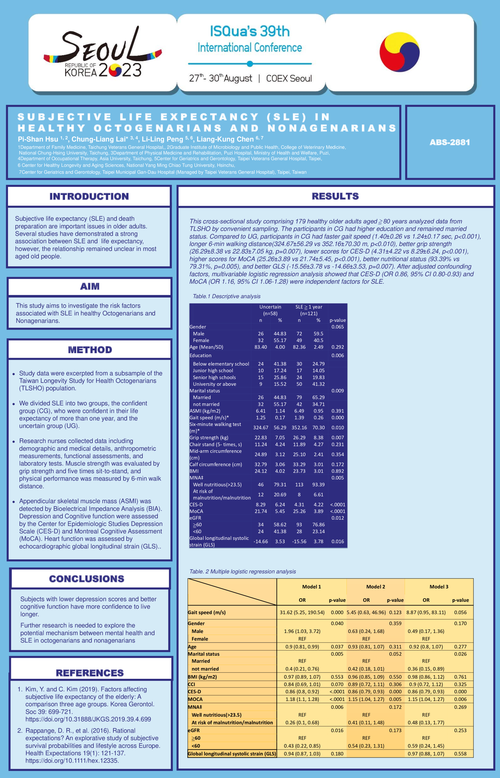
Title: SUBJECTIVE LIFE EXPECTANCY (SLE) IN HEALTHY OCTOGENARIANS AND NONAGENARIANS
Introduction: Subjective life expectancy (SLE) and death preparation are important issues in older adults. Several studies
have demonstrated a strong association between SLE and life expectancy, however, the relationship remained unclear
in most aged old people. This study aims to investigate the risk factors associated with SLE in healthy Octogenarians and
Nonagenarians
Methods: Study data were excerpted from a subsample of the Taiwan Longevity Study for Health Octogenarians
(TLSHO) population. We divided SLE into two groups, the confident group (CG), who were confident in their life
expectancy of more than one year, and the uncertain group (UG). Research nurses collected data including demographic
and medical details, anthropometric measurements, functional assessments, and laboratory tests. Muscle strength was
evaluated by grip strength and five times sit-to-stand, and physical performance was measured by 6-min walk distance.
Appendicular skeletal muscle mass (ASMI) was detected by Bioelectrical Impedance Analysis (BIA). Depression and
Cognitive function were assessed by the Center for Epidemiologic Studies Depression Scale (CES-D) and Montreal
Cognitive Assessment (MoCA). Heart function was assessed by echocardiographic global longitudinal strain (GLS).
Results: This cross-sectional study comprising 179 healthy older adults aged ≧ 80 years analyzed data from TLSHO by
convenient sampling. The participants in CG had higher education and remained married status. Compared to UG,
participants in CG had faster gait speed (1.40±0.26 vs 1.24±0.17 sec, p<0.001), longer 6-min walking
distance(324.67±56.29 vs 352.16±70.30 m, p<0.010), better grip strength (26.29±8.38 vs 22.83±7.05 kg, p=0.007), lower
scores for CES-D (4.31±4.22 vs 8.29±6.24, p<0.001), higher scores for MoCA (25.26±3.89 vs 21.74±5.45, p<0.001),
better nutritional status (93.39% vs 79.31%, p=0.005), and better GLS (-15.56±3.78 vs -14.66±3.53, p=0.007). After
adjusted confounding factors, multivariable logistic regression analysis showed that CES-D (OR 0.86, 95% CI 0.80-0.93)
and MoCA (OR 1.16, 95% CI 1.06-1.28) were independent factors for SLE.
Conclusion: Subjects with lower depression scores and better cognitive function have more confidence to live longer.
Further research is needed to explore the potential mechanism between mental health and SLE in octogenarians and
nonagenarians.
Keywords: OCTOGENARIAN, SUBJECTIVE LIFE EXPECTANCY