708 posters, 8 topics, 16 sessions, 1,190 authors, 600 institutions
ePostersLive by SciGen Technologies S.A. All rights reserved.
ISQua's 39th International Conference 2023
August 27 - 30, 2023 | Seoul, Republic of Korea

P884
TWENTY-ONE YEARS AND STILL GOING STRONG: A CASE STUDY OF THE RESILIENCE AND SUSTAINABILITY OF A TYPE 1 DIABETES TRANSITION PROGRAM
Poster Presenter
Authors
Ann Carrigan, Jane Holmes-Walker, Ann Maguire, Kaye Farrell, Siri Wiig, Veslemøy Guise, Elizabeth Davis, Timothy Jones, Nehal Singh, Jeffrey Braithwaite, Yvonne Zurynski
Affiliations
Macquarie University, Australian Institute of Health Innovation, Centre for Healthcare Resilience and Implementation Science, Macquarie University, Australia, Westmead Hospital, Sydney, Australia; Sydney University Medical School, Children’s Hospital at Westmead, Sydney, Australia, Westmead Hospital, Sydney, Australia, University of Stavanger, Norway, Telethon Kids Institute, Western Australia; Perth Children’s Hospital, Perth, Western Australia, Telethon Kids Institute, Western Australia; 7Perth Children’s Hospital, Perth, Western Australia, Australian Institute of Health Innovation, Centre for Healthcare Resilience and Implementation Science, Macquarie University, Australia
Part of Topic
Complexity, Emergencies, and Sustainability
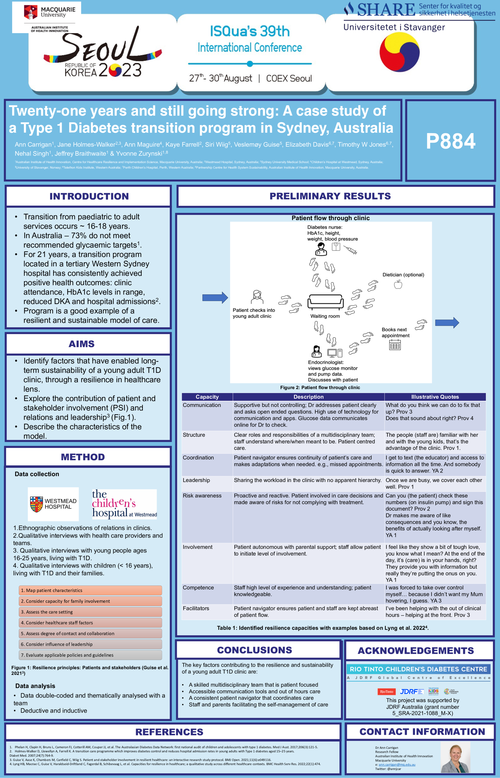
Twenty-one years and still going strong: A case study of a Type 1 Diabetes transition program in Sydney, Australia
Ann Carrigan1, Jane Holmes-Walker2,3, Ann Maguire4, Kaye Farrell2, Siri Wiig5, Veslemøy Guise5, Elizabeth Davis6,7, Timothy W Jones6,7,
Nehal Singh1, Jeffrey Braithwaite1 & Yvonne Zurynski1,8
-
Transition from paediatric to adult services occurs ~ 16-18 years.
-
In Australia – 73% do not meet
recommended glycaemic targets1.
-
For 21 years, a transition program
located in a tertiary Western Sydney hospital has consistently achieved positive health outcomes: clinic attendance, HbA1c levels in range, reduced DKA and hospital admissions2.
-
Program is a good example of a resilient and sustainable model of care.
Study aims
-
Identify factors that have enabled long- term sustainability of a young adult T1D clinic, through a resilience in healthcare lens.
-
Explore the contribution of patient and stakeholder involvement (PSI) and relations and leadership3 (Fig.1).
-
Describe the characteristics of the model.
Data collection based on Resilience principles: Patients and stakeholders (Guise et al. 2021)
1. Ethnographic observations of relations in clinics.
2.Qualitative interviews with health care providers and teams.
3. Qualitative interviews with young people ages 16-25 years, living with T1D.
4. Qualitative interviews with children (< 16 years), living with T1D and their families.
The key factors contributing to the resilience and sustainability of a young adult T1D clinic are:
-
A skilled multidisciplinary team that is patient focused
-
Accessible communication tools and out of hours care
-
A consistent patient navigator that coordinates care
-
Staff and parents facilitating the self-management of care