708 posters, 8 topics, 16 sessions, 1,190 authors, 600 institutions
ePostersLive by SciGen Technologies S.A. All rights reserved.
ISQua's 39th International Conference 2023
August 27 - 30, 2023 | Seoul, Republic of Korea

P883
FRAILTY AMONG SUBURBAN COMMUNITY-DWELLING ELDERLY POPULATION AFTER ONE-YEAR COVID-19 PANDEMIC IN CIREBON REGENCY, INDONESIA
Part of Topic
Complexity, Emergencies, and Sustainability
Frailty among suburban community-dwelling elderly population after one-year COVID-19 pandemic in Cirebon Regency, Indonesia
AFMZ. ZEIN1,2, W. PRATIWI3, N. DOHANA4
1 Dept of Internal Medicine, Faculty of Medicine, Universitas Swadaya Gunung Jati, Cirebon, Indonesia
2 Dept of Internal Medicine, Waled General Hospital, Cirebon, Indonesia
3 Dept of Public Health and Community Medicine, Faculty of Medicine, Universitas Swadaya Gunung Jati, Cirebon, Indonesia
4 Dept of Health, The Government of Cirebon Regency, Cirebon, Indonesia
Introduction
The pandemic of COVID-19 has affected significant impact worldwide, especially among older adults. Frailty is a determinant of susceptibility to morbidity and mortality due to COVID-19 infection in elderly.
Aim
The study aimed to determine the frailty status and to identify risk factors associated among suburban elderly population in Cirebon Regency, Indonesia after one-year COVID-19 pandemic.
Method
A cross-sectional study of community-dwelling aged 60 years and older was conducted in Klangenan, Cirebon Regency, Indonesia from March until June 2021. A questionnaire was used in thi study for determining baseline characeristics of the participants, healthcare access, comorbidity and frailty status. The Ina-FRAIL scale wasused to determine frailty status (frail/not frail). Chi-square test and logistic regression were used to determine association between independent variables and frailty. This study has obtained ethical clearance for medical research ethics.
Results
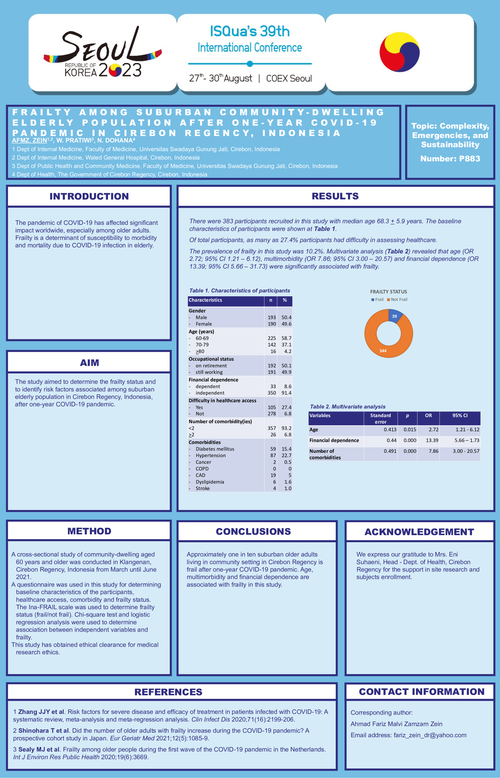
There were 383 participants recruited in this study with median age 68.3 + 5.9 years. The baseline characteristics of participants were shown at Table 1. Of total participants, as many 27.4% paritcipants had difficulty in assessing healthcare. The prevalence of frailty in this study was 10.2%. Multivariate analysis (Table 2) revealed that age (OR 2.72; 95%CI 1.21-6.12), multimorbidity (OR 7.86; 95%CI 3.00-20.57) and financial dependence (OR 13.39; 95%CI 5.66-31.73) were significantly associated with frailty.
Conclusions
Approximately one in ten suburban older adults living in community setting in Cirebon Regency is frail after one-year COVID-19 pandemic. Age, multimorbidity and financial dependence are associated with frailty in this study.
Acknowledgement
We express our gratitude to Mrs. Eni Suhaeni, Head - Dept. of Health, Cirebon Regency for the support in site research and subjects enrollment.
References
1 Zhang JJY et al. Risk factors for severe disease and efficacy of treatment in patients infected with COVID-19: A systematic review, meta-analysis and meta-regression analysis. Clin Infect Dis 2020;71(16):2199-206.
2 Shinohara T et al. Did the number of older adults with frailty increase during the COVID-19 pandemic? A prospective cohort study in Japan. Eur Geriatr Med 2021;12(5):1085-9.
3 Sealy MJ et al. Frailty among older people during the first wave of the COVID-19 pandemic in the Netherlands. Int J Environ Res Public Health 2020;19(6):3669.
Contact information
Corresponding author: Ahmad Fariz Malvi Zamzam Zein
email address: fariz_zein_dr@yahoo.com