708 posters, 8 topics, 16 sessions, 1,190 authors, 600 institutions
ePostersLive by SciGen Technologies S.A. All rights reserved.
ISQua's 39th International Conference 2023
August 27 - 30, 2023 | Seoul, Republic of Korea

P573
COVID- 19 PANDEMIC CONTRIBUTE NEGATIVE IMPACT ON READINESS OF INTERNATIONAL RE-ACCREDITATION IN A MAJOR PRIVATE HOSPITAL IN NEGERI SEMBILAN, MALAYSIA
Poster Presenter
Authors
Affiliations
Part of Topic
Workforce, Policy, and Governance
COVID- 19 PANDEMIC CONTRIBUTE NEGATIVE IMPACT ON READINESS FOR INTERNATIONAL RE-ACCREDITATION IN A MAJOR PRIVATE HOSPITAL IN NEGERI SEMBILAN, MALAYSIA
INTRODUCTION: KPJ Seremban Specialist Hospital is a tertiary private specialist hospital located in the City of Seremban, State of Negeri Sembilan, Malaysia, with 195 operational beds. It is one of the 29 private hospitals under KPJ Healthcare Berhad group of hospitals, the largest hospital group in Malaysia.
KPJ Seremban Specialist Hospital has embarked on the quality and safety journey since 2006 and we continuously improved our service and delivery of care by being accredited by national and international accreditation bodies. It has accomplished 4th cycle of national accreditation and is due for the 4th cycle of international accreditation. The COVID-19 pandemic had exhausted healthcare workers mentally, physically, and financially.
RESEARCH QUESTION: Do COVID-19 have a negative impact on the readiness of international re-accreditation process?
AIM: The objective of this study is to assess the readiness of healthcare workers to undergo the international re-accreditation process following the COVID-19 pandemic.
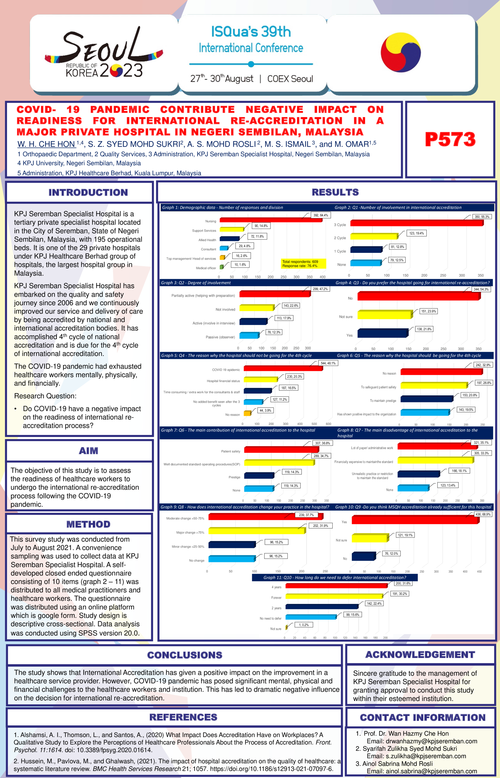
RESULTS: A total of 609 respondents participated in this study with a response rate 79.2%. 64.4% (n=392) were nursing staff, followed by support services 14.8% (n=90), Allied Health 11.8% (n=72), consultant 4.8% (n=29), Top management/ Head of services 2.6% (n=16) and Medical Officer 1.6% (n=1.6%). Majority of respondents were senior staff that had been involved with the previous three cycles (n = 340, 55.8%) of this International Accreditation. 53.0% (n=323) respondents do not prefer the hospital going for the fourth cycle. The reason was due to COVID 19 pandemic 48.1% (n=544), hospital financial status 20.3% (n=230), time consuming / extra work for the consultants & staff 16.5% (n=187) and no added benefit seen after the 3 cycles 11.2% (n=127).
On the other hand, the respondents agreed that the impact of International Accreditation includes; 26.8% (n= 197) to safeguard patient safety, 20.8% (n=153) to maintain prestige and 19.5% (n=143) has shown positive impact to the organization. In addition, the main contributions of International Accreditation were patient safety 36.8% (n=307), well documented standard operating procedures (SOP) 34.7% (n=289) and prestige 14.3% (n=119). 85.1% (n=518) of the respondents also agreed that this International Accreditation brings changes to their practices in the hospital.
CONCLUSIONS: The study shows that International Accreditation has given a positive impact on the improvement in a healthcare service provider. However, COVID-19 pandemic has posed significant mental, physical and financial challenges to the healthcare workers and institution. This has led to dramatic negative influence on the decision for international re-accreditation.