708 posters, 8 topics, 16 sessions, 1,190 authors, 600 institutions
ePostersLive by SciGen Technologies S.A. All rights reserved.
ISQua's 39th International Conference 2023
August 27 - 30, 2023 | Seoul, Republic of Korea

ISQUA2023-ABS-1953
BUILDING RESEARCH CAPACITY IN HEALTH PROFESSIONALS FOR IMPROVING THE QUALITY OF CARE
Poster Presenter
Authors
Affiliations
Part of Topic
Workforce, Policy, and Governance
Building Research Capacity in Health Professionals for Improving the Quality of Care
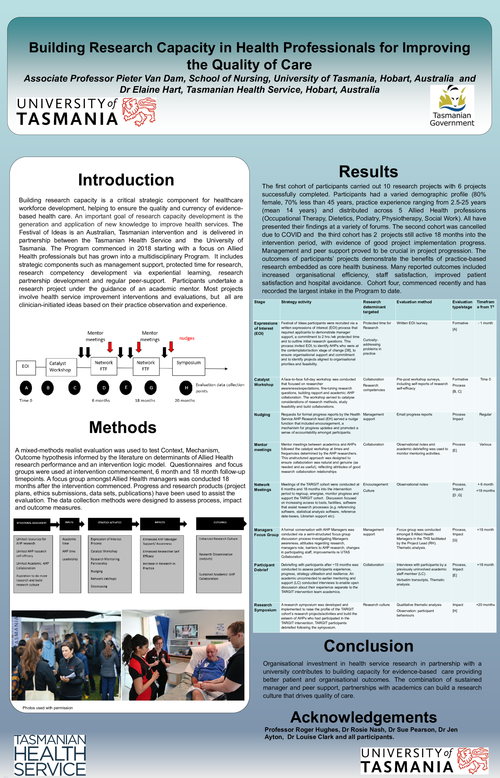
Associate Professor Pieter Van Dam, School of Nursing, University of Tasmania, Hobart, Australia and Dr Elaine Hart, Tasmanian Health Service, Hobart, Australia
Introduction
Building research capacity is a critical strategic component for healthcare workforce development, helping to ensure the quality and currency of evidence-based health care. An important goal of research capacity development is the generation and application of new knowledge to improve health services. The Festival of Ideas is an Australian, Tasmanian intervention and is delivered in partnership between the Tasmanian Health Service and the University of Tasmania. The Program commenced in 2018 starting with a focus on Allied Health professionals but has grown into a multidisciplinary Program. It includes strategic components such as management support, protected time for research, research competency development via experiential learning, research partnership development and regular peer-support. Participants undertake a research project under the guidance of an academic mentor. Most projects involve health service improvement interventions and evaluations, but all are clinician-initiated ideas based on their practice observation and experience.
Methods
A mixed-methods realist evaluation was used to test Context, Mechanism, Outcome hypothesis informed by the literature on determinants of Allied Health research performance and an intervention logic model. Questionnaires and focus groups were used at intervention commencement, 6 month and 18 month follow-up timepoints. A focus group amongst Allied Health managers was conducted 18 months after the intervention commenced. Progress and research products (project plans, ethics submissions, data sets, publications) have been used to assist the evaluation. The data collection methods were designed to assess process, impact and outcome measures.
Results
The first cohort of participants carried out 10 research projects with 6 projects successfully completed. Participants had a varied demographic profile (80% female, 70% less than 45 years, practice experience ranging from 2.5-25 years (mean 14 years) and distributed across 5 Allied Health professions (Occupational Therapy, Dietetics, Podiatry, Physiotherapy, Social Work). All have presented their findings at a variety of forums. The second cohort was cancelled due to COVID and the third cohort has 2 projects still active 18 months into the intervention period, with evidence of good project implementation progress. Management and peer support proved to be crucial in project progression. The outcomes of participants’ projects demonstrate the benefits of practice-based research embedded as core health business. Many reported outcomes included increased organisational efficiency, staff satisfaction, improved patient satisfaction and hospital avoidance. Cohort four, commenced recently and has recorded the largest intake in the Program to date.
Conclusion
Organisational investment in health service research in partnership with a university contributes to building capacity for evidence-based care providing better patient and organisational outcomes. The combination of sustained manager and peer support, partnerships with academics can build a research culture that drives quality of care.
Acknowledgements
Professor Roger Hughes, Dr Rosie Nash, Dr Sue Pearson, Dr Jen Ayton, Dr Louise Clark and all participants.