708 posters, 8 topics, 16 sessions, 1,190 authors, 600 institutions
ePostersLive by SciGen Technologies S.A. All rights reserved.
ISQua's 39th International Conference 2023
August 27 - 30, 2023 | Seoul, Republic of Korea

P560
A BLENDED LEARNING PROGRAMME IN AIRWAY CRISIS MANAGEMENT FOR ANAESTHESIA NURSES
Poster Presenter
Part of Topic
Workforce, Policy, and Governance
A BLENDED LEARNING PROGRAMME IN AIRWAY CRISIS MANAGEMENT FOR ANAESTHESIA NURSES
Pamela Chia1, Lucy Davies2, Sandy Lim1, Malkit Kaur D/O Karnam Singh3, Haiying Shen3, Evangeline Lim2, Josephine Tan2
1 Women’s Anaesthesia, KK Women’s and Children’s Hospital, Singapore
2 Paediatric Anaesthesia, KK Women’s and Children’s Hospital, Singapore
3 OT services, Division of Nursing, KK Women’s and Children’s Hospital, Singapore
Introduction
Prompt recognition and management of airway crises by the anaesthetic team is fundamental to safe anaesthetic practice. Anaesthesia nurses have an integral role in the provision of anaesthetic care in difficult airway crises. In our
institution, KK Women’s and Children’s Hospital (KKH), a tertiary women’s and children’s hospital in Singapore, we conducted a survey to identify learning structures in airway management. Survey participants cited that more than 70% of their knowledge and skills on managing patient’s airway comes from in-service training, preceptor nurse and ad-hoc training by anaesthetists. The aim of this educational quality improvement project is to develop a blended learning programme in airway crisis management for anaesthesia nurses.
Methods
39 anaesthesia nurses in KKH major operating theatre were recruited in this study. An online survey was conducted to gather information about the participant’s background pertaining to anaesthetic knowledge, experience and their perception of their competency in airway management. Participants were also asked to complete 14 multiple choice questions (MCQ) relating to general airway topics. Information gathered from the survey facilitated the development of the curriculum. The curriculum included basic airway management, advanced paediatric, adult and obstetric airway management, airway equipment and effective communication in crisis management. Our blended learning programme consisted of pre-workshop online learning and a 2-day workshop consisting of a Zoom case-based discussion, practical skill stations, and simulation sessions for paediatric, obstetric and adult airway scenarios. At the end of the course, participant’s competency was determined through completion of the same MCQ questions and confidence surveys as
what was administered pre-programme. We used a 4 point Likert scale (strongly disagree=1, disagree=2, agree=3, strongly agree=4) to ask participants if they agreed or disagreed with statements in the same surveys given to anaesthesia nurses pre-programme and postprogramme
regarding difficult airway skills, management and knowledge. Using the above scoring system, a Mann-Whitney U test was conducted on both results and the p values derived reflected statistically significant change.
Results
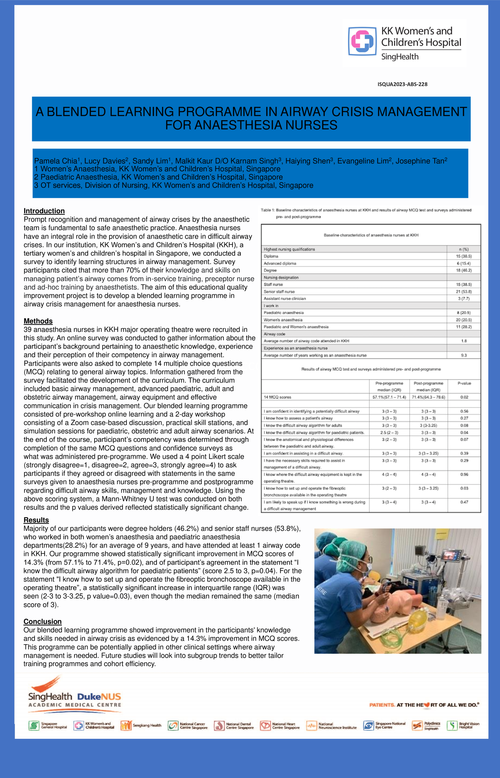
Majority of our participants were degree holders (46.2%) and senior staff nurses (53.8%), who worked in both women’s anaesthesia and paediatric anaesthesia departments(28.2%) for an average of 9 years, and have attended at least 1 airway code in KKH. Our programme showed statistically significant improvement in MCQ scores of 14.3% (from 57.1% to 71.4%, p=0.02), and of participant’s agreement in the statement “I know the difficult airway algorithm for paediatric patients” (score 2.5 to 3, p=0.04). For the statement "I know how to set up and operate the fibreoptic bronchoscope available in the operating theatre”, a statistically significant increase in interquartile range (IQR) was seen (2-3 to 3-3.25, p value=0.03), even though the median remained the same (median score of 3).
Conclusion
Our blended learning programme showed improvement in the participants' knowledge and skills needed in airway crisis as evidenced by a 14.3% improvement in MCQ scores. This programme can be potentially applied in other clinical settings where airway management is needed. Future studies will look into subgroup trends to better tailor training
programmes and cohort efficiency.