708 posters, 8 topics, 16 sessions, 1,190 authors, 600 institutions
ePostersLive by SciGen Technologies S.A. All rights reserved.
ISQua's 39th International Conference 2023
August 27 - 30, 2023 | Seoul, Republic of Korea

P536
DEVELOPING CAPABILITY: GUIDING PRINCIPLES FROM A REALIST EVALUATION OF IMPLEMENTATION OF MULTI-SITE HOSPITAL INTERVENTIONS
Poster Presenter
Authors
Janet LONG, Emilie Francis-Auton, Mitchell Sarkies, Jeffrey Braithwaite
Affiliations
Macquarie University, Australian Insitute of Health Innovation, Macquarie University, Sydney Australia, Australian Insitute of Health Innovation, Macquarie University, Sydney Australia; Sydney Health Partners Implementation Science Program, Sydney University
Part of Topic
Workforce, Policy, and Governance
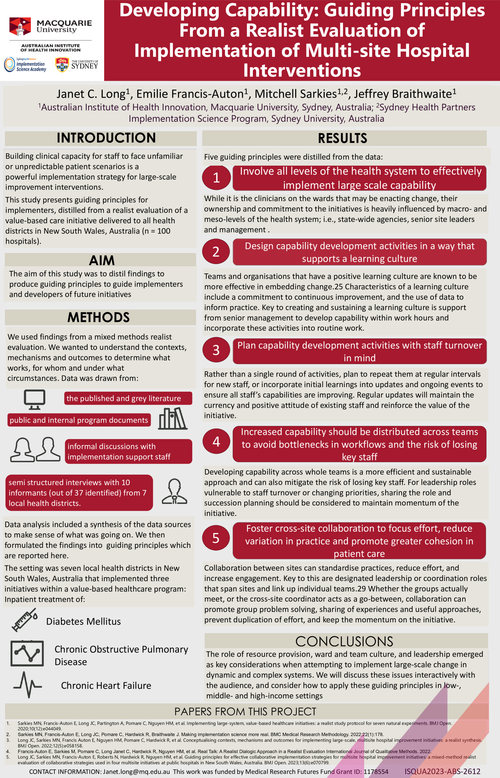
DEVELOPING CAPABILITY: GUIDING PRINCIPLES FROM A REALIST EVALUATION OF IMPLEMENTATION OF
MULTI-SITE HOSPITAL INTERVENTIONS
Introduction: Building clinical capacity for staff to face unfamiliar or unpredictable patient scenarios is a powerful
implementation strategy for large-scale improvement interventions. This study presents guiding principles for
implementers, distilled from a realist evaluation of a value-based care initiative delivered to all health districts in New
South Wales Australia (n = 100 public hospitals). The aim of this study was to distil findings to produce guiding principles
to guide implementers and developers of future initiatives.
Methods: We used findings from a mixed methods realist evaluation. We wanted to understand the contexts,
mechanisms and outcomes to determine what works, for whom and under what circumstances. The setting was seven
local health districts in New South Wales, Australia that implemented three initiatives within a value-based healthcare
program: inpatient treatment of chronic heart failure, chronic obstructive pulmonary disease, and diabetes mellitus. Data
was drawn from the literature, public and internal program documents, informal discussions with implementation support
staff, and semi structured interviews with 10 informants (out of 37 identified) from seven local health districts. Data
analysis included a synthesis of the data sources to make sense of what was going on. We then formulated the findings
into guiding principles which are reported here.
Results: Five guiding principles were distilled from the data: 1. Involve all levels of the health system to effectively
implement large-scale capability development 2. Design capability development activities in a way that supports a
learning culture, 3. Plan capability development activities with staff turnover in mind, 4. Increased capability should be
distributed across teams to avoid bottlenecks in workflows and the risk of losing key staff, 5. Foster cross-site
collaboration to focus effort, reduce variation in practice and promote greater cohesion in patient care.
Conclusion: The role of resource provision, ward and team culture, and leadership emerged as key considerations when
attempting to implement large-scale change in dynamic and complex systems. We will discuss these issues interactively
with the audience, and consider how to apply these guiding principles in low-, middle- and high-income settings.