708 posters, 8 topics, 16 sessions, 1,190 authors, 600 institutions
ePostersLive by SciGen Technologies S.A. All rights reserved.
ISQua's 39th International Conference 2023
August 27 - 30, 2023 | Seoul, Republic of Korea

P533
PSYCHOLOGICAL SAFETY AND NURSES’ BURNOUT: A MODERATED MEDIATION MODEL OF PROMOTIVE VOICE AND COLLECTIVISM
Poster Presenter
Authors
Affiliations
Part of Topic
Workforce, Policy, and Governance
PSYCHOLOGICAL SAFETY AND NURSES’ BURNOUT: A MODERATED MEDIATION MODEL OF PROMOTIVE VOICE AND COLLECTIVISM
1. INTRODUCTION:
•Psychological safety describes the positive belief that they will not be punished for asking questions or expressing ideas. Hence, psychological safety may increase promotive voice and reduce burnout.
•Promotive voice refers to expressing individual ideas for organizational functioning (Liang et al., 2012). It may alleviate burnout by giving opportunities for self-expression and improvement (Sherf et al., 2021).
•South Korea belongs to a collectivist culture in which group harmony and hierarchy are highly valued (Lee & Yang, 2019).
•Hence, South Korea is the apt place to explore the effect of collectivism on the relationship between psychological safety, promotive voice, and burnout.
2. AIM:
•This study aimed to investigate
(1)The relationship between nurses’ psychological safety and burnout.
(2)The mediating effect of promotive voice on the relationship between psychological safety and burnout.
(3)The moderating effect of collectivism on the relationship between psychological safety and promotive voice.
(4)The moderated mediation model in which collectivism moderates the mediating effect of promotive voice on the relationship between psychological safety and burnout.
•By verifying these aims, this study intended to examine the organizational and individual antecedents of nurses’ burnout.
3. METHOD:
•Design and setting: This study was conducted with cross-sectional online survey data from 1,255 staff nurses in 34 conveniently selected Korean hospitals.
•Data analysis: The PROCESS SPSS macro (Model 7) was performed with 10,000 bootstraps to examine the mediating role of promotive voice, the moderating role of collectivism, and the final moderated mediation hypothesis.
•Control variables: Age and gender
4. RESULTS:
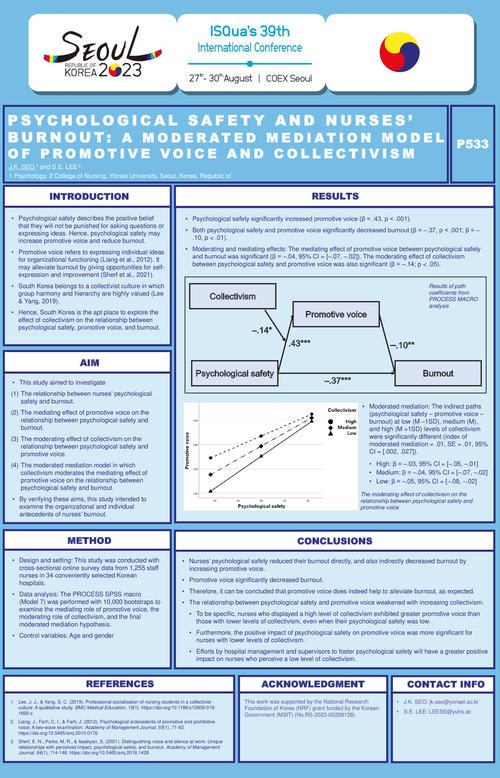
•Psychological safety significantly increased promotive voice (β = .43, p < .001).
•Both psychological safety and promotive voice significantly decreased burnout (β = –.37, p < .001; β = –.10, p < .01).
•Moderating and mediating effects: The mediating effect of promotive voice between psychological safety and burnout was significant (β = –.04, 95% CI = [–.07, –.02]). The moderating effect of collectivism between psychological safety and promotive voice was also significant (β = –.14; p < .05).
•Moderated mediation: The indirect paths (psychological safety – promotive voice – burnout) at low (M –1SD), medium (M), and high (M +1SD) levels of collectivism were significantly different (index of moderated mediation = .01, SE = .01, 95% CI = [.002, .027]).
5. CONCLUSIONS:
•Nurses’ psychological safety reduced their burnout directly, and also indirectly decreased burnout by increasing promotive voice.
•Promotive voice significantly decreased burnout.
•Therefore, it can be concluded that promotive voice does indeed help to alleviate burnout, as expected.
•The relationship between psychological safety and promotive voice weakened with increasing collectivism.
•To be specific, nurses who displayed a high level of collectivism exhibited greater promotive voice than those with lower levels of collectivism, even when their psychological safety was low.
•Furthermore, the positive impact of psychological safety on promotive voice was more significant for nurses with lower levels of collectivism.
•Efforts by hospital management and supervisors to foster psychological safety will have a greater positive impact on nurses who perceive a low level of collectivism.