708 posters, 8 topics, 16 sessions, 1,190 authors, 600 institutions
ePostersLive by SciGen Technologies S.A. All rights reserved.
ISQua's 39th International Conference 2023
August 27 - 30, 2023 | Seoul, Republic of Korea

P532
THE GENDER EQUALITY LEARNING UNDER CULTURAL ASPECTS: ENHANCING NURSING STUDENTS’ COMPETENCY OF GENDER SENSITIVITY
Poster Presenter
Authors
Affiliations
Part of Topic
Workforce, Policy, and Governance
THE GENDER EQUALITY LEARNING UNDER CULTURAL ASPECTS: ENHANCING NURSING STUDENTS’ COMPETENCY OF GENDER SENSITIVITY
Hwey-Fang Liang, PhD, RN, Professor,
Department of Nursing, Chang Gung University of Science and Technology, Chia-Yi Campus, Taiwan
Introduction:
The gender equality is an attitude, thinking and belief. Also, the gender equality education is a process,which can promote the understanding and practice of gender diversity through the teaching method of multiculturalism,and achieve the goal of gender equality. Respect and dismantle gender come from culture stereotypes. Especially in the field of nursing education, the content scope and education of gender equality should be actively developed and explored to cultivate future nurses with gender equality literacy.
Purpose: to explore the gender-contact experiences of nursing students.
Methods:
A qualitative and purposive sampling research method were used. The semi-structured interview guide, and in-depth interviews were implemented. Each participant was interviewed 40-60 minutes approximately for this study period. The process was recorded and analyzed by using content analysis method.
Participants:
A total of 40 people were interviewed, including 20 boys (50%) and 20 girls (50%). In terms of nursing education system, there were 24 (60%) two-year college students and 16 (40%) four-year college students, with an average age of 22.5±1.5.
Results:
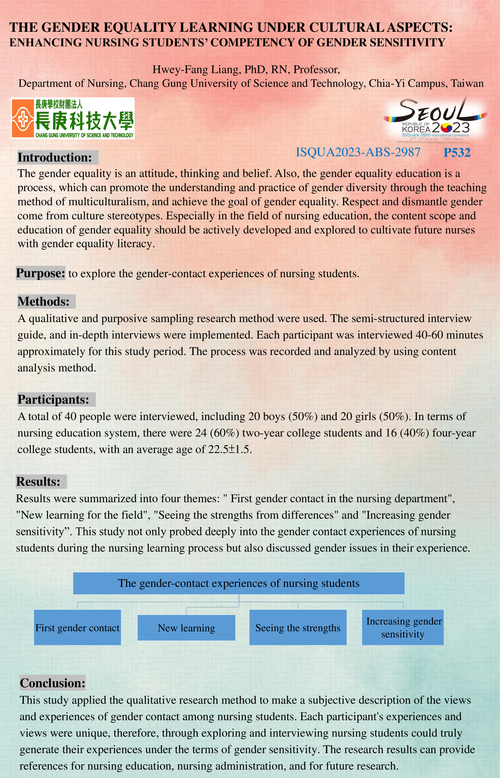
Results were summarized into four themes: " First gender contact in the nursing department", "New learning for the field", "Seeing the strengths from differences" and "Increasing gender sensitivity”. This study not only probed deeply into the gender contact experiences of nursing students during the nursing learning process but also discussed gender issues in their experience.