708 posters, 8 topics, 16 sessions, 1,190 authors, 600 institutions
ePostersLive by SciGen Technologies S.A. All rights reserved.
ISQua's 39th International Conference 2023
August 27 - 30, 2023 | Seoul, Republic of Korea

P519
ASSOCIATIONS OF WORK-FAMILY CONFLICT, FAMILY-WORK CONFLICT, PERSONAL BURNOUT, AND LEAVING INTENTION AMONG NURSES DURING COVID-19 PANDEMIC
Poster Presenter
Authors
Affiliations
Part of Topic
Workforce, Policy, and Governance
INTRODUCTION
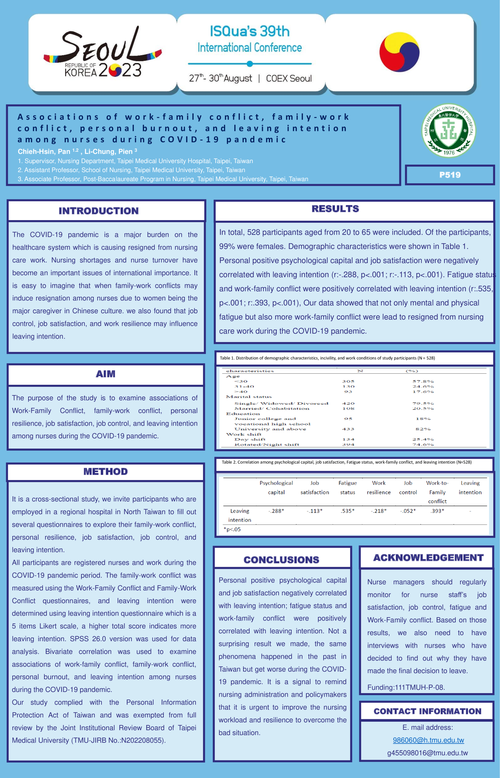
The COVID-19 pandemic is a major burden on the healthcare system which is causing resigned from nursing care work. Nursing shortages and nurse turnover have become an important issues of international importance. It is easy to imagine that when family-work conflicts may induce resignation among nurses due to women being the major caregiver in Chinese culture. we also found that job control, job satisfaction, and work resilience may influence leaving intention.
AIM
The purpose of the study is to examine associations of Work-Family Conflict, family-work conflict, personal resilience, job satisfaction, job control, and leaving intention among nurses during the COVID-19 pandemic.
METHOD
It is a cross-sectional study, we invite participants who are employed in a regional hospital in North Taiwan to fill out several questionnaires to explore their family-work conflict, personal resilience, job satisfaction, job control, and leaving intention.
All participants are registered nurses and work during the COVID-19 pandemic period. The family-work conflict was measured using the Work-Family Conflict and Family-Work Conflict questionnaires, and leaving intention were determined using leaving intention questionnaire which is a 5 items Likert scale, a higher total score indicates more leaving intention. SPSS 26.0 version was used for data analysis. Bivariate correlation was used to examine associations of work-family conflict, family-work conflict, personal burnout, and leaving intention among nurses during the COVID-19 pandemic.
Our study complied with the Personal Information Protection Act of Taiwan and was exempted from full review by the Joint Institutional Review Board of Taipei Medical University (TMU-JIRB No.:N202208055).
RESULTS
In total, 528 participants aged from 20 to 65 were included. Of the participants, 99% were females. Demographic characteristics were shown in Table 1. Personal positive psychological capital and job satisfaction were negatively correlated with leaving intention (r:-.288, p<.001; r:-.113, p<.001). Fatigue status and work-family conflict were positively correlated with leaving intention (r:.535, p<.001; r:.393, p<.001), Our data showed that not only mental and physical fatigue but also more work-family conflict were lead to resigned from nursing care work during the COVID-19 pandemic.
CONCLUSIONS
Personal positive psychological capital and job satisfaction negatively correlated with leaving intention; fatigue status and work-family conflict were positively correlated with leaving intention. Not a surprising result we made, the same phenomena happened in the past in Taiwan but get worse during the COVID-19 pandemic. It is a signal to remind nursing administration and policymakers that it is urgent to improve the nursing workload and resilience to overcome the bad situation.
ACKNOWLEDGEMENT
Nurse managers should regularly monitor for nurse staff’s job satisfaction, job control, fatigue and Work-Family conflict. Based on those results, we also need to have interviews with nurses who have decided to find out why they have made the final decision to leave.