Loading...

708 posters, 8 topics, 16 sessions, 1,190 authors, 600 institutions

ePostersLive by SciGen Technologies S.A. All rights reserved.

ISQua's 39th International Conference 2023

August 27 - 30, 2023 | Seoul, Republic of Korea

ISQua's 39th International Conference 2023 banner

P511

NEEDS ASSESSMENT IN LONG-TERM CARE: EXPRESSION OF NATIONAL PRINCIPLES FOR PRIORITY SETTING IN SERVICE ALLOCATION.
Part of Topic

Workforce, Policy, and Governance

Needs assessment in long-term care: Expression of national principles for priority setting in service allocation.

Background

•Long-term care services to older adults are characterized by increasing needs and scarce resources.
•Political strategies have led to an increased focus on "ageing in place" and efficient use of resources.
•Aim: Explore how three political principles for prioritisation in long-term care; resource, severity and benefit principle are expressed in the process of service allocation to older adults. 
 

Methods

•Qualitative study design with data from interviews, observations and individual decision letters where service allocators grant or refuse long-term care services.
•The data were analyzed using thematic analysis.
 

Results

Themes related to service allocators' expression of the principles:

Resource principle

1) Lowest effective level of care as a criterion for service allocation

2) Blanket allocation of low-cost care services

Severity principle

3) Severity of medical and rehabilitation needs

4) Severity of care needs

Benefit principle

5) Benefit of generous service allocation

6) Benefit of avoiding services

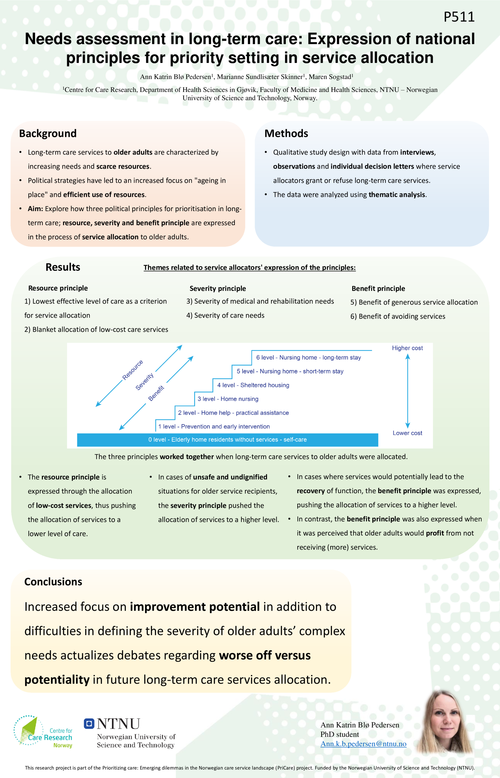
The three principles worked together when long-term care services to older adults were allocated.

•The resource principle is expressed through the allocation of low-cost services, thus pushing the allocation of services to a lower level of care.
•In cases of unsafe and undignified situations for older service recipients, the severity principle pushed the allocation of services to a higher level.
•In cases where services would potentially lead to the recovery of function, the benefit principle was expressed, pushing the allocation of services to a higher level.
•In contrast, the benefit principle was also expressed when it was perceived that older adults would profit from not receiving (more) services.

Conclusions

Increased focus on improvement potential in addition to difficulties in defining the severity of older adults’ complex needs actualizes debates regarding worse off versus potentiality in future long-term care services allocation.

ISQua's 39th International Conference 2023 » banner
Copyright © 2015-2026, ePostersLive® SciGen is a registered trademark of SciGen Technologies S.A. Patent pending.

This website and third-party tools we use rely on cookies for the best user experience. By selecting "I agree", you agree to cookie usage as described in our Privacy Policy.