708 posters, 8 topics, 16 sessions, 1,190 authors, 600 institutions
ePostersLive by SciGen Technologies S.A. All rights reserved.
ISQua's 39th International Conference 2023
August 27 - 30, 2023 | Seoul, Republic of Korea

ISQUA2023-ABS-2550
THE IMPACT OF SELF-LEADERSHIP SKILLS OF HEALTHCARE EMPLOYEES ON INSTITUTIONAL PERFORMANCE AND JOB PERFORMANCE
Poster Presenter
Authors
Affiliations
Part of Topic
Workforce, Policy, and Governance
Introduction:
Considering challenges and opportunities associated with business life, leaders can achieve success in current environment of organization with some factors. These factors; the leader’s entrepreneurial employees, who produce innovative and creative ideas, capacity pf using authorizations and shared leadership effectively in a certain trust environment. This research is conducted in order to investigate the relationship between self-leadership skills of health employees and job performance and institutional performance.
Methods:
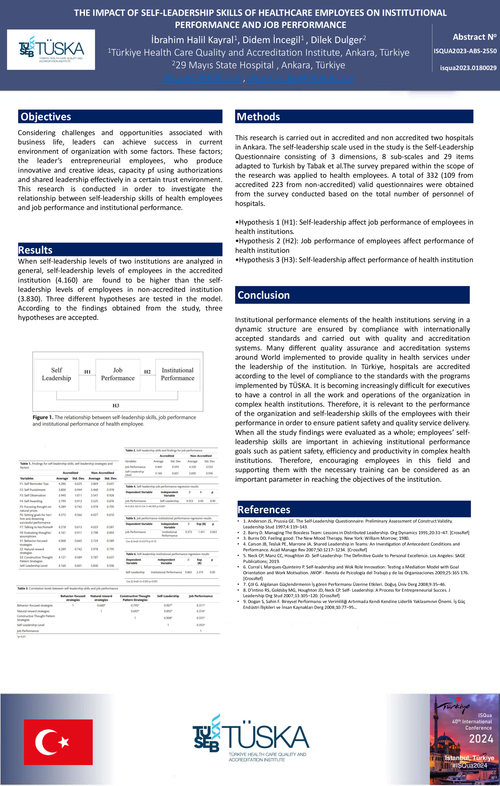
This research is carried out in accredited and non accredited two hospitals in Ankara. The self-leadership scale used in the study is the Self-Leadership Questionnaire consisting of 3 dimensions, 8 sub-scales and 29 items adapted to Turkish by Tabak et al.The survey prepared within the scope of the research was applied to health employees. A total of 332 (109 from accredited 223 from non-accredited) valid questionnaires were obtained from the survey conducted based on the total number of personnel of hospitals.
- Hypothesis 1 (H1): Self-leadership affect job performance of employees in health institutions.
- Hypothesis 2 (H2): Job performance of employees affect performance of health institution
- Hypothesis 3 (H3): Self-leadership affect performance of health institution
Results:
When self-leadership levels of two institutions are analyzed in general, self-leadership levels of employees in the accredited institution (4.160) are found to be higher than the self-leadership levels of employees in non-accredited institution (3.830). Three different hypotheses are tested in the model. According to the findings obtained from the study, three hypotheses are accepted.
Conclusion:
Institutional performance elements of the health institutions serving in a dynamic structure are ensured by compliance with internationally accepted standards and carried out with quality and accreditation systems. Many different quality assurance and accreditation systems around World implemented to provide quality in health services under the leadership of the institution. In Türkiye, hospitals are accredited according to the level of compliance to the standards with the programs implemented by TÜSKA. It is becoming increasingly difficult for executives to have a control in all the work and operations of the organization in complex health institutions. Therefore, it is relevant to the performance of the organization and self-leadership skills of the employees with their performance in order to ensure patient safety and quality service delivery.When all the study findings were evaluated as a whole; employees’ self-leadership skills are important in achieving institutional performance goals such as patient safety, efficiency and productivity in complex health institutions. Therefore, encouraging employees in this field and supporting them with the necessary training can be considered as an important parameter in reaching the objectives of the institution.