708 posters, 8 topics, 16 sessions, 1,190 authors, 600 institutions
ePostersLive by SciGen Technologies S.A. All rights reserved.
ISQua's 39th International Conference 2023
August 27 - 30, 2023 | Seoul, Republic of Korea

ISQUA2023-ABS-2805
EVALUATION OF THE ATTITUDES OF HEALTHCARE ACCREDITATION SURVEYORS ABOUT DISTANCE TRAININGS: CASE OF TÜSKA
Poster Presenter
Authors
Didem INCEGIL, Gulay Yazici, İbrahim Halil Kayral, Figen Cizmeci Senel
Affiliations
Part of Topic
Workforce, Policy, and Governance
EVALUATION OF THE ATTITUDES OF HEALTHCARE ACCREDITATION SURVEYORS ABOUT DISTANCE TRAININGS: CASE OF TÜSKA
Didem İNCEGİL, Gülay YAZICI, Figen ÇİZMECİ ŞENEL, İbrahim Halil KAYRAL
Introduction:
Training is an important field that changes throughout life and is constantly developing. Previously, only face-to-face trainings would come to mind when the subject of training was mentioned. Distance training is realized through communication with help of technological tools such as text, graphics, video, sound, satellite, computer, multimedia. Especially recently, due to the adverse conditions caused by COVID-19 pandemic, distance working and distance training model has increased in all areas. Within the scope of activities of Türkiye Healthcare Quality and Accreditation Institute (TÜSKA); It uses a distance model in remote accreditation interim surveys and surveyor capacity building trainings. TÜSKA Healthcare Accreditation Surveyor Training Program, selection and training of health services accreditation surveyors and capacity building training of surveyors are prepared with the aim of determining relevant processes. In this study, perceptions and attitudes of TÜSKA Healthcare Accreditation Surveyors about distance trainings are be evaluated and advantages and disadvantages of distance training model is be evaluated.
Methods:
Population of the research consists of 133 people who are TÜSKA Health Accreditation Surveyor. Since it was aimed to reach the universe, sample selection is not made. The questionnaire form used for data collection consists of 2 main parts and 29 questions in total. A questionnaire consisting of 11 questions on sociodemographic characteristics of surveyors and the " Opinions Scale on Distance Training" consisting of 18 questions are used. The scale consists of 18 items and 4 factors. It is a 5-point Likert type scale. The questionnaire form is sent to the e-mail addresses given to surveyors by TÜSKA using google questionnaire method. In the analysis of the data, frequency tables are used as Central Tendency and Measures of Variability Basic Statistics. In comparisons, when the data are not normally distributed, Mann Whitney U test, Kruskal Wallis test and Spearman Correlation Analysis are be used. In January, 2023, the ethics committee of this study is approved by Ankara Yıldırım Beyazıt University.
Results:
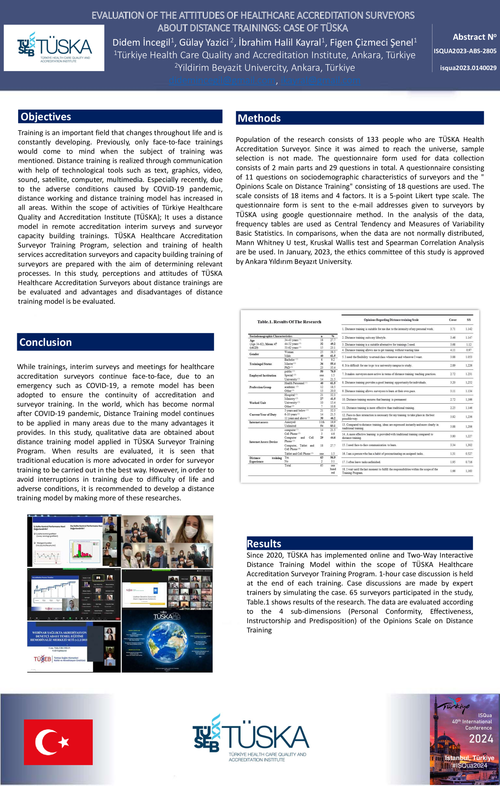
Since 2020, TÜSKA has implemented online and Two-Way Interactive Distance Training Model within the scope of TÜSKA Healthcare Accreditation Surveyor Training Program. 1-hour case discussion is held at the end of each training. Case discussions are made by expert trainers by simulating the case. 65 surveyors participated in the study, Table.1 shows results of the research. The data are evaluated according to the 4 sub-dimensions (Personal Conformity, Effectiveness, Instructorship and Predisposition) of the Opinions Scale on Distance Training
Conclusion:
While trainings, interim surveys and meetings for healthcare accreditation surveyors continue face-to-face, due to an emergency such as COVID-19, a remote model has been adopted to ensure the continuity of accreditation and surveyor training. In the world, which has become normal after COVID-19 pandemic, Distance Training model continues to be applied in many areas due to the many advantages it provides. In this study, qualitative data are obtained about distance training model applied in TÜSKA Surveyor Training Program. When results are evaluated, it is seen that traditional education is more advocated in order for surveyor training to be carried out in the best way. However, in order to avoid interruptions in training due to difficulty of life and adverse conditions, it is recommended to develop a distance training model by making more of these researches.