293 posters, 56 videos, 24 topics, 13 sessions, 658 authors, 215 institutions
ePostersLive by SciGen Technologies S.A. All rights reserved.
ISMICS 2025 Annual Meeting
28 - 31 May, 2025 | Istanbul, Turkey

P39
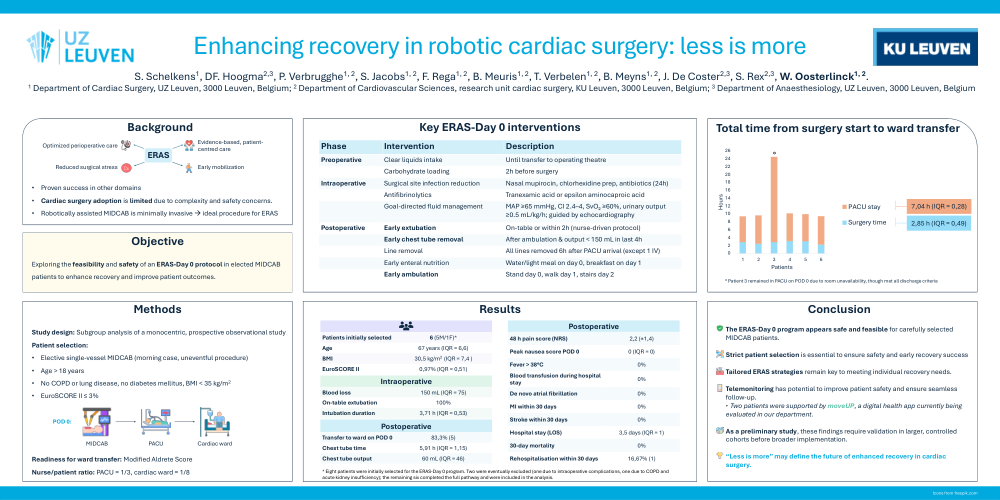
Enhancing Recovery In Robotic Cardiac Surgery: Less Is More
Poster Presenter
Authors
Sanne Schelkens, Danny Hoogma, Peter Verbrugghe, Steven Jacobs, Filip Rega, Bart Meuris, Tom Verbelen, Bart Meyns, Johan De Coster, Steffen Rex, Wouter Oosterlinck
Affiliations
Department of Cardiac Surgery, UZ Leuven, 3000 Leuven, Belgium, Department of Cardiovascular Sciences, research unit cardiac surgery, KU Leuven, 3000 Leuven, Belgium; Department of Anaesthesiology, UZ Leuven, 3000 Leuven, Belgium, Department of Cardiac Surgery, UZ Leuven, 3000 Leuven, Belgium; Department of Cardiovascular Sciences, research unit cardiac surgery, KU Leuven, 3000 Leuven, Belgium, Department of Cardiac Surgery, UZ Leuven, 3000 Leuven, Belgium; Department of Cardiovascular Sciences, research unit cardiac surgery, KU Leuven, 3000 Leuven, Belgium
Part of Topic
Coroanry Revasc
Background
• Proven success in other domains
• Cardiac surgery adoption is limited due to complexity and safety concerns.
• Robotically assisted MIDCAB is minimally invasive → ideal procedure for ERAS
Objective
Exploring the feasibility and safety of an ERAS-Day 0 protocol in elected MIDCAB patients to enhance recovery and improve patient outcomes.
Methods
Study design: Subgroup analysis of a monocentric, prospective observational study
Patient selection:
• Elective single-vessel MIDCAB (morning case, uneventful procedure)
• Age > 18 years
• No COPD or lung disease, no diabetes mellitus, BMI < 35 kg/m2
• EuroSCORE II ≤ 3%
Readiness for ward transfer: Modified Aldrete Score
Nurse/patient ratio: PACU = 1/3, cardiac ward = 1/8
Conclusion
The ERAS-Day 0 program appears safe and feasible for carefully selected MIDCAB patients. Strict patient selection is essential to ensure safety and early recovery success Tailored ERAS strategies remain key to meeting individual recovery needs. Telemonitoring has potential to improve patient safety and ensure seamless follow-up. ‣ Two patients were supported by moveUP, a digital health app currently being evaluated in our department. As a preliminary study, these findings require validation in larger, controlled cohorts before broader implementation. “Less is more” may define the future of enhanced recovery in cardiac surgery.