293 posters, 56 videos, 24 topics, 13 sessions, 658 authors, 215 institutions
ePostersLive by SciGen Technologies S.A. All rights reserved.
ISMICS 2025 Annual Meeting
28 - 31 May, 2025 | Istanbul, Turkey

P32
Sequence Considerations In Hybrid Coronary Revascularization: Stent-first Or Surgery-first
Poster Presenter
Authors
David Zapata, Kevin Ho, Hannah Frederick, Aakash Shah, Brad Taylor
Affiliations
Part of Topic
Coroanry Revasc
Objective
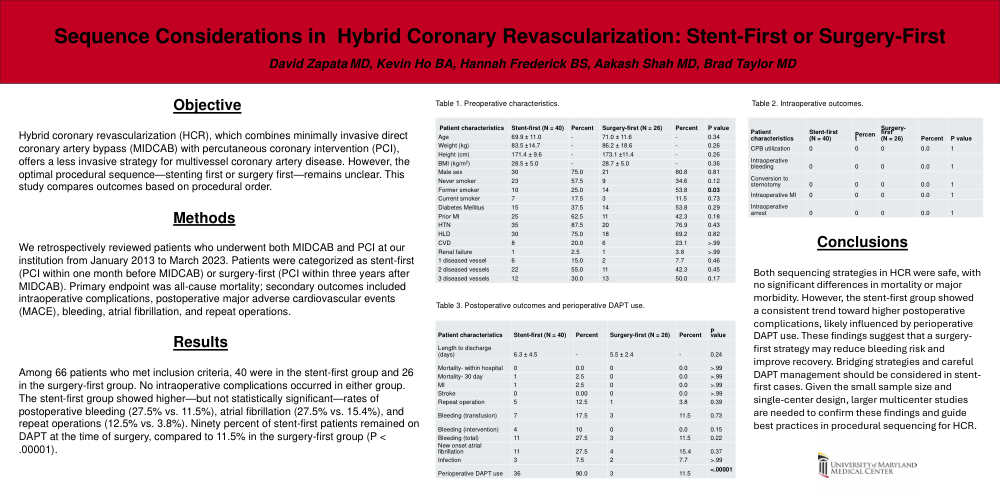
Hybrid coronary revascularization (HCR), which combines minimally invasive direct coronary artery bypass (MIDCAB) with percutaneous coronary intervention (PCI), offers a less invasive strategy for multivessel coronary artery disease. However, the optimal procedural sequence—stenting first or surgery first—remains unclear. This study compares outcomes based on procedural order.
Methods
We retrospectively reviewed patients who underwent both MIDCAB and PCI at our institution from January 2013 to March 2023. Patients were categorized as stent-first (PCI within one month before MIDCAB) or surgery-first (PCI within three years after MIDCAB). Primary endpoint was all-cause mortality; secondary outcomes included intraoperative complications, postoperative major adverse cardiovascular events (MACE), bleeding, atrial fibrillation, and repeat operations.
Results
Among 66 patients who met inclusion criteria, 40 were in the stent-first group and 26 in the surgery-first group. No intraoperative complications occurred in either group. The stent-first group showed higher—but not statistically significant—rates of postoperative bleeding (27.5% vs. 11.5%), atrial fibrillation (27.5% vs. 15.4%), and repeat operations (12.5% vs. 3.8%). Ninety percent of stent-first patients remained on DAPT at the time of surgery, compared to 11.5% in the surgery-first group (P < .00001).
Conclusions
Both sequencing strategies in HCR were safe, with no significant differences in mortality or major morbidity. However, the stent-first group showed a consistent trend toward higher postoperative complications, likely influenced by perioperative DAPT use. These findings suggest that a surgery-first strategy may reduce bleeding risk and improve recovery. Bridging strategies and careful DAPT management should be considered in stent-first cases. Given the small sample size and single-center design, larger multicenter studies are needed to confirm these findings and guide best practices in procedural sequencing for HCR.