293 posters, 56 videos, 24 topics, 13 sessions, 658 authors, 215 institutions
ePostersLive by SciGen Technologies S.A. All rights reserved.
ISMICS 2025 Annual Meeting
28 - 31 May, 2025 | Istanbul, Turkey

P35
Effect Of Posterior Pericardiotomy On Atrial Fibrillation In Minimally Invasive Direct Coronary Artery Bypass Surgery
Poster Presenter
Authors
Affiliations
Part of Topic
Coroanry Revasc
Effect of Posterior Pericardiotomy on Atrial Fibrillation in Minimally Invasive Direct Coronary Artery Bypass Surgery
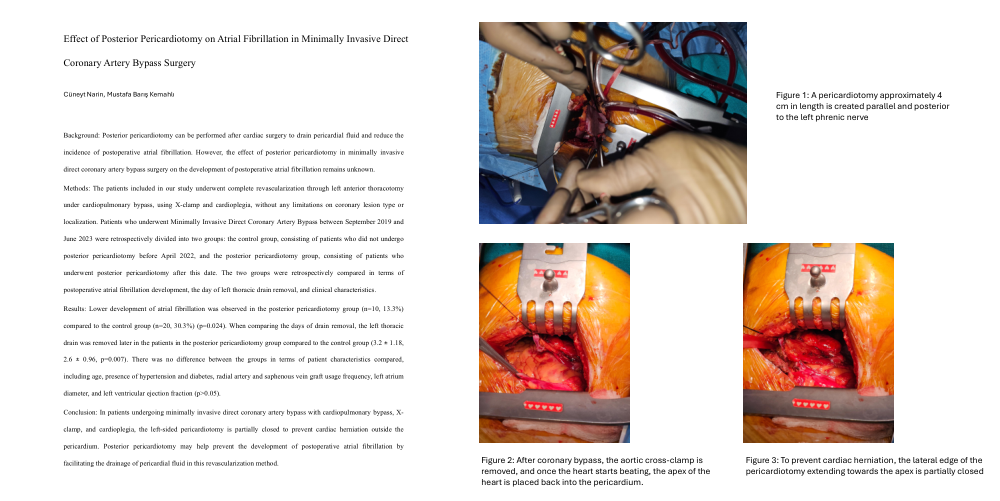
Background: Posterior pericardiotomy can be performed after cardiac surgery to drain pericardial fluid and reduce the incidence of postoperative atrial fibrillation. However, the effect of posterior pericardiotomy in minimally invasive direct coronary artery bypass surgery on the development of postoperative atrial fibrillation remains unknown.
Methods: The patients included in our study underwent complete revascularization through left anterior thoracotomy under cardiopulmonary bypass, using X-clamp and cardioplegia, without any limitations on coronary lesion type or localization. Patients who underwent Minimally Invasive Direct Coronary Artery Bypass between September 2019 and June 2023 were retrospectively divided into two groups: the control group, consisting of patients who did not undergo posterior pericardiotomy before April 2022, and the posterior pericardiotomy group, consisting of patients who underwent posterior pericardiotomy after this date. The two groups were retrospectively compared in terms of postoperative atrial fibrillation development, the day of left thoracic drain removal, and clinical characteristics.
Results: Lower development of atrial fibrillation was observed in the posterior pericardiotomy group (n=10, 13.3%) compared to the control group (n=20, 30.3%) (p=0.024). When comparing the days of drain removal, the left thoracic drain was removed later in the patients in the posterior pericardiotomy group compared to the control group (3.2 ± 1.18, 2.6 ± 0.96, p=0.007). There was no difference between the groups in terms of patient characteristics compared, including age, presence of hypertension and diabetes, radial artery and saphenous vein graft usage frequency, left atrium diameter, and left ventricular ejection fraction (p>0.05).
Conclusion: In patients undergoing minimally invasive direct coronary artery bypass with cardiopulmonary bypass, X-clamp, and cardioplegia, the left-sided pericardiotomy is partially closed to prevent cardiac herniation outside the pericardium. Posterior pericardiotomy may help prevent the development of postoperative atrial fibrillation by facilitating the drainage of pericardial fluid in this revascularization method.