293 posters, 56 videos, 24 topics, 13 sessions, 658 authors, 215 institutions
ePostersLive by SciGen Technologies S.A. All rights reserved.
ISMICS 2025 Annual Meeting
28 - 31 May, 2025 | Istanbul, Turkey

P31
High Patency Rates And Low Wound Complication Rates Can Be Achieved With No Touch Endoscopic Vein Harvesting
Poster Presenter
Authors
Part of Topic
Coroanry Revasc
Video
High Patency Rates And Low Wound Complication Rates Can Be Achieved With No Touch Endoscopic Vein Harvesting
Kunihiko Yoshino1, Rihito Tamaki2, Keita Kikuchi1, Hiroki Sakai1, Joji Ito1
1. Tokyo Bay Urayasu Ichikawa Medical Center
2. St. Luke’s International Hospital
①Background
The saphenous vein graft (SVG) remains an essential conduit in coronary artery bypass grafting (CABG), offering advantages such as wide availability, sufficient length, and ease of handling. However, traditional harvesting methods are associated with notable disadvantages, including reduced long-term patency and a high incidence of leg wound complications.
According to the ESC guidelines, Endoscopic Vein Harvesting (EVH) is recommended to reduce wound complications, while the No-touch technique is advocated to improve long-term graft patency[1-2].
To integrate the benefits of both approaches, we developed a new technique: No-touch Endoscopic Vein Harvesting (NT-EVH), aiming to achieve both high graft patency and reduced wound complication rates[3]. This study was conducted to evaluate the early outcomes of NT-EVH, focusing on one-year graft patency and wound complication rates.
②Methods
Primary Outcomes
Statistical Analysis
③Results
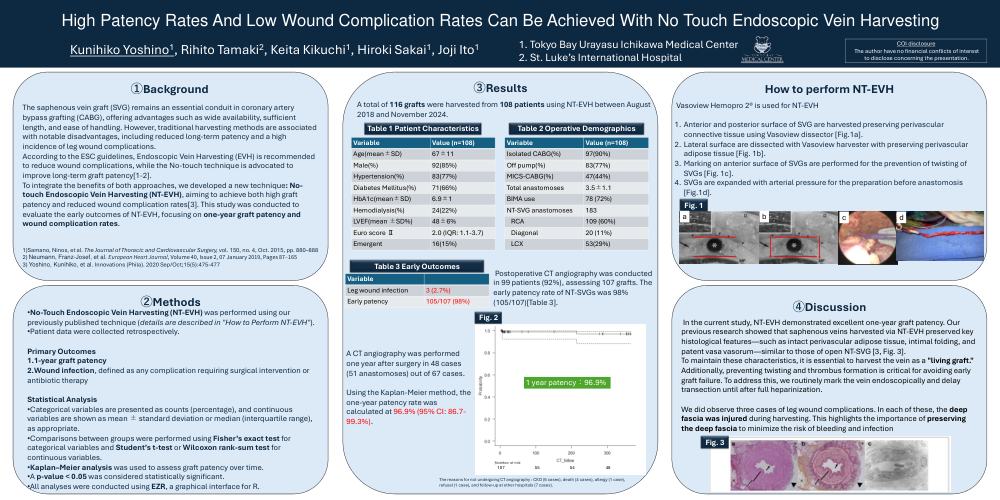
A total of 116 grafts were harvested from 108 patients using NT-EVH between August 2018 and November 2024.
Postoperative CT angiography was conducted in 99 patients (92%), assessing 107 grafts. The early patency rate of NT-SVGs was 98% (105/107)[Table 3].
A CT angiography was performed one year after surgery in 48 cases (51 anastomoses) out of 67 cases.
Using the Kaplan-Meier method, the one-year patency rate was calculated at 96.9% (95% CI: 86.7-99.3%).
How to perform NT-EVH
Vasoview Hemopro 2® is used for NT-EVH
1. Anterior and posterior surface of SVG are harvested preserving perivascular connective tissue using Vasoview dissector [Fig.1a].
2. Lateral surface are dissected with Vasoview harvester with preserving perivascular adipose tissue [Fig. 1b].
3. Marking on anterior surface of SVGs are performed for the prevention of twisting of SVGs [Fig. 1c].
4. SVGs are expanded with arterial pressure for the preparation before anastomosis [Fig.1d].
④Discussion
In the current study, NT-EVH demonstrated excellent one-year graft patency. Our previous research showed that saphenous veins harvested via NT-EVH preserved key histological features—such as intact perivascular adipose tissue, intimal folding, and patent vasa vasorum—similar to those of open NT-SVG [3, Fig. 3].
To maintain these characteristics, it is essential to harvest the vein as a "living graft." Additionally, preventing twisting and thrombus formation is critical for avoiding early graft failure. To address this, we routinely mark the vein endoscopically and delay transection until after full heparinization.
We did observe three cases of leg wound complications. In each of these, the deep fascia was injured during harvesting. This highlights the importance of preserving the deep fascia to minimize the risk of bleeding and infection