293 posters, 56 videos, 24 topics, 13 sessions, 658 authors, 215 institutions
ePostersLive by SciGen Technologies S.A. All rights reserved.
ISMICS 2025 Annual Meeting
28 - 31 May, 2025 | Istanbul, Turkey

P30
Sex Differences In Outcomes After On-pump Minimally Invasive Coronary Artery Bypass Grafting Via Anterior Thoracotomy
Poster Presenter
Authors
Part of Topic
Coronary Revasc plus
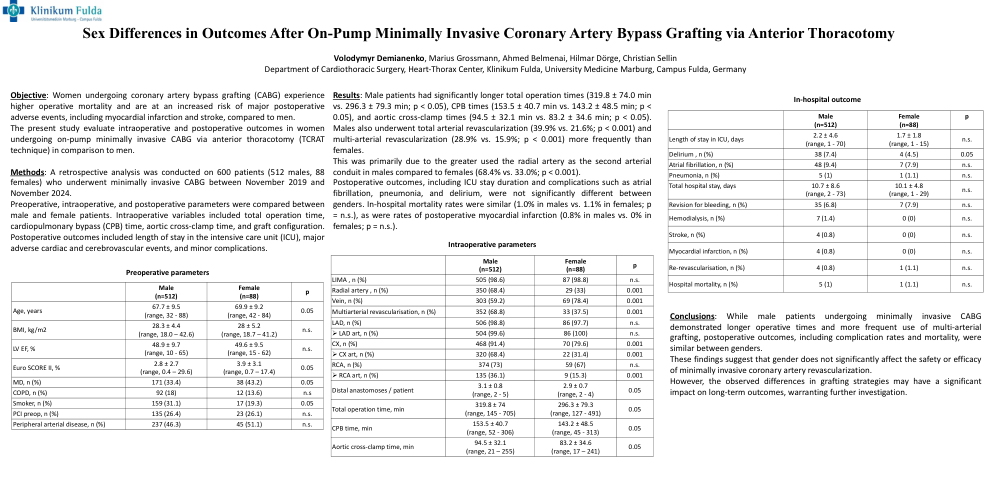
Sex Differences in Outcomes After On-Pump Minimally Invasive Coronary Artery Bypass Grafting via Anterior Thoracotomy
Objective: Women undergoing coronary artery bypass grafting (CABG) experience higher operative mortality and are at an increased risk of major postoperative adverse events, including myocardial infarction and stroke, compared to men. The present study evaluate intraoperative and postoperative outcomes in women undergoing on-pump minimally invasive CABG via anterior thoracotomy (TCRAT technique) in comparison to men.
Methods: A retrospective analysis was conducted on 600 patients (512 males, 88 females) who underwent minimally invasive CABG between November 2019 and November 2024. Preoperative, intraoperative, and postoperative parameters were compared between male and female patients. Intraoperative variables included total operation time, cardiopulmonary bypass (CPB) time, aortic cross-clamp time, and graft configuration. Postoperative outcomes included length of stay in the intensive care unit (ICU), major adverse cardiac and cerebrovascular events, and minor complications.
Results: Male patients had significantly longer total operation times (319.8 ± 74.0 min vs. 296.3 ± 79.3 min; p < 0.05), CPB times (153.5 ± 40.7 min vs. 143.2 ± 48.5 min; p < 0.05), and aortic cross-clamp times (94.5 ± 32.1 min vs. 83.2 ± 34.6 min; p < 0.05). Males also underwent total arterial revascularization (39.9% vs. 21.6%; p < 0.001) and multi-arterial revascularization (28.9% vs. 15.9%; p < 0.001) more frequently than females (Table1). This was primarily due to the greater used the radial artery as the second arterial conduit in males compared to females (68.4% vs. 33.0%; p < 0.001). Postoperative outcomes, including ICU stay duration and complications such as atrial fibrillation, pneumonia, and delirium, were not significantly different between genders. In-hospital mortality rates were similar (1.0% in males vs. 1.1% in females; p = n.s.), as were rates of postoperative myocardial infarction (0.8% in males vs. 0% in females; p = n.s.).
Conclusions: While male patients undergoing minimally invasive CABG demonstrated longer operative times and more frequent use of multi-arterial grafting, postoperative outcomes, including complication rates and mortality, were similar between genders. These findings suggest that gender does not significantly affect the safety or efficacy of minimally invasive coronary artery revascularization. However, the observed differences in grafting strategies may have a significant impact on long-term outcomes, warranting further investigation.