293 posters, 56 videos, 24 topics, 13 sessions, 658 authors, 215 institutions
ePostersLive by SciGen Technologies S.A. All rights reserved.
ISMICS 2025 Annual Meeting
28 - 31 May, 2025 | Istanbul, Turkey

P25
The Role Of Intra-aortic Balloon Pump Bridge Therapy At Resource Limited Institutions
Poster Presenter
Part of Topic
Coronary Revasc plus
The Role of Intra-Aortic Balloon Pump Bridge Therapy at Resource Limited Institutions:
Introduction:
•to characterize the indications for IABP usage at a community-based institution in the post IABP Shock 2 Era.
Manual chart review of retrospective data spanning from 2018 to 2023 was conducted on electronic medical records by two independent reviewer to identify all adult patients who received IABP placement.
Presence of co-morbidities, severity of coronary disease, and hemodynamic measurements were documented based on chart review
Differences between survivors and in-hospital mortalities were studied. Difference between the sexes were studied.
Significant differences between cohorts were found using the chi squared exact test and the Wilcoxon rank-sum test for categorical and continuous variables, respectively.
Kaplan Meier Survivor analysis was conducted on the entire cohort to study in-hospital mortality. Analysis was right-censored for patient discharge.
Sex Based Differences:
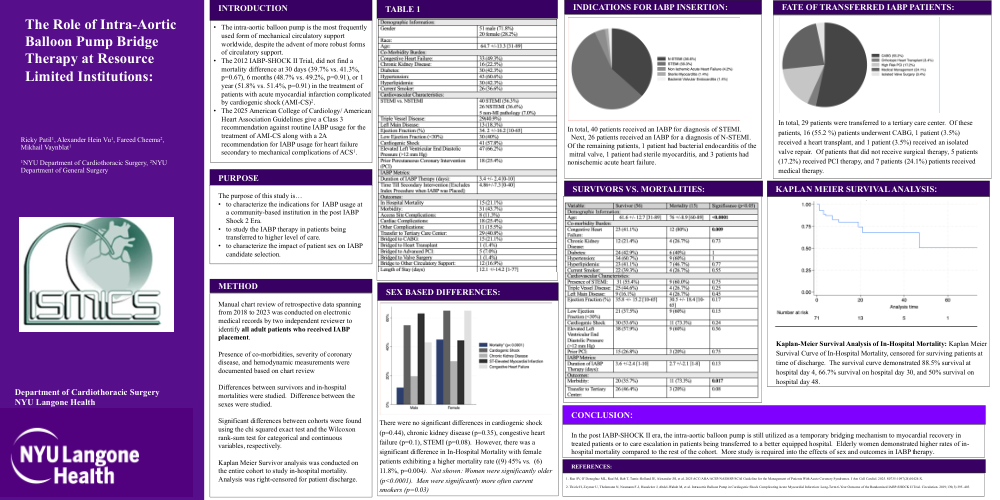
There were no significant differences in cardiogenic shock (p=0.44), chronic kidney disease (p=0.35), congestive heart failure (p=0.1), STEMI (p=0.08). However, there was a significant difference in In-Hospital Mortality with female patients exhibiting a higher mortality rate ((9) 45% vs. (6) 11.8%, p=0.004). Not shown: Women were significantly older (p<0.0001). Men were significantly more often current smokers (p=0.03).
Indications for IABP Insertion:
In total, 40 patients received an IABP for diagnosis of STEMI. Next, 26 patients received an IABP for a diagnosis of N-STEMI. Of the remaining patients, 1 patient had bacterial endocarditis of the mitral valve, 1 patient had sterile myocarditis, and 3 patients had nonischemic acute heart failure.
Fate of Transferred IABP Patients:
In total, 29 patients were transferred to a tertiary care center. Of these patients, 16 (55.2 %) patients underwent CABG, 1 patient (3.5%) received a heart transplant, and 1 patient (3.5%) received an isolated valve repair. Of patients that did not receive surgical therapy, 5 patients (17.2%) received PCI therapy, and 7 patients (24.1%) patients received medical therapy.
Kaplan Meier Survival Analysis: Kaplan Meier Survival Curve of In-Hospital Mortality, censored for surviving patients at time of discharge. The survival curve demonstrated 88.5% survival at hospital day 4, 66.7% survival on hospital day 30, and 50% survival on hospital day 48.
Conclusion:
In the post IABP-SHOCK II era, the intra-aortic balloon pump is still utilized as a temporary bridging mechanism to myocardial recovery in treated patients or to care escalation in patients being transferred to a better equipped hospital. Elderly women demonstrated higher rates of in-hospital mortality compared to the rest of the cohort. More study is required into the effects of sex and outcomes in IABP therapy.