293 posters, 56 videos, 24 topics, 13 sessions, 658 authors, 215 institutions
ePostersLive by SciGen Technologies S.A. All rights reserved.
ISMICS 2025 Annual Meeting
28 - 31 May, 2025 | Istanbul, Turkey

P22
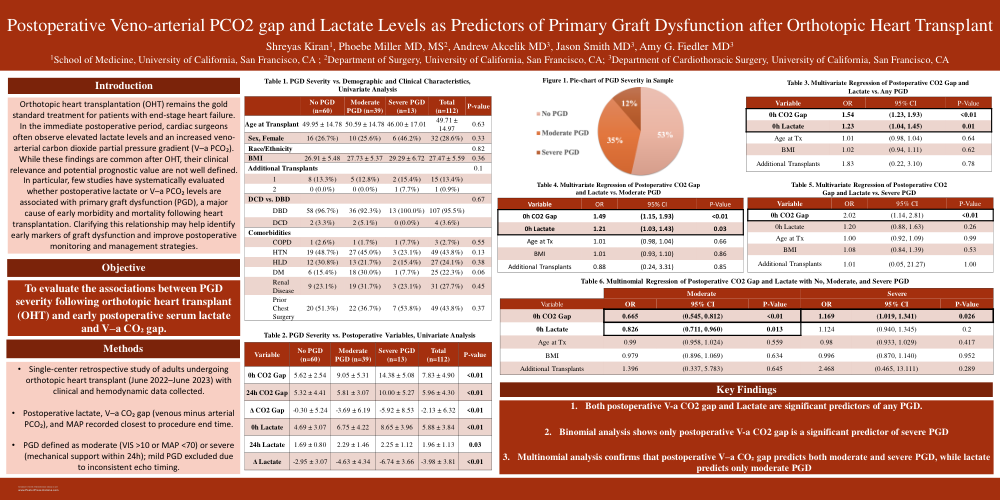
Postoperative Veno-arterial Pco2 Gap And Lactate Levels As Predictors Of Primary Graft Dysfunction After Orthotopic Heart Transplant
Poster Presenter
Authors
Shreyas Kiran, Phoebe Miller, Andrew Akcelik, Jason Smith, Amy Fiedler
Affiliations
School of Medicine, University of California, San Francisco, CA, Department of Surgery, University of California, San Francisco, CA, Department of Cardiothoracic Surgery, University of California, San Francisco, CA
Part of Topic
Coronary Revasc plus
Postoperative Veno-arterial PCO2 gap and Lactate Levels as Predictors of Primary Graft Dysfunction after Orthotopic Heart Transplant
Shreyas Kiran1, Phoebe Miller MD, MS2, Andrew Akcelik MD3, Jason Smith MD3, Amy G. Fiedler MD3
1School of Medicine, University of California, San Francisco, CA ; 2Department of Surgery, University of California, San Francisco, CA; 3Department of Cardiothoracic Surgery, University of California, San Francisco, CA
Orthotopic heart transplantation (OHT) remains the gold standard treatment for patients with end-stage heart failure. In the immediate postoperative period, cardiac surgeons often observe elevated lactate levels and an increased venoarterial carbon dioxide partial pressure gradient (V–a PCO₂). While these findings are common after OHT, their clinical relevance and potential prognostic value are not well defined. In particular, few studies have systematically evaluated whether postoperative lactate or V–a PCO₂ levels are associated with primary graft dysfunction (PGD), a major cause of early morbidity and mortality following heart transplantation. Clarifying this relationship may help identify early markers of graft dysfunction and improve postoperative monitoring and management strategies.