293 posters, 56 videos, 24 topics, 13 sessions, 658 authors, 215 institutions
ePostersLive by SciGen Technologies S.A. All rights reserved.
ISMICS 2025 Annual Meeting
28 - 31 May, 2025 | Istanbul, Turkey

P23
The Influence Of Severe Obesity On The Safety Of Minimally Invasive Coronary Revascularization
Poster Presenter
Authors
Part of Topic
Coronary Revasc plus
The Influence of Severe Obesity on the Safety of Minimally Invasive Coronary Revascularization
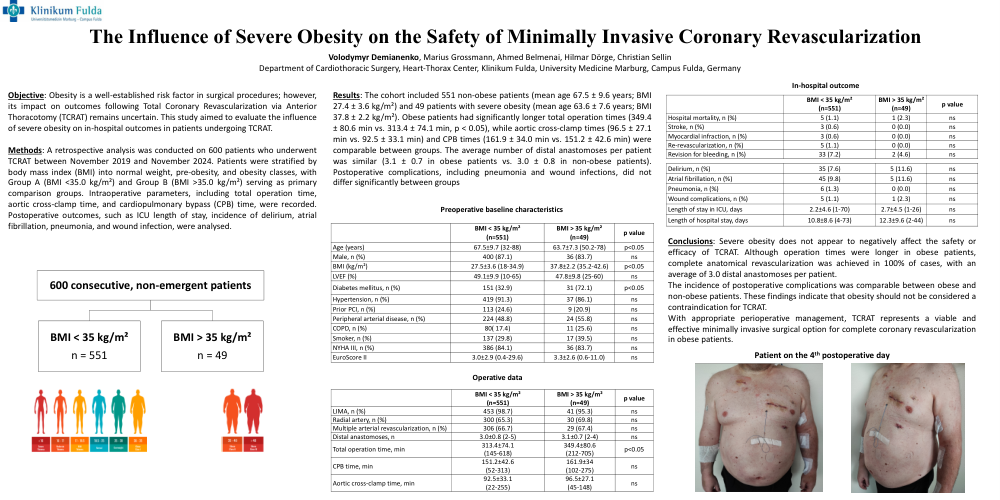
Objective: Obesity is a well-established risk factor in surgical procedures; however, its impact on outcomes following Total Coronary Revascularization via Anterior Thoracotomy (TCRAT) remains uncertain. This study aimed to evaluate the influence of severe obesity on in-hospital outcomes in patients undergoing TCRAT.
Methods: A retrospective analysis was conducted on 600 patients who underwent TCRAT between November 2019 and November 2024. Patients were stratified by body mass index (BMI) into normal weight, pre-obesity, and obesity classes, with Group A (BMI <35.0 kg/m²) and Group B (BMI >35.0 kg/m²) serving as primary comparison groups. Intraoperative parameters, including total operation time, aortic cross-clamp time, and cardiopulmonary bypass (CPB) time, were recorded. Postoperative outcomes, such as ICU length of stay, incidence of delirium, atrial fibrillation, pneumonia, and wound infection, were analyzed.
Results: The cohort included 551 non-obese patients (mean age 67.5 ± 9.6 years; BMI 27.4 ± 3.6 kg/m²) and 49 patients with severe obesity (mean age 63.6 ± 7.6 years; BMI 37.8 ± 2.2 kg/m²). Obese patients had significantly longer total operation times (349.4 ± 80.6 min vs. 313.4 ± 74.1 min, p < 0.05), while aortic cross-clamp times (96.5 ± 27.1 min vs. 92.5 ± 33.1 min) and CPB times (161.9 ± 34.0 min vs. 151.2 ± 42.6 min) were comparable between groups. The average number of distal anastomoses per patient was similar (3.1 ± 0.7 in obese patients vs. 3.0 ± 0.8 in non-obese patients). Postoperative complications, including pneumonia and wound infections, did not differ significantly between groups.
Conclusions: Severe obesity does not appear to negatively affect the safety or efficacy of TCRAT. Although operation times were longer in obese patients, complete anatomical revascularization was achieved in 100% of cases, with an average of 3.0 distal anastomoses per patient. The incidence of postoperative complications, including infections, was comparable between obese and non-obese patients. These findings indicate that obesity should not be considered a contraindication for TCRAT. With appropriate perioperative management, TCRAT represents a viable and effective minimally invasive surgical option for complete coronary revascularization in obese patients.