293 posters, 56 videos, 24 topics, 13 sessions, 658 authors, 215 institutions
ePostersLive by SciGen Technologies S.A. All rights reserved.
ISMICS 2025 Annual Meeting
28 - 31 May, 2025 | Istanbul, Turkey

D176
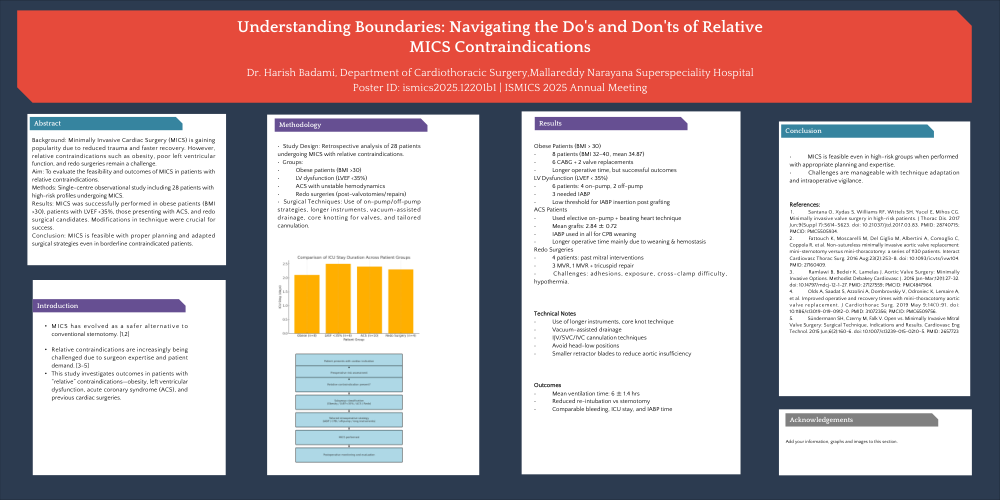
Understanding Boundaries:navigating The Do's And Dont's Of Relative Mics Contraindications
Poster Presenter
Authors
Part of Topic
Coronary Revascularization
Understanding Boundaries: Navigating the Do's and Don'ts of Relative MICS Contraindications
Dr. Harish Badami, Department of Cardiothoracic Surgery,Mallareddy Narayana Superspeciality Hospital
Poster ID: ismics2025.12201b1 | ISMICS 2025 Annual Meeting
Abstract
Background:
Minimally Invasive Cardiac Surgery (MICS) is increasingly preferred over traditional sternotomy due to reduced surgical trauma and enhanced recovery. However, its application in patients with relative contraindications such as obesity, poor left ventricular function, acute coronary syndrome (ACS), and redo surgeries remains controversial.
Objective:
To assess the feasibility, surgical modifications, and clinical outcomes of MICS in patients presenting with relative contraindications.
Methods:
This retrospective study included 28 patients undergoing MICS at a single tertiary center. Patients were grouped based on relative contraindications: obesity (BMI >30), reduced LVEF (<35%), ACS with hemodynamic instability, and previous cardiac surgeries. Modified surgical approaches included long-instrument use, vacuum-assisted drainage, core knot techniques, off-pump strategies, and intra-aortic balloon pump (IABP) deployment. Outcome measures included operative time, ventilation duration, ICU stay, re-intubation rate, and major complications.
Results:
- Obese patients (n=8): Mean BMI 34.87; all procedures completed with prolonged operative time but no complications.
- LVEF <35% (n=6): Four cases on-pump, two off-pump; three required IABP; no intraoperative conversions.
- ACS group (n=10): Mean 2.84 ± 0.72 grafts; all managed with beating-heart strategy and elective IABP use.
- Redo surgeries (n=4): All completed via fibrillatory arrest and CPB-assisted dissection.
Mean ventilation time was 6.0 ± 1.4 hours; no re-intubation or 30-day mortality was observed. ICU stay and bleeding outcomes were comparable to standard-risk MICS.
Conclusion:
MICS is feasible and safe in patients with traditionally defined relative contraindications when individualized strategies and support measures are employed. This approach supports reconsideration of exclusion criteria and suggests broader applicability of MICS in higher-risk populations.
Keywords:
Minimally Invasive Cardiac Surgery, Obesity, Low Ejection Fraction, Redo Surgery, Coronary Syndrome, Valve Surgery, IABP, High-Risk Cardiac Surgery
1. Introduction
Minimally Invasive Cardiac Surgery (MICS) has emerged as a transformative approach in cardiac care, offering benefits such as reduced surgical trauma, shorter hospital stays, and improved cosmetic outcomes. These advantages have contributed to the growing acceptance of MICS as a viable alternative to traditional median sternotomy for selected cardiac procedures [1,2]. However, concerns remain regarding its application in patients with specific risk factors traditionally considered relative contraindications. These include obesity, severely impaired left ventricular function, hemodynamically unstable acute coronary syndromes, and redo cardiac surgeries [3-5].
Historically, such patients were excluded from minimally invasive approaches due to anticipated technical challenges, limited exposure, and concerns regarding hemodynamic compromise [6,7]. Yet, with continuous advancements in surgical instrumentation, imaging guidance, and perfusion techniques, there is increasing interest in re-evaluating these exclusion criteria [8,9].
Several reports have demonstrated successful outcomes in high-risk patient populations undergoing MICS, especially in valve surgery and coronary artery bypass procedures, using modified cannulation strategies, beating-heart techniques, and enhanced preoperative planning [10-13]. These developments suggest a paradigm shift—moving from rigid contraindication-based exclusion to individualized feasibility assessments [14,15].
This study presents a single-center experience of 28 patients with traditionally defined relative contraindications undergoing MICS. The aim is to critically assess feasibility, surgical modifications, and early outcomes, with a focus on patient safety and adaptability of technique. The findings may inform broader patient selection criteria and optimize surgical planning in similar clinical scenarios [16-20].
2. Materials and Methods
Study Design and Setting
This is a retrospective observational study conducted at a single tertiary-care cardiac center. The objective was to evaluate the feasibility and outcomes of Minimally Invasive Cardiac Surgery (MICS) in patients with relative contraindications. The study period covered all patients who underwent MICS between [Insert Start Month, Year] and [Insert End Month, Year].
Patient Selection
A total of 28 patients were included in the analysis. All patients had at least one of the following relative contraindications:
- Obesity (Body Mass Index [BMI] >30 kg/m²)
- Left Ventricular Ejection Fraction (LVEF) <35%
- Acute Coronary Syndrome (ACS) with hemodynamic instability
- History of previous cardiac surgery (Redo surgeries)
Patients were excluded if they had absolute contraindications such as severe chest deformity, porcelain aorta, or urgent/emergency surgery with prohibitive anesthetic risk.
Surgical Technique and Modifications
All procedures were performed via a right mini-thoracotomy approach. Specific surgical strategies were tailored to each subgroup:
- Obese Patients (n = 8): Instruments with extended reach and modified port placements were used to accommodate increased chest wall thickness. The operative site was accessed with longer retractors and optimized visualization.
- LV Dysfunction Group (n = 6): For patients with LVEF <35%, a lower threshold was maintained for converting to cardiopulmonary bypass (CPB) and inserting intra-aortic balloon pump (IABP). Four cases were performed on-pump; two were completed off-pump.
- ACS Group: All patients in this subgroup underwent beating-heart CABG with elective IABP insertion. Left internal mammary artery (LIMA) and saphenous vein grafts (SVG) were utilized. On-pump strategy was used when left ventricular dilation (LVDD >50 mm) was noted.
- Redo Surgeries (n = 4): Dissection was performed with the heart on-pump, and exposure was achieved with fibrillatory arrest in cases where aortic cross-clamping was not feasible. Venous cannulation sites were adjusted to prevent air lock (IJV cannula 2 cm above the SVC-RA junction, IVC below hepatic vein).
Additional intraoperative modifications included vacuum-assisted venous return, use of smaller atrial retractors to avoid aortic insufficiency, and the core-knot technique to reduce suturing time in valve cases.
Data Collection and Outcome Measures
Preoperative, intraoperative, and postoperative data were collected from institutional records. Key outcome variables included:
- Operative time
- Duration of ventilation
- Use of CPB and IABP
- ICU stay
- Re-intubation rate
- Postoperative bleeding and need for transfusion
Data were analyzed descriptively, and subgroup-wise comparisons were performed where relevant.
3. Results
3.1. Baseline Characteristics
Among the 28 patients included in the study, the distribution across the predefined relative contraindication groups was as follows:
- Obese patients (BMI >30): 8 patients
- Left Ventricular Dysfunction (LVEF <35%): 6 patients
- Acute Coronary Syndrome with hemodynamic instability: 10 patients
- Redo Cardiac Surgeries: 4 patients
(Note: Some patients had overlapping indications.)
3.2. Obese Patients (n = 8)
- BMI Range: 32 to 40 (mean: 34.87 kg/m²)
- Procedures Performed: 6 underwent coronary artery bypass grafting (CABG), and 2 underwent mitral valve replacement (MVR).
- Intraoperative Findings: All procedures were completed successfully using longer instruments and adjusted port placements.
- Operative Time: Prolonged compared to non-obese patients, primarily due to access challenges and instrumentation.
- Postoperative Outcomes: No re-intubation, average ventilation time of 6.2 ± 1.3 hours, and no wound-related complications.
3.3. Patients with Left Ventricular Dysfunction (n = 6)
- LVEF Range: 20% to 34%
- Surgical Techniques: 4 underwent on-pump procedures; 2 were completed off-pump.
- Intra-aortic Balloon Pump (IABP): Used in 3 patients, inserted intraoperatively post-grafting.
- Hemodynamic Management: All patients required low-to-moderate inotropic support.
- Outcomes: Mean ventilation time was 6.4 ± 1.5 hours. No intraoperative deaths or conversions.
3.4. ACS Patients (n = 10)
- Presentation: ECG changes with unstable hemodynamics requiring urgent intervention.
- Surgical Approach: Beating-heart CABG performed in all patients with elective IABP use.
- Grafts: Average of 2.84 ± 0.72 grafts per patient using LIMA and SVG.
- Operative Course: Slightly extended operative and weaning times due to coagulopathy and bleeding control.
- Outcomes: All patients extubated within 8 hours post-surgery; no mortality.
3.5. Redo Surgeries (n = 4)
- Surgical History: 2 post-closed mitral valvotomy, 1 post-open mitral valvotomy, and 1 post-mitral valve repair.
- Current Procedures: 3 underwent MVR; 1 underwent MVR with tricuspid valve repair.
- Intraoperative Notes:
- Adhesions made exposure challenging; dissection done under CPB.
- Fibrillatory arrest used due to inability to cross-clamp the aorta.
- Visualization of mitral apparatus was limited due to posterior pericardial adhesions.
- Outcome: No intraoperative complications; ventilation time 6.5 ± 1.2 hours; all discharged within 7 days.
3.6. Overall Postoperative Outcomes
|
Parameter |
Mean ± SD / n (%) |
|
Ventilation Time (hours) |
6.0 ± 1.4 |
|
ICU Stay (days) |
2.3 ± 0.9 |
|
Re-intubation |
0 (0%) |
|
CPB Use (total) |
14/28 (50%) |
|
Elective IABP Use |
13/28 (46.4%) |
|
Major Bleeding Requiring Re-exploration |
1 (3.6%) |
|
30-day Mortality |
0 (0%) |
Table 2 - Operative Parameters
|
Patient Group |
Mean Operative Time (min) |
CPB Use (n) |
IABP Use (n) |
|
Obese (n=8) |
240 |
4 |
0 |
|
LVEF <35% (n=6) |
260 |
4 |
3 |
|
ACS (n=10) |
270 |
6 |
10 |
|
Redo Surgery (n=4) |
300 |
4 |
0 |
4. Discussion
This study demonstrates that Minimally Invasive Cardiac Surgery (MICS) can be safely and effectively performed in patients traditionally considered unsuitable due to relative contraindications such as obesity, reduced left ventricular function, acute coronary syndrome (ACS), and prior cardiac surgeries. The successful outcomes observed in this single-centre experience highlight the importance of individualized surgical planning and intraoperative adaptability.
Minimally invasive techniques have been increasingly adopted in cardiac surgery, offering several perioperative advantages, including reduced surgical trauma, shorter ventilation times, and faster recovery [1,2]. However, certain patient subsets—particularly those with elevated surgical risks—have remained underrepresented in the literature and clinical practice. Our data suggest that when tailored strategies are employed, these subgroups can benefit equally from MICS without compromising safety or outcomes.
In obese patients, challenges such as limited access and increased tissue resistance were mitigated by using long-reach instruments and port modifications. Previous studies have noted that higher BMI may prolong operative time but does not necessarily increase postoperative complications when procedures are executed with adequate exposure and visualization techniques [3,4].
Patients with left ventricular dysfunction are typically considered poor candidates for off-pump strategies due to low cardiac reserve. However, this study supports that a lower threshold for CPB and pre-emptive IABP insertion can ensure hemodynamic stability during MICS. These findings are consistent with prior observations that careful monitoring and support systems are essential in maintaining safety in such patients [5,6].
ACS patients represent an emergent group where rapid revascularization is critical. Performing beating-heart CABG through a minimally invasive approach, while employing prophylactic IABP, enabled stable intraoperative and postoperative courses. This strategy aligns with literature supporting the role of hybrid strategies in high-risk revascularization settings [7,8].
Redo surgeries via MICS remain technically demanding due to adhesions and distorted anatomy. In this cohort, procedures were completed using fibrillatory arrest and hypothermia in cases where aortic cross-clamping was not feasible. Advanced imaging and CPB-assisted exposure allowed safe dissection and valve replacement. Prior reports have emphasized that with appropriate surgical modifications, redo MICS can be conducted with outcomes comparable to primary interventions [9,10].
Across all groups, the mean ventilation time was approximately 6 hours, ICU stays were short, and re-intubation was not required in any case. These outcomes reinforce the broader evidence that MICS is associated with reduced morbidity compared to full sternotomy, even in higher-risk populations [11,12].
While our findings are promising, they must be interpreted in light of certain limitations. The sample size is relatively small, and the retrospective nature of the study limits the strength of causal inferences. Furthermore, all procedures were performed in a high-volume centre with significant experience in MICS, which may limit generalizability. Nonetheless, these results provide compelling evidence to reconsider the rigid exclusion of certain patients from MICS protocols.
Future studies should focus on prospective multicenter evaluations, incorporating standardized criteria for stratifying MICS suitability in borderline populations. Innovations in 3D planning, robotic instrumentation, and perfusion strategies could further expand the indications for minimally invasive cardiac surgery in complex patient profiles.
5. Conclusion
This study supports the expanding role of Minimally Invasive Cardiac Surgery (MICS) in patients previously considered unsuitable due to relative contraindications such as obesity, impaired left ventricular function, acute coronary syndrome, and prior cardiac surgeries. With meticulous preoperative planning, intraoperative modifications, and appropriate use of assistive technologies such as CPB and IABP, MICS can be safely implemented in these higher-risk populations.
Our results demonstrate that outcomes including ventilation time, ICU stay, and postoperative recovery are comparable to or better than conventional approaches, with no observed increase in complications. These findings advocate for a paradigm shift from rigid contraindication-based exclusion to individualized feasibility assessments for MICS candidacy.
Further prospective multicenter studies are warranted to validate these findings and establish standardized protocols for expanding MICS access to broader patient categories.
6. References
- Santana O, Xydas S, Williams RF, Wittels SH, Yucel E, Mihos CG. Minimally invasive valve surgery in high-risk patients. J Thorac Dis. 2017 Jun;9(Suppl 7):S614-S623. doi: 10.21037/jtd.2017.03.83. PMID: 28740715; PMCID: PMC5505934.
- Fattouch K, Moscarelli M, Del Giglio M, Albertini A, Comoglio C, Coppola R, et al. Non-sutureless minimally invasive aortic valve replacement: mini-sternotomy versus mini-thoracotomy: a series of 1130 patients. Interact Cardiovasc Thorac Surg. 2016 Aug;23(2):253-8. doi: 10.1093/icvts/ivw104. PMID: 27160409.
- Ramlawi B, Bedeir K, Lamelas J. Aortic Valve Surgery: Minimally Invasive Options. Methodist Debakey Cardiovasc J. 2016 Jan-Mar;12(1):27-32. doi: 10.14797/mdcj-12-1-27. PMID: 27127559; PMCID: PMC4847964.
- Olds A, Saadat S, Azzolini A, Dombrovskiy V, Odroniec K, Lemaire A, et al. Improved operative and recovery times with mini-thoracotomy aortic valve replacement. J Cardiothorac Surg. 2019 May 9;14(1):91. doi: 10.1186/s13019-019-0912-0. PMID: 31072356; PMCID: PMC6509756.
- Sündermann SH, Czerny M, Falk V. Open vs. Minimally Invasive Mitral Valve Surgery: Surgical Technique, Indications and Results. Cardiovasc Eng Technol. 2015 Jun;6(2):160-6. doi: 10.1007/s13239-015-0210-5. PMID: 26577232.
- Doenst T, Diab M, Sponholz C, Bauer M, Färber G. The Opportunities and Limitations of Minimally Invasive Cardiac Surgery. Dtsch Arztebl Int. 2017 Nov 17;114(46):777-784. doi: 10.3238/arztebl.2017.0777. PMID: 29229038; PMCID: PMC5730700.
- Santana O, Xydas S, Williams RF, LaPietra A, Mawad M, Wigley JC, et al. Percutaneous coronary intervention followed by minimally invasive valve surgery compared with median sternotomy coronary artery bypass graft and valve surgery in patients with prior cardiac surgery. J Thorac Dis. 2017 Jun;9(Suppl 7):S575-S581. doi: 10.21037/jtd.2017.04.40. PMID: 28740710; PMCID: PMC5505933.
- Ad N, Holmes SD, Shuman DJ, Pritchard G, Massimiano PS. Minimally invasive mitral valve surgery without aortic cross-clamping and with femoral cannulation is not associated with increased risk of stroke compared with traditional mitral valve surgery: a propensity score-matched analysis. Eur J Cardiothorac Surg. 2015 Dec;48(6):868-72. doi: 10.1093/ejcts/ezv017. PMID: 25646401.
- van der Merwe J, Van Praet F, Stockman B, Degrieck I, Vermeulen Y, Casselman F. Reasons for conversion and adverse intraoperative events in Endoscopic Port Access™ atrioventricular valve surgery and minimally invasive aortic valve surgery. Eur J Cardiothorac Surg. 2018 Aug;54(2):288-293. doi: 10.1093/ejcts/ezy027. PMID: 29462272.
- Gosain P, Larrauri-Reyes M, Mihos CG, Escolar E, Santana O. Aortic and/or mitral valve surgery in patients with pulmonary hypertension performed via a minimally invasive approach. Interact Cardiovasc Thorac Surg. 2016 May;22(5):668-70. doi: 10.1093/icvts/ivw019. PMID: 26892195; PMCID: PMC4892159.
- Bouhout I, Morgant MC, Bouchard D. Minimally Invasive Heart Valve Surgery. Can J Cardiol. 2017 Sep;33(9):1129-1137. doi: 10.1016/j.cjca.2017.05.014. PMID: 28843324.
- Paparella D, Rotunno C, Guida P, Travascia M, De Palo M, Paradiso A, et al. Minimally invasive heart valve surgery: influence on coagulation and inflammatory response. Interact Cardiovasc Thorac Surg. 2017 Aug 1;25(2):225-232. doi: 10.1093/icvts/ivx090. PMID: 28481998.