293 posters, 56 videos, 24 topics, 13 sessions, 658 authors, 215 institutions
ePostersLive by SciGen Technologies S.A. All rights reserved.
ISMICS 2025 Annual Meeting
28 - 31 May, 2025 | Istanbul, Turkey

D12
Coronary Endarterectomy Outcomes In Patients Undergoing Cabg: An Experience Of Qatar Over The Last Decade
Poster Presenter
Part of Topic
Coronary Revascularization
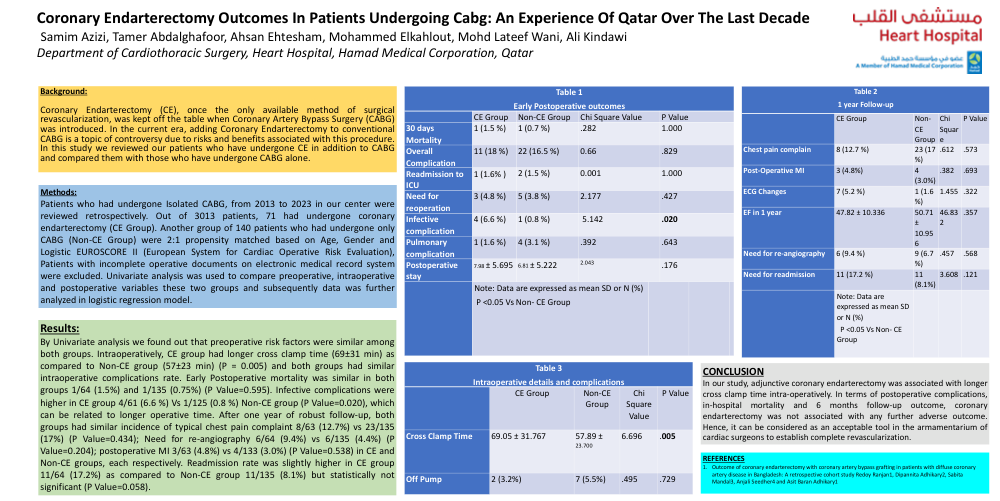
Background: Coronary Endarterectomy (CE), once the only available method of surgical revascularization, was kept off the table when Coronary Artery Bypass Surgery (CABG) was introduced. In the current era, adding Coronary Endarterectomy to conventional CABG is a topic of controversy due to risks and benefits associated with this procedure. In this study we reviewed our patients who have undergone CE in addition to CABG and compared them with those who have undergone CABG alone.
Methods: Patients who had undergone Isolated CABG, from 2013 to 2023 in our center were reviewed retrospectively. Out of 3013 patients, 71 had undergone coronary endarterectomy (CE Group). Another group of 140 patients who had undergone only CABG (Non-CE Group) were 2:1 propensity matched based on Age, Gender and Logistic EUROSCORE II (European System for Cardiac Operative Risk Evaluation), Patients with incomplete operative documents on electronic medical record system were excluded. Univariate analysis was used to compare preoperative, intraoperative and postoperative variables these two groups and subsequently data was further analyzed in logistic regression model.
Results: By Univariate analysis we found out that preoperative risk factors were similar among both groups. Intraoperatively, CE group had longer cross clamp time (69±31 min) as compared to Non-CE group (57±23 min) (P = 0.005) and both groups had similar intraoperative complications rate. Early Postoperative mortality was similar in both groups 1/64 (1.5%) and 1/135 (0.75%) (P Value=0.595). Infective complications were higher in CE group 4/61 (6.6 %) Vs 1/125 (0.8 %) Non-CE group (P Value=0.020), which can be related to longer operative time. After one year of robust follow-up, both groups had similar incidence of typical chest pain complaint 8/63 (12.7%) vs 23/135 (17%) (P Value=0.434); Need for re-angiography 6/64 (9.4%) vs 6/135 (4.4%) (P Value=0.204); postoperative MI 3/63 (4.8%) vs 4/133 (3.0%) (P Value=0.538) in CE and Non-CE groups, each respectively. Readmission rate was slightly higher in CE group 11/64 (17.2%) as compare to Non-CE group 11/135 (8.1%) but statistically not significant (P Value=0.058).
Conclusion: In our study, adjunctive coronary endarterectomy was associated with longer cross clamp time intra-operatively. In terms of postoperative complications, in-hospital mortality and 6 months follow-up outcome, coronary endarterectomy was not associated with any further adverse outcome. Hence, it can be considered as an acceptable tool in the armamentarium of cardiac surgeons to establish complete revascularization.