293 posters, 56 videos, 24 topics, 13 sessions, 658 authors, 215 institutions
ePostersLive by SciGen Technologies S.A. All rights reserved.
ISMICS 2025 Annual Meeting
28 - 31 May, 2025 | Istanbul, Turkey

D145
Technique For Concomitant Closure Of The Left Atrial Appendage As Part Of Robotically Assisted Direct Coronary Artery Bypass
Poster Presenter
Authors
Part of Topic
Coronary Revascularization
Technique For Concomitant Closure Of The Left Atrial Appendage As Part Of Robotically Assisted Direct Coronary Artery Bypass
Introduction
Atrial fibrillation is an increasingly relevant comorbidity in cardiac surgical patients1 and has been the focus of many efforts in adapting therapies to better mitigate negative long-term outcomes through ablation and/or closure of the left atrial appendage (LAA). LAA closure in itself provides a significant reduction of stroke risk and consequently mortality in patients who undergo cardiac procedures. Furthermore, eventually stopping oral anticoagulants after LAA closure reduces the incidence of associated bleeding complications. In the growing field of robotically assisted coronary surgery, minimally invasive strategies have posed a challenge in exposing and closing the LAA.
Methods
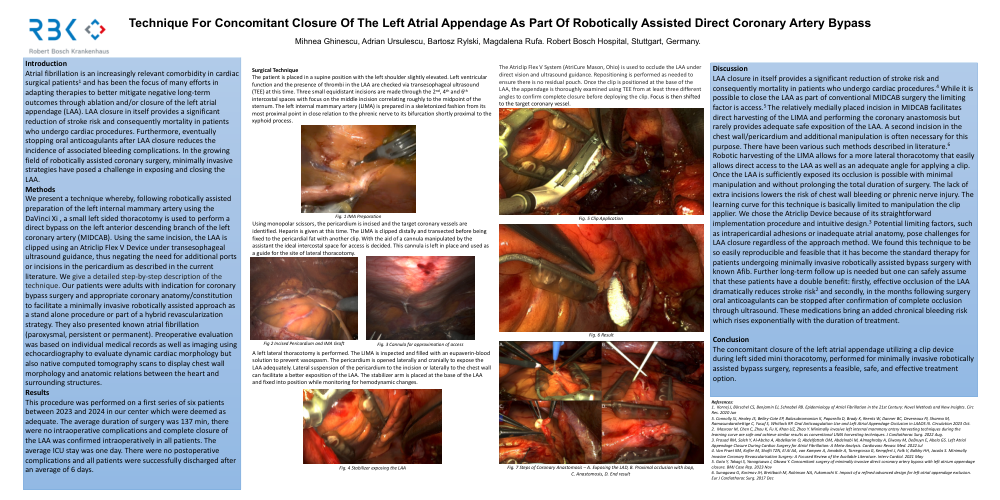
We present a technique whereby, following robotically assisted preparation of the left internal mammary artery using the DaVinci Xi , a small left sided thoracotomy is used to perform a direct bypass on the left anterior descending branch of the left coronary artery (MIDCAB). Using the same incision, the LAA is clipped using an Atriclip Flex V Device under transesophageal ultrasound guidance, thus negating the need for additional ports or incisions in the pericardium as described in the current literature. We give a detailed step-by-step description of the technique. Our patients were adults with indication for coronary bypass surgery and appropriate coronary anatomy/constitution to facilitate a minimally invasive robotically assisted approach as a stand alone procedure or part of a hybrid revascularization strategy. They also presented known atrial fibrillation (paroxysmal, persistent or permanent). Preoperative evaluation was based on individual medical records as well as imaging using echocardiography to evaluate dynamic cardiac morphology but also native computed tomography scans to display chest wall morphology and anatomic relations between the heart and surrounding structures.
Results
This procedure was performed on a first series of six patients between 2023 and 2024 in our center which were deemed as adequate. The average duration of surgery was 137 min, there were no intraoperative complications and complete closure of the LAA was confirmed intraoperatively in all patients. The average ICU stay was one day. There were no postoperative complications and all patients were successfully discharged after an average of 6 days.
Discussion
LAA closure in itself provides a significant reduction of stroke risk and consequently mortality in patients who undergo cardiac procedures.4 While it is possible to close the LAA as part of conventional MIDCAB surgery the limiting factor is access.5 The relatively medially placed incision in MIDCAB facilitates direct harvesting of the LIMA and performing the coronary anastomosis but rarely provides adequate safe exposition of the LAA. A second incision in the chest wall/pericardium and additional manipulation is often necessary for this purpose. There have been various such methods described in literature.6Robotic harvesting of the LIMA allows for a more lateral thoracotomy that easily allows direct access to the LAA as well as an adequate angle for applying a clip. Once the LAA is sufficiently exposed its occlusion is possible with minimal manipulation and without prolonging the total duration of surgery. The lack of extra incisions lowers the risk of chest wall bleeding or phrenic nerve injury. The learning curve for this technique is basically limited to manipulation the clip applier. We chose the Atriclip Device because of its straightforward implementation procedure and intuitive design.3 Potential limiting factors, such as intrapericardial adhesions or inadequate atrial anatomy, pose challenges for LAA closure regardless of the approach method. We found this technique to be so easily reproducible and feasible that it has become the standard therapy for patients undergoing minimally invasive robotically assisted bypass surgery with known Afib. Further long-term follow up is needed but one can safely assume that these patients have a double benefit: firstly, effective occlusion of the LAA dramatically reduces stroke risk2 and secondly, in the months following surgery oral anticoagulants can be stopped after confirmation of complete occlusion through ultrasound. These medications bring an added chronical bleeding risk which rises exponentially with the duration of treatment.
Conclusion
The concomitant closure of the left atrial appendage utilizing a clip device during left sided mini thoracotomy, performed for minimally invasive robotically assisted bypass surgery, represents a feasible, safe, and effective treatment option.