293 posters, 56 videos, 24 topics, 13 sessions, 658 authors, 215 institutions
ePostersLive by SciGen Technologies S.A. All rights reserved.
ISMICS 2025 Annual Meeting
28 - 31 May, 2025 | Istanbul, Turkey

D123
Clinical Results Of Da Vinci Robot-assisted Minimally Invasive Multivessel Coronary Artery Bypass Grafting
Poster Presenter
Authors
Affiliations
Part of Topic
Coronary Revascularization
Clinical Results Of Da Vinci Robot-assisted Minimally Invasive Multivessel Coronary Artery Bypass Grafting
Sheng Wang1; Zhao Li1; Guoqing Lu1
1Fuwai Central China Cardiovascular Hospital (Central China Fuwai Hospital of Zhengzhou University), Zhengzhou, China
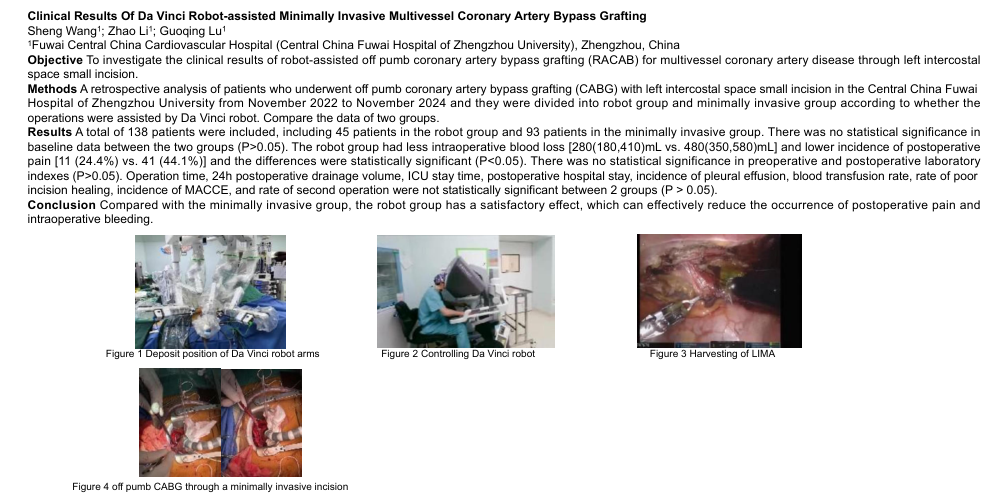
Objective To investigate the clinical results of robot-assisted off pumb coronary artery bypass grafting (RACAB) for multivessel coronary artery disease through left intercostal space small incision.
Methods A retrospective analysis of patients who underwent off pumb coronary artery bypass grafting (CABG) with left intercostal space small incision in the Central China Fuwai Hospital of Zhengzhou University from November 2022 to November 2024 and they were divided into robot group and minimally invasive group according to whether the operations were assisted by Da Vinci robot. Compare the data of two groups.
Results A total of 138 patients were included, including 45 patients in the robot group and 93 patients in the minimally invasive group. There was no statistical significance in baseline data between the two groups (P>0.05). The robot group had less intraoperative blood loss [280(180,410)mL vs. 480(350,580)mL] and lower incidence of postoperative pain [11 (24.4%) vs. 41 (44.1%)] and the differences were statistically significant (P<0.05). There was no statistical significance in preoperative and postoperative laboratory indexes (P>0.05). Operation time, 24h postoperative drainage volume, ICU stay time, postoperative hospital stay, incidence of pleural effusion, blood transfusion rate, rate of poor incision healing, incidence of MACCE, and rate of second operation were not statistically significant between 2 groups (P > 0.05).
Conclusion Compared with the minimally invasive group, the robot group has a satisfactory effect, which can effectively reduce the occurrence of postoperative pain and intraoperative bleeding.