293 posters, 56 videos, 24 topics, 13 sessions, 658 authors, 215 institutions
ePostersLive by SciGen Technologies S.A. All rights reserved.
ISMICS 2025 Annual Meeting
28 - 31 May, 2025 | Istanbul, Turkey

P28
Antegrade Perfusion In Minimally Invasive Coronary Artery Bypass Grafting: Axillary Cannulation Outcomes
Poster Presenter
Authors
Part of Topic
Coronary Revasc plus
Antegrade Perfusion in Minimally Invasive CABG: Axillary Cannulation Outcomes
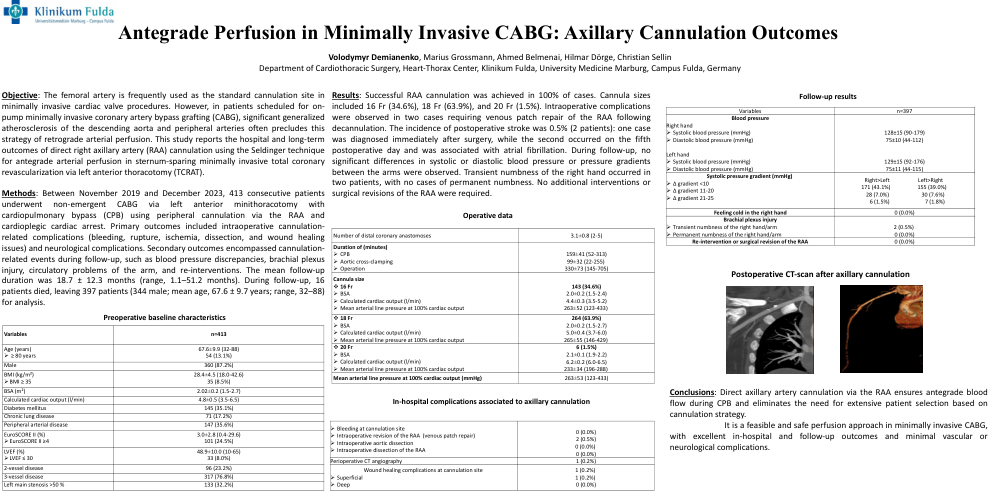
Objective: The femoral artery is frequently used as the standard cannulation site in minimally invasive cardiac valve procedures. However, in patients scheduled for on-pump minimally invasive coronary artery bypass grafting (CABG), significant generalized atherosclerosis of the descending aorta and peripheral arteries often precludes this strategy of retrograde arterial perfusion. This study reports the hospital and long-term outcomes of direct right axillary artery (RAA) cannulation using the Seldinger technique for antegrade arterial perfusion in sternum-sparing minimally invasive total coronary revascularization via left anterior thoracotomy (TCRAT).
Methods: Between November 2019 and December 2023, 413 consecutive patients underwent non-emergent CABG via left anterior minithoracotomy with cardiopulmonary bypass (CPB) using peripheral cannulation via the RAA and cardioplegic cardiac arrest. Primary outcomes included intraoperative cannulation-related complications (bleeding, rupture, ischemia, dissection, and wound healing issues) and neurological complications. Secondary outcomes encompassed cannulation-related events during follow-up, such as blood pressure discrepancies, brachial plexus injury, circulatory problems of the arm, and re-interventions. The mean follow-up duration was 18.7 ± 12.3 months (range, 1.1–51.2 months). During follow-up, 16 patients died, leaving 397 patients (344 male; mean age, 67.6 ± 9.7 years; range, 32–88) for analysis.
Results: Successful RAA cannulation was achieved in 100% of cases. Cannula sizes included 16 Fr (34.6%), 18 Fr (63.9%), and 20 Fr (1.5%). Intraoperative complications were observed in two cases requiring venous patch repair of the RAA following decannulation. The incidence of postoperative stroke was 0.5% (2 patients): one case was diagnosed immediately after surgery, while the second occurred on the fifth postoperative day and was associated with atrial fibrillation. During follow-up, no significant differences in systolic or diastolic blood pressure or pressure gradients between the arms were observed. Transient numbness of the right hand occurred in two patients, with no cases of permanent numbness. No additional interventions or surgical revisions of the RAA were required.
Conclusions: Direct axillary artery cannulation via the RAA ensures antegrade blood flow during CPB and eliminates the need for extensive patient selection based on cannulation strategy. It is a feasible and safe perfusion approach in minimally invasive CABG, with excellent in-hospital and follow-up outcomes and minimal vascular or neurological complications.